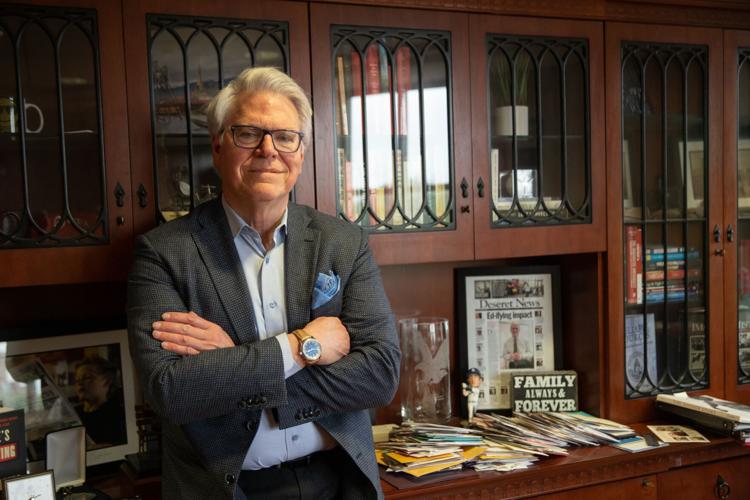



In a conference room next to his office, where he has meetings almost daily, Ed Kelley reminisced on his time at OU and the legacy he leaves behind as he prepares to depart from his role as dean of Gaylord College of Journalism and Mass Communications.
Kelley served as interim dean of Gaylord College starting in August 2015 after Joe Foote, dean emeritus, stepped down. About eight months later, in March 2016, former OU president David Boren officially named Kelley dean of the college.
Ahead of his 70th birthday, Kelley announced on March 1 that he would step down from his role at the end of the fiscal year, on June 30, saying the college deserves younger leadership.
“Should Gaylord College — an institution devoted to serving the needs of a constantly changing, 24/7 media environment that soon will be dominated by Generation Z — be overseen by a white-haired dean who is 70 years old? I think not,” Kelley wrote in the letter announcing his departure from the university.
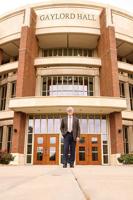
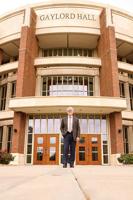
Sitting in Gaylord Hall, what he called the best building on campus, Kelley said he’s ready for his next adventure. For the first time in his life, Kelley said, he doesn’t have a plan.
“I surprised myself that I didn't want or need an absolute mission at the end of the exit plan,” Kelley said. “I'll figure it out. There are seasons in everybody's, not only their career, but their lives too, and I’m looking forward to this, this next season. We're all running out of time, particularly people my age, and I want to make the most of whatever time I have left on earth.”
As an OU alum, longtime journalist and dean of a nationally ranked journalism college, Kelley said OU made his career, setting him on the course for the future when he graduated in 1975.
Kelley grew up over 80 miles from Norman in Perry. While attending Perry High School, he wrote about sports events for the Perry Daily Journal.
After high school, Kelley wanted to be the world’s greatest sports writer. He attended Northern Oklahoma College for two years before moving to Norman in 1973. In his two years at Northern Oklahoma, he wrote sports stories and later became editor of the newspaper.
When he moved to OU in 1973, Kelley immediately called Michael Vitt, soon-to-be editor of the OU Daily, then The Oklahoma Daily. Kelley said Vitt took a chance on him and hired Kelley as an assistant sports editor.
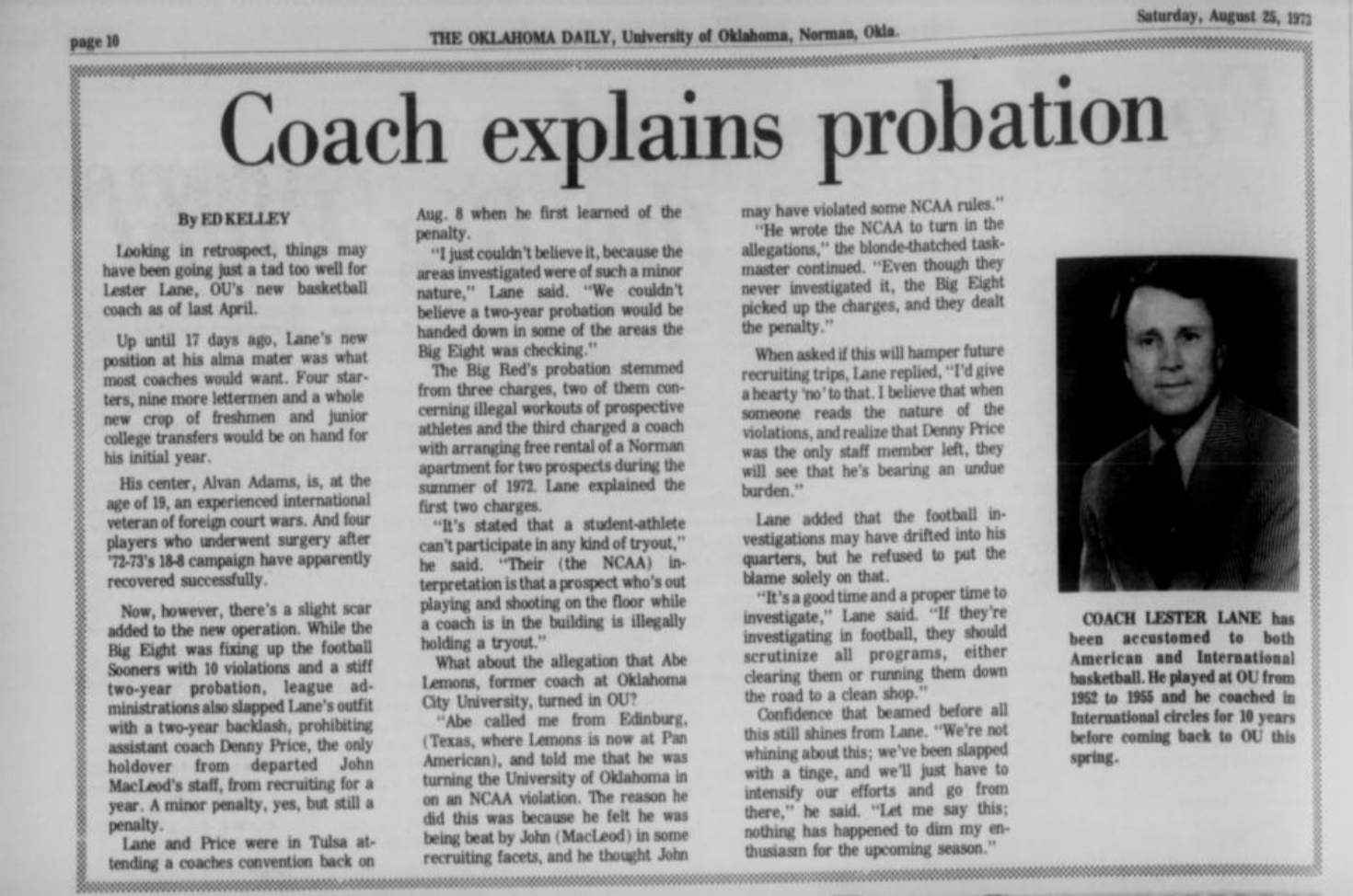
Ed Kelley's first story found in the OU Daily archives was printed on Aug. 25, 1973. As an assistant sports editor, Kelley covered Sooners football and basketball, both of which were facing probations that year.
Kelley covered Barry Switzer’s first year coaching OU’s football team. After a solid season where the Sooners went 10-0-1 with no bowl game due to recruiting violations, he wanted a change and found himself on the staff’s most prestigious beat, covering the OU administration.
In 1975 as he was about to graduate, Kelley had two options: follow his friend and go to the University of Missouri, one of the country’s most renowned journalism programs, to earn an advanced degree or stay and work for The Oklahoman.
“My previous experience as an intern really wasn't all that hot. And I thought I'll do (The Oklahoman) for a few months, and if it doesn't get any better, I'll go,” Kelley said. “Well, it did get better after a few months, and I never made it to Mizzou.”
Kelley first joined the Oklahoma Publishing Company and The Oklahoman in 1974 as a summer intern and started full time after graduation. Between 1974 and 1986, Kelley was a state roving reporter, city editor of The Oklahoman and the afternoon paper, the Oklahoma City Times, and business editor. Starting in 1986, Kelley worked in Washington for four years and acted as bureau chief for the last three.
In 1990, Kelley returned to Oklahoma City to be managing editor, leading the coverage of the Oklahoma City bombing in 1996. In 1999, he was on the editorial page staff and was editorial page editor. He took over as editor in 2003.
In 2011, Kelley was named editor of The Washington Times. Kelley later worked as a senior contributing editor for Deseret News in Salt Lake City starting in 2014, before returning to his alma mater and working in Gaylord College, which at the time, was barely a decade into its transition from its prior existence as the H.H. Herbert School of Journalism.
“It's really difficult for people to come from the industry into a job like this unless you have had a long-standing relationship with that one place,” Kelley said. “In other words, I don't think I could have gone anywhere else, local, state or anywhere else, and have any chance of being successful. The only reason I was in that position was because I was an alum.”
‘Against the building’
On the morning of April 19, 1995, Kelley went to work like the rest of his colleagues, ready for another day editing at The Oklahoman.
At 9:02 a.m., Kelley’s plans for that morning shifted when Timothy McVeigh bombed the Alfred P. Murrah Federal Building downtown. Kelley’s team of journalists immediately headed out to cover the ensuing chaos in downtown Oklahoma City and what would be the biggest story of Kelley’s career.
McVeigh was eventually arrested in Perry, Kelley’s hometown.
Kelley described the reporters and photographers on the scene that day and in the coming days as up against the building.
“Journalists, in these kinds of stories, if we're not the first responders, we’re the second,” Kelley said. “People who work at metropolitan newspapers are really good journalists, top of the line, but they're not war correspondents. They're not conflict reporters. They didn't sign up to see a bombing with 168 people killed and 600 wounded.”
The Oklahoman received numerous accolades for its coverage of the Oklahoma City bombing, with the National Press Foundation naming Kelley editor of the year in 1996.
Kelley said, despite the accolades, a part of that newsroom was never the same after that day. Kelley and his team realized, slowly, the impact reporting on traumatic events has on journalists. They were victims, too.
“A lesson that came out of the Oklahoma City bombing, I think you've seen that now across the country as well as in other parts of the world, is the understanding that journalists who cover these incredibly tragic events, they need professional help,” Kelley said. “The reporters, editors and photographers who were up against the building, they were downtown dealing with the worst thing they’d ever gone through. … The emotional trauma was substantial.”
Kelley thought back to 1995, when he called in licensed counselors that week and in the ensuing months to speak with his staff, saying he now wishes he made it mandatory for everybody covering the bombing. He said the practice needs to be standardized, and he thinks newsrooms changed their practices after the Oklahoma City bombing and the attacks on Sept. 11, 2001.
Kelley said the bombing taught him numerous lessons, beyond the need for mental health counselors for journalists. He tells people the Oklahoma City bombing was one of the last national stories before the Internet. In 1995, The Oklahoman was published the following day, on April 20, and he said he knew of only one news organization in Oklahoma to have a working website at the time: The Oklahoma Daily.
20 years later, Kelley took his management of the newsroom during a state and national attack to his role at OU, saying he emphasizes the importance of people first.
“Stories matter, and people matter,” Kelley said. “For a long time after the bombing, (people) will never look at a story the same again. Stories are about people, and not always just facts.”
‘There needs to be an Ed Kelley in the life of every dean’
While he served as dean from 2004 to 2015, Foote frequently had lunches with the then-Oklahoman editor, discussing the life of Gaylord College and administration.
Foote said he valued those lunches and the opportunity to confide in somebody.
“It was a great opportunity for me to share my innermost thoughts about the college and to bounce ideas off him to learn from his very considerable knowledge of the field,” Foote said. “(Being dean) is a challenging job. There needs to be an Ed Kelley in the life of every dean.”
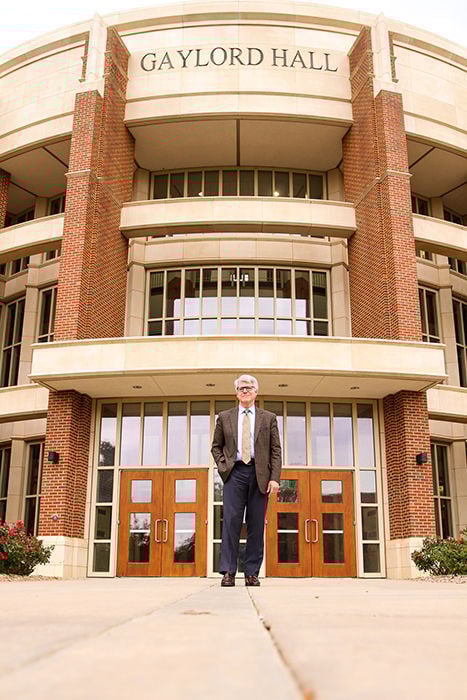
Ed Kelley, when he was named dean of the Gaylord College of Journalism and Mass Communication in March 2016 after serving as interim dean since August 2015. After seven years in the role, Kelley will step down at the end of the fiscal year.
While Kelley served as dean, Foote said OU’s administration was extremely tumultuous, and Kelley was a constant.
On Sept. 20, 2017, Boren announced his retirement as OU president, effective the next June. In March 2018, James Gallogly was named OU’s next president.
During his 10 months as president, Gallogly oversaw massive budget cuts, led layoffs and firings and, in the eyes of many on campus, failed to respond to racist incidents in a proper manner. Donations to the university also decreased.
Also during Gallogly’s short tenure, the university engaged the law firm Jones Day to investigate allegations of sexual harassment against Boren in addition to allegations that his administration had inflated data regarding alumni donations to elevate OU’s rankings in U.S. News and World Report.
Gallogly resigned in May 2019, and Joseph Harroz Jr. took over as interim and eventual OU president.
During this turmoil, Foote said Gaylord College continued to move forward, and that was thanks to Kelley.
“During the time he was dean, he was a constant, steadying hand and an excellent representative of the college and the university,” Foote said. “To protect Gaylord’s interests and to reassure the alumni that everything was in good shape. There was a sense of stability and confidence that you had with him at the helm, even though there was a lot of uncertainty above him.”
Foote said Gaylord students during this time would not notice the institutional changes because the college remained on its course with Kelley.
Kelley said his experience in the industry prepared him for the constantly changing environment of higher education. He watched the constant changes of the world, so watching the constant changes of a university was no different to him. Kelley said one of the biggest changes during his time as dean was the COVID-19 pandemic.
“At times, it was clumsy, but I'm really proud that OU did, with a lot of work by a lot of people, survive that period and still provide a learning environment for students at both undergraduate and graduate levels,” Kelley said.
Before becoming dean, Kelley was the director of experiential learning for the college, where he worked to increase internship opportunities for students. He said one of the best things about Gaylord is that the environment is conducive to student success.
Kelley said Gaylord is a family, and one he will always be a part of.
“We all know that families can be dysfunctional. First, admit there are times that we're probably dysfunctional here at Gaylord as well,” Kelley said. “I do think that it's really important for everyone at OU, not just here at Gaylord, but everyone at OU, to students, to help them get through here. I think we do a pretty good job of that.”
Gaylord College’s dysfunctional family reared its head in February 2020 when former professor Peter Gade used a racial slur in his journalism capstone class. Gade stepped down from teaching the class a few days later. In 2022, Imran Hasnat, a Gaylord College assistant professor, was charged and later convicted of making lewd proposals to a child under 16.
Kelley said when he decided to leave the role, he always knew he didn’t want to overstay his welcome. He said many people in positions of power tend to do so, and he didn’t want to be one to do that, even if he had the support of the university to keep his job.
Harroz told OU Daily he tried to get Kelley to stay on as dean, but after he made that decision, Harroz knew Kelley had built the foundation for Gaylord’s continued success.
“I love Dean Kelley, as a colleague, as a friend, as a person,” Harroz said. “He is a part of the heart of the university. … He always wanted to make sure (Gaylord) continued to be successful. I think he built a foundation to allow us to continue to flourish, and he will always be a member of our community.”
Bob Ross, OU regent and chairman of the Inasmuch Foundation, said Kelley’s work with Gaylord and Inasmuch has shown how great of a leader he is. Kelley served on the foundation’s advisory Committee of the Ethics and Excellence in Journalism Coalition and on several grant committees.
Ross said Kelley is passionate about quality education, and that was evident even while he worked as a journalist before returning to his alma mater to take Gaylord College to the next level.
“It's just a reflection of his leadership and his ability to really get things done,” Ross said. “He's such a hard worker. I can't believe that he's retiring. … He (is) just … a fabulous leader, a great Oklahoman and a strong supporter of the University of Oklahoma. It's gonna be really tough to see him leave Gaylord, but I know his passions are going to continue to be directed toward helping students.”
Paige Uhr, senior director of development in Gaylord College, wrote to OU Daily that Keith Edwards, Gaylord Board of Visitors president, came up with the idea to raise funds secretly to establish an endowed scholarship in Kelley’s honor.
“The dean’s main priority has always been student support, so its a perfect fit,” Uhr wrote.
In less than six weeks, the scholarship raised $76,315 from 62 donors. The scholarship will assist undergraduate students in the college in need of financial support.
Ahead of his final commencement as dean of Gaylord College on May 13, Kelley knows the journalism and mass communications program will be taken to new heights as the university begins searching for his successor.
With his numerous accolades as a journalist and working at top newsrooms in the country, Kelley said being dean was the most satisfying jobs he’s ever had. As he now departs the university, Kelley said he’s not the retiring type, but he knows he and his wife, Carole, want to spend more time with their three children and four grandchildren.
Foote, Harroz and Ross said the university is better off because Kelley acted as a leader, and he loved students above everything.
Kelley said Gaylord College is one of the best schools in the country, and it’s because of the students and faculty he has been successful in his job.
“There's something about being able to work at your alma mater,” Kelley said. “In my case, to be able, not just (work for) the university as a whole, but in the journalism and mass communication program that jump-started my career is very, very special. I'm as fortunate as anybody who's ever worked at the University of Oklahoma.”
Read more OU Daily stories featuring Ed Kelley:



This story was edited by Alexia Aston and Jazz Wolfe. Nikkie Aisha copy edited this story.


