

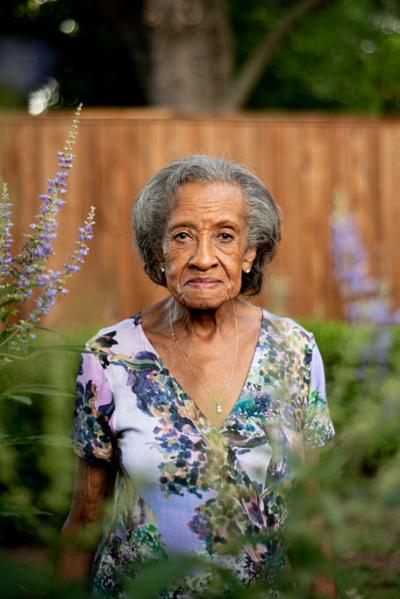
Barbara Henderson, a civil rights activist whose work helped change Norman, died Saturday morning at 92.
Henderson became the first Norman Human Rights Commission chair in the early 1970s and the first to receive the Norman Human Rights Award in 1985 for her work, per reporting by The Oklahoman. She spent her life volunteering for local, regional and national causes alongside her husband, George Henderson.
“She was my wife, my best friend, and the matriarch of our family. An irreplaceable part of my heart and soul is left,” George, 94, wrote in a Facebook post Thursday. “But so too are memories of her remarkable contributions to our family and the numerous lives she touched when we married on Aug. 9, 1952 and began our intertwined life journey.”
Miles Kelly, director of the Henderson Scholars Program, which was created to continue the legacies of the Hendersons by providing access to higher education, wrote in a text to OU Daily that Henderson’s work changed Norman and opened doors.
“As Dr. George Henderson has often described it, theirs was ‘a George and Barbara collaboration,’ with Barbara advancing the work of human relations throughout the broader Norman community,” Kelly wrote. “Barbara’s legacy is deeply connected to the values at the heart of the Henderson Scholars Program: courage, compassion, service and a commitment to ensuring others have the opportunity to belong and thrive.”
As prominent civil rights activists in the OU and Norman communities, the Hendersons were recognized in 2011 as recipients of the Xenia Institute’s Sam Mathews Social Justice Award, according to the Oklahoma Hall of Fame. The Henderson Community Pillar Award, which honors individuals and organizations investing in positive community impact, is named after the couple.
Henderson and George, who was the third full-time Black professor at OU, were the first Black couple to purchase a home in Norman, which was a sundown town until 1967.

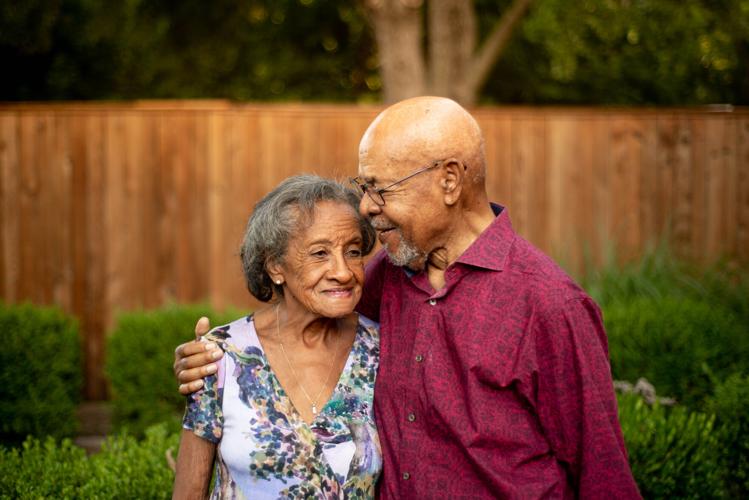
Barbara and George Henderson pose during a photoshoot at their home in Norman, Oklahoma on June 28, 2022.
The couple and their children moved to Norman from Detroit in 1967 when George accepted an offer to teach at OU. George recalled in his book, “My Mother’s Dream: The Story of a First-Generation College Student,” that Henderson was “more than a little peeved” about the move and agreed on the condition that the family — then seven children and Henderson’s mother — would relocate in a few years if things didn’t work.
Despite her hesitation, Henderson made clear to faculty members and then-OU President George Lynn Cross that her family would live in Norman, not Oklahoma City. She found three homes in west Norman she liked, but all three fell through. Due to a covenant in effect in Norman at the time, realtors and landlords did not sell or rent to anyone who was Black.
In an interview with the Oklahoma Historical Society in 2011, George said almost all Black OU students lived in east Norman, while west Norman was considered more prestigious and housed “movers and shakers and community leaders.” Ultimately, a group of realtors defied the covenant, selling the couple a house on Osborne Drive, George said.
The Hendersons lived in that same house for nearly six decades, helping shape an evolving city.
Following the establishment of the Norman Human Rights Commission, Henderson’s work helped open housing and apartment complexes up to Black residents across the city, George said.
‘Trusted adviser, best friend’
Henderson, born in 1933, was a first-year at Michigan State in 1951 — Barbara Beard at the time — when she met George, then-sophomore. In a 2024 interview with OU Daily, George recalled Henderson’s background, noting she was from an affluent, middle-class family that owned a house in Covert Township, Michigan.
While they were at Michigan State, only about 100 of its 12,500 students were Black, and of those only a handful were women.
George remembered noticing Henderson’s blue eyes the first time he saw her.
“I said to myself, ‘That's it, she's it,’” George told the Daily in 2024.
He approached her with a poor impersonation of actor Humphrey Bogart, he recalled in his book.
“You know you like me, baby,” he said. “Would you like to go on a date with me sometime?”
“Not in your lifetime,” she replied, walking away.
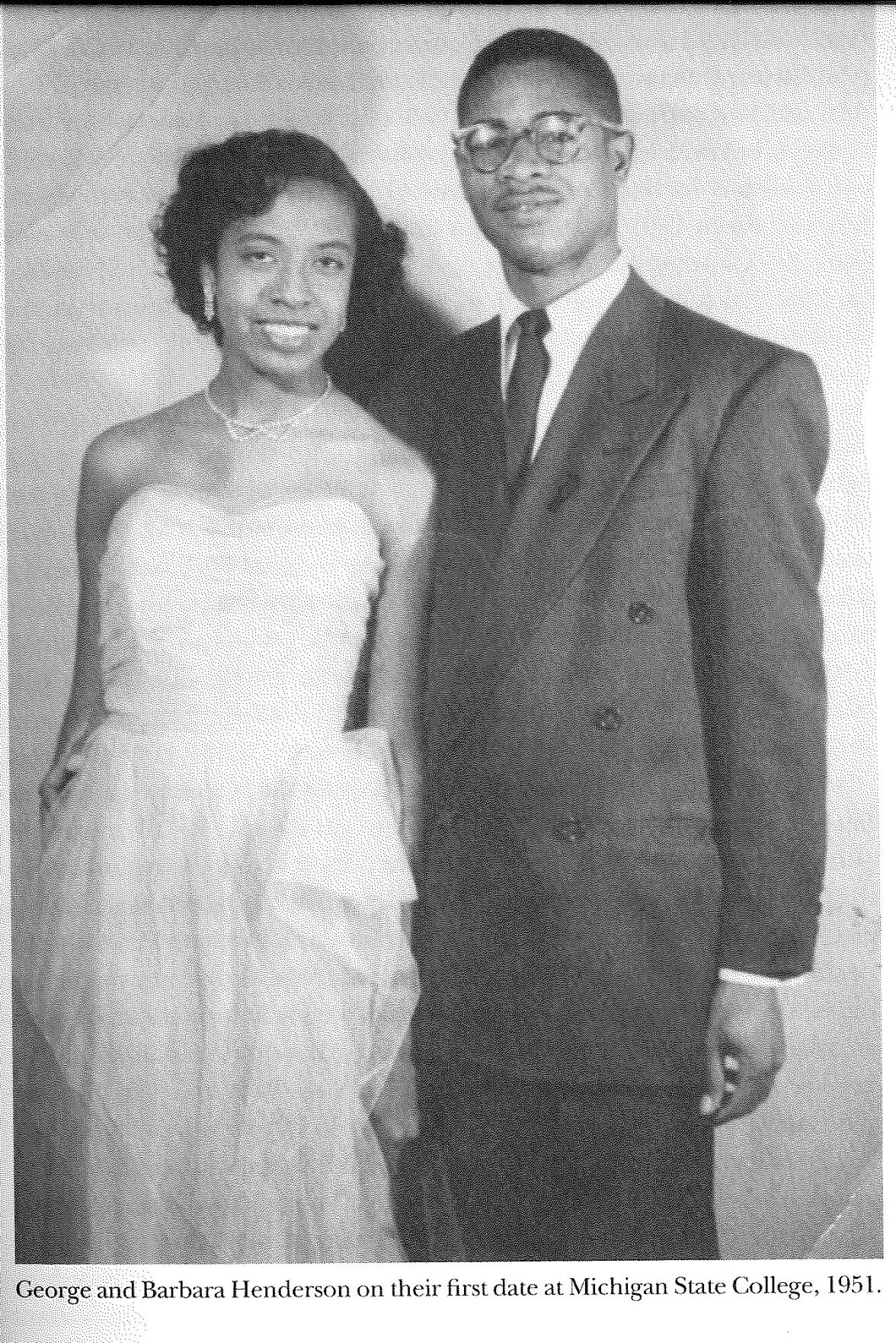
George and Barbara Henderson on their first date at Michigan State College in 1951.
The two had their first date after some pleading from George, who remembers calling to ask her out to a movie.
“I talked to her faster than I’ve ever talked to a female before because I didn’t want her to hang up on me,” George told the Daily in 2024.
George recalled asking Henderson to marry him.
“I know I am asking you to do something very risky. Will you marry me? And she said, 'Yes, stupid,’ … ” George said. “I found a soulmate. I found the only other person that I ever, ever cared so much about other than my mother.”
The Hendersons celebrated their 74th wedding anniversary Aug. 9.

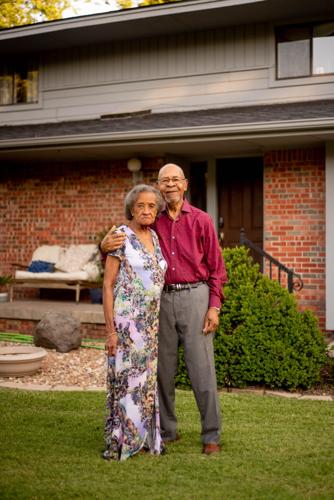
Barbara and George Henderson pose during a photoshoot at their home in Norman, Oklahoma on June 28, 2022.
The couple moved to Detroit after George served two years in the Air Force. The Hendersons were heavily involved in the Detroit civil rights movement, working with civil rights leaders including the Rev. Martin Luther King Jr., Malcolm X and Rosa Parks.
George met Parks when they judged a Detroit neighborhood beautification contest, he recalled during his Legacy Lecture on campus in April 2025. Henderson, he noted, had met Parks in the grocery store three weeks prior.
George forever relied on his wife, calling her the “most central figure” in his life during his Oklahoma Hall of Fame induction in 2003.
“She has been my most ardent support, trusted adviser, best friend and soulmate,” George said. “Without her love, approval and encouragement, I probably would not have come to Oklahoma and I certainly would not have stayed here without her.”
‘Thanks to Barbara Henderson’
In his memoir, “Race and the University,” George wrote it was clear that some did not want him, Henderson and their family in Norman.
He spent many mornings picking up trash that had accumulated on his lawn overnight, left by bigoted Norman residents. He encountered racist comments written on sidewalks and public restroom stalls, and received anonymous degrading messages to the point he forbade his children from answering the phone for the first two months the family was in Norman.
In his first semester at OU, George, along with the other Black professors working at the university, met with Black students across campus. The group, now the Black Student Association, officially became the Afro-American Student Union in November 1967.
Henderson and George became advisors and mentors for several students, and their house was the first social setting where they could express themselves, especially after the new group was not received well by other students on campus.
In a February 2025 speech at a Norman City Council meeting during the commemoration of Black History Month, George said Henderson urged him forward.
“I was frustrated things were not progressing as fast as I wanted them to, and I didn't think that I would end up with very much of anything. And (King) said, ‘George, what we are about is not about us. It's about the next generation of us,’” George said.
“Thanks to Barbara Henderson, who would not leave, said that ‘We came and we leave when we're ready to leave, and this will be our pledge to ourselves and to our children.’”

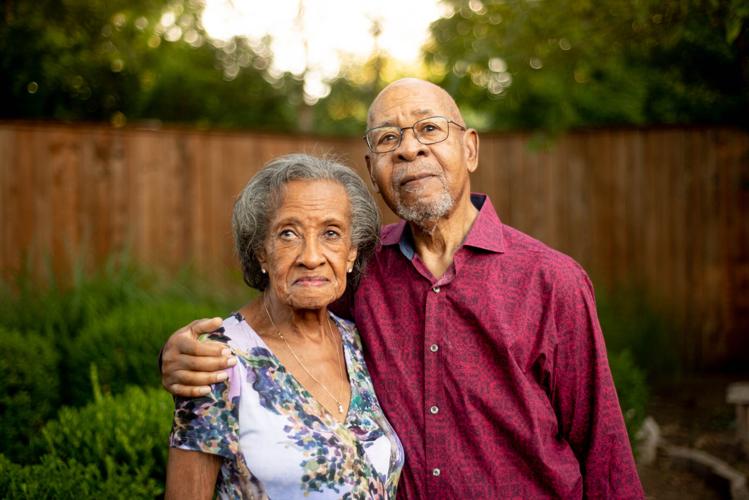
Barbara and George Henderson pose during a photoshoot at their home in Norman, Oklahoma on June 28, 2022.
She was the rock of her family at other critical points, including the night King was assassinated in Memphis. George was driving when the news broke on the radio. He pulled over and cried before returning home to find Barbara and his children mourning in front of the television.
“She had already calmed the children down,” George said in his interview with the historical society. “Later that evening we decided that we would continue and we would be safe and whatever happened we were going to continue speaking out and trying to champion what we believed was right.”
In the ensuing decades, as George became in many ways the conscience of the state’s flagship university, they championed what was right together.
And in doing so, George and Henderson made lasting change in their adopted hometown.
Former OU Daily editor Peggy Dodd contributed to this report with work delivered before her graduation in May 2025. Macey Thaxton and Willie Gillespie also contributed to this reporting.
This story was edited by Reagan Rozzi. Larkin Bock and Sophie Hemker copy edited this story.


