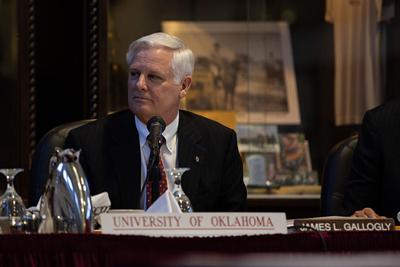

Being a university president hasn’t been what James Gallogly expected.
When former OU President David Boren announced his retirement in September 2017, ending a 24-year reign, OU was in the midst of what most people thought of as a golden era.
There were flaws, but donations seemed to be pouring in. Racist events were dealt with quickly and fiercely. Staffers didn’t seem too worried about money. Retention rates were breaking records. Campus was beautiful.
“Whoever came in to replace David Boren was going to have some challenges,” said Cal Hobson, a former state representative and senator for the Norman area who served from 1978 to 2006. “And certainly the new president has.”
In the nearly two years since, the perception of OU has fundamentally changed. President Gallogly did not inherit the OU he might have anticipated.
Events within and beyond his control have made a hard job harder: The secret search for Boren’s successor created discord and apprehension. The announcement of Gallogly as his replacement was criticized. Gallogly’s public disclosure of OU’s poor financial standing caused anger. His promise to get OU’s “house in order” created an atmosphere of trepidation. The administrative firings and multiple rounds of layoffs that followed prompted outrage. Gallogly’s response to racism on campus proved to be lackluster. The knowledge that OU hired a law firm to look into misreported data and sexual misconduct claims against Boren brought on disbelief.
For many, the campus climate changed for the worse. One measure of the challenges and perceptions of OU today: In January, donations to the university had dramatically decreased when compared to what they were at the same point during Fiscal Year 2018. While there were many factors relating to the decline, some OU community members believe it had to do with Gallogly's chaotic year.
But Gallogly, roughly 10 months into his administration, said he stands by his decisions.
“If you look at my motives in all of this ... I'm totally motivated by student success,” Gallogly told The Daily. “And that's how I sleep at night, knowing that I'm here making some really tough decisions. I didn't know I'd be doing that when I got here.”
And since January, donations have increased, said university spokesperson Lauren Brookey. Between January and March, cash gifts totaled roughly "$29.3 million or 17 percent ahead of the same time last year," Brookey said in an email.
As Gallogly’s first academic year comes to a close, the OU community has been through swift and chaotic change. Unexpected problems have been a test of not just Gallogly’s financial expertise, but his soft skills. And for many OU community members, Gallogly has not yet passed that test.
Gallogly’s business acumen alone has not been enough to outweigh the real problems he was left to deal with — a sad confrontation with reality and a slow goodbye to the OU many once knew.
Unexpected problems, difficult response
Gallogly’s first year was plagued by OU’s debt of nearly $1 billion and the continued loss of money as expenses outweighed revenues. These financial burdens have defined much of how Gallogly has viewed his job and related to his employees.
Once he realized these monetary issues, he came in on July 1 not just with a university to lead but with a problem to solve. And, in some ways, he seems poised to solve it.
While a main criticism of Gallogly has been his lack of experience in higher education administration, his understanding of budgets and institutional financial health seems to be getting OU closer to a positive bottom line. By this spring, Gallogy said he has already found roughly $32 million in savings, and expects that number to continue to climb. And at the March Board of Regents meeting, Gallogly said the university now has a positive bottom line.
His straight-shooter approach may improve OU’s relationship with the state Legislature while also pulling OU away from troublesome economic trends in higher education nationally.
“I think that’s what everyone is hoping for, even if there is short-term angst about some of these decisions,” said Jeff Hickman, a longtime state representative and speaker of the House, and now State Regent for Higher Education.
These decisions include Gallogly terminating multiple top administrators on his first day in office, including OU’s chief financial officer. Roughly a month later, former Vice President of University Community Jabar Shumate was let go after an audit found he had misused his university vehicle. Nearly three months after, the first round of university layoffs occurred, hitting hard in the landscaping, IT and research departments. Two months after that, more layoffs came, again hitting IT.
Along the way, Gallogly made other changes focused on upgrading and modernizing university functions that he said were years behind business world operations. This shift included switching to online timesheets, centralizing human resources, no longer leasing laptops, hiring seasonal help for landscaping, selling off some of OU’s fleet and much more.
Gallogly has called himself a “financial expert.” He has experience at turning around companies like LyondellBasell, an international plastics, chemicals and refining company that Gallogly took charge of in 2009 after it filed bankruptcy. Through thousands of layoffs and plant closures in six years, he created an “industry leader.”
“If you look at his history, he is what some people call a turnaround expert,” said Judith Wilde, a professor at George Mason University who studies university presidents. “He goes into businesses that were in financial trouble and has turned them around. Which sounds wonderful. But he does that by getting rid of a lot of staff people.”
So far, these changes have allowed for a faculty pay raise, a reduction of graduate assistant fees and research growth, among other things.
“Taking care of the business side of the university in a more efficient way flows over and helps us with the magic in the classroom. So that's where I’ve tried to approach it,” Gallogly said. “A lot of people say, ‘Well, this isn’t a business.’ Well, parts are.
“Do we have the right backbone to help people be efficient? Do we have the right standards of expectations? Do we have the right systems?” Gallogly said. “I’m trying to build those basic tools back into our university so that we can run more efficiently, save money and then hold tuition flat and all of that.”
When any new president is hired, changes are expected. When Boren took over the university in 1994, he made similar staffing changes, Hickman said. But, even for a nontraditional, private-sector president like Gallogly, the speed and magnitude of the changes at OU was unusual, Wilde said.
The financial changes may be pushing OU toward greater fiscal health, but the pace and tone with which they were done has been jarring to the OU community. People were used to Boren’s “OU family” rhetoric and had not seen change like this in years, said Hobson, who worked closely with multiple university presidents during his time in the state Legislature.
“I think that is a very difficult way to build and maintain morale or dedication and allegiance to the university,” Hobson said. “It certainly was not the best way to reassure the university family that we’re all in this together.”
CEO experience not always enough
At Oklahoma State University, President Burns Hargis came to the helm in 2008 after a career in the banking business and as an attorney. Out of the Big 12 presidents, only Hargis and Gallogly have backgrounds in the private sector.
Hargis said his private sector background taught him lessons in “leadership, collaboration, fundraising and politics” that have helped him as he deals with the challenges of funding and student recruitment competition. Similar to Gallogly, Hargis focused on “cost-saving and efficiency efforts” in his early years, making changes to IT, janitorial services, the university’s vehicle fleet and more.
Hargis also faced concerns over his lack of academic experience, but said that nontraditional presidents can have success as long as they have experienced people in other critical positions.
“The role of a university president is not to run academics but is to support the academic mission through fundraising and to make sure state leaders are aware of our economic impact and our needs,” Hargis said in an email.
But Gallogly has not been able to focus only on the financials.
The beginning of Gallogly’s first academic year was full of issues mostly related to monetary inefficiencies and his responses to them. But in December 2018, halfway through his first term, news broke of OU hiring a law firm to look into discrepancies in data reporting during Boren’s tenure. This was the first of many instances where a major issue arose that was outside of the natural wheelhouse of Gallogly’s financial expertise.
Then, in January, multiple instances of racism on campus prompted students to call for strong action from Gallogly. Students were furious when they felt he did not deliver.
“The University of Oklahoma’s lack of responses and perpetual defense of these lackluster responses demonstrate the lack of concern the university has for the wellbeing of marginalized students, faculty, and staff,” read a statement from OU’s Black Emergency Response Team released soon after the incidents. “Responding to these issues with the inadequate campus resources at our disposal is no longer sufficient.”
Gallogly said he is not used to dealing with those types of issues, especially when they include young adults rather than older employees. Adults who are years into their professional careers typically make better decisions, he said. But still, when confronted with student anger at an on-campus protest, Gallogly teared up.
“I'll take some of that heat from time to time. And I'll misstep from time to time as I'm learning,” Gallogly later told The Daily. “I’ve been a parent, but I've been kind of an absent parent a lot because of the kinds of jobs I've taken. I’ve had tens of thousands of employees and so I'm not home very often. So being around younger people is a bit of a new experience for me. I’ll trip, I’ll fall, I’ll bruise, I’ll skin my knee, whatever, get up and I'll come at it again and listen a little harder and try a little harder the next time.”
The most recent non-financial issue that Gallogly inherited and his CEO experience did not prepare him for was the discovery that Boren and another of his recently terminated top administrators are being investigated for sexual misconduct allegations.
The discord in today’s OU is maybe most clear when considering the investigations into the Boren administration — some people believe Gallogly is out to tarnish Boren’s reputation and that is why he is scrutinizing him. Gallogly said this is untrue.
At this point, it’s unclear what his long-term plans are at OU. After saving LyondellBasell from ruin, Gallogly stayed at the company for only six years. Wilde said the length of time new presidents stay at universities after making extensive changes depends. According to a 2017 study by the American Council on Education, the average tenure of university presidents is six and a half years.
“Some of them come in, make the changes and then get out. Then someone else comes in and smooths things over, but at least what may have been considered necessary changes are completed,” Wilde said. “Some make the changes and then come back to smooth things over themselves and stay … I think it’s too early to know what the future is going to be with him.”
Hickman said he believes once Gallogly has addressed the most critical issues, Gallogly and the OU community can expect more of a routine. Deeper relationships will be formed on and off campus and the atmosphere will become more relaxed.
“Soft skills are just as important as hard skills, and I think he’s working to balance that,” Hickman said. “But I’ve seen sides of him to know that he is capable of that. And the longer he has to build personal relationships with students, the more you’ll see that.”
Overall, Gallogly likely has a better idea of what he’ll deal with as a university president moving forward. But until he’s mastered the soft skills, he said he’s trying.
“I'm an old guy … The most precious thing I have is my time,” Gallogly said. “So when people are screaming things and I get up there and don’t know exactly what to say, my heart's in the right place. I'm trying really hard. I'm investing the most precious thing I have — my time.”
Update: This article was updated at 11:35 a.m. to reflect new data on donations to the university.


