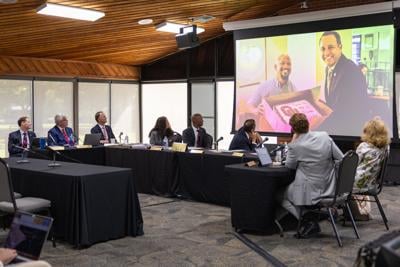

The OU Board of Regents met to discuss and approve the naming of a new residence hall, policy revisions for employee paid time off and a vice president search committee during its meeting in Norman.
Committee reports
Regent Rick Nagel said, he along with Regents Kenneth Waits and Robert Ross reviewed the committee's goals for the 2024-25 year to match in accordance with the refresh strategic plan. Nagel said the committee is putting stronger emphasis on STEM-related degrees as they continue monitoring success metrics such as enrollment, graduation and research productivity.
Nagel acknowledged the departure of former Vice President for Research and Partnerships Tomás Díaz de la Rubia. OU President Joseph Harroz Jr. announced Díaz de la Rubia would be leaving OU for a position at the University of Arizona in October.
Nagel said OU is now the fourth fastest growing research university in the nation.
Regent John Braught said the Sutton Hall demolition is currently scheduled to occur this winter break. According to Ross the committee previously asked for an update on deferred maintenance at each committee meeting.
Regent Anita Holloway said the committee has received the external audits for Cameron University, Rogers State University and the OU-Norman campus and the OU Health Sciences Center for the fiscal year that ended June 30.
According to Holloway, OU is seeing increases in tuition revenue and unrestricted cash, while maintaining high student retention and graduation rates. Holloway said the cost for the average Oklahoma resident attending OU’s Norman campus has decreased by 28% since 2019 due to a combination of scholarships and financial aid.
Ross said he, Holloway and Regent Natalie Shirley met in October at the OU Health Sciences Center in Oklahoma City to discuss the KPI dashboard — a tool that unites data sources and provide visual feedback showing how the university is performing against key performance indicators — and final student enrollment.
Ross said the center is up 3% in enrollment in nursing and public health and the public health and professional program saw a 28% increase. Ross said they also exceeded their spending budget in several key areas.
Shirley said she, Holloway and Braught met this month to discuss several key performance indicators at OU, Rogers State University and Cameron University. Shirley said they discussed the collaboration between the OU Polytechnic Institute and the Tulsa Hub.
Cameron University
Interim Cameron University President Jari Askins said she was updated on the presidential search process for both Cameron and Rogers State University.
The OU Board of Regents has approved all items for Cameron University, including program modifications, naming the Cameron exchange building and the findings of the external auditor’s reports and audited financial statements in the 2023-24 fiscal year. Shirley motioned to grant Askins a $5,000 per month housing allowance while she remains interim president. Shirley said Askins' current house is uninhabitable.
Rogers State University
The OU Board of Regents has approved all items for Rogers State University, including several program modifications, HVAC improvements and the findings of the external auditor’s reports and audited financial statements in the 2023-24 fiscal year.
Harroz remarks
OU President Joseph Harroz Jr. said OU has been experiencing a growth in enrollment despite the national trend of a decrease in enrollment.
Harroz said that OU’s growth particularly in STEM-related majors has resulted in OU needing more space for students. Harroz said OU will be creating a new STEM-focused lab that will include a 250-student classroom east of Ellison Hall.
Harroz also mentioned the naming of the new residence hall McCasland Hall in honor of the McCasland Foundation’s $10 million gift to support its construction and maintenance costs.
“It has lounges, study spaces, storm shelters, community spaces. It truly is beautiful,” Harroz said.
Harroz also acknowledged the Jacobson Hall project, which was approved by the regents in 2022. Harroz said OU is requesting a $1 million increase of the already $15 million budget. The project is part of Harroz’s Campus Master Plan of Capital Improvement Projects for the Norman campus to renovate and modernize the building.
Harroz said OU is also seeking to build a weather research and manufacturing facility.
Harroz introduced Gallogly College of Engineering Dean John Klier to present to the board Gallogly’s goals and updates.
According to Klier, the college is experiencing a growth in both faculty and students. To help recruit students, Klier said they created two teams comprising both faculty and students to help recruit potential graduates. Klier said since implementing this recruiting strategy in 2020, the college has seen a 45% increase in incoming students and 30% increase in undergraduate students.
Klier said that several of the initiatives the college implements exist to ready incoming students to transition more easily into its engineering programs, such as offering tutoring, summer programs and workshops.
Regent Anita Holloway asked Klier what they were doing to help retain OU graduates. Klier said they’ve established an office within corporate partnerships to help network and connect recent graduates in Oklahoma.
Program modifications
Regents approved a list of substantive changes to several degree programs. Each change has already been approved by the appropriate faculty and deans prior to being approved by regents.
Program modifications include an undergraduate certificate of machine learning and artificial intelligence, as well as a master’s degree in applied artificial intelligence. The master’s course would be available at OU’s Norman and Tulsa campuses.
Regents also approved the addition of master’s programs in cybersecurity leadership, cybersecurity and software development and integration. According to the agenda, the cybersecurity programs would offer students risk management and leadership skills.
The Dodge Family College of Arts and Sciences requested the removal of its human and health services administration option of its master’s of integrative studies program. According to the agenda, only 13 students are currently enrolled in the program, with the last student being slated to graduate in the summer of 2025.
Regents also approved adding a law and policy concentration to the political science bachelor’s degree. According to the agenda, this new concentration is intended to better prepare students who plan on attending law school.
Regents also approved adding a law and policy concentration to the political science bachelor’s degree. According to the agenda, this new concentration is intended to better prepare students who plan on attending law school.
Regents approved The Christopher C. Gibbs College of Architecture’s request to add a business law course to its construction science bachelor’s program to meet American Council for Construction Education accreditation requirements. According to the agenda, to keep the degree at 120 credit hours, the College of Architecture is removing two credit-specific courses as well as microeconomics.
Regents approved Gaylord College of Journalism and Mass Communication’s request to add crisis communication, media analytics and social media marketing certificates in its graduation program. Each certificate would require 12 additional coursework hours and only be available to those pursuing the strategic communication and digital communication option.
Regents approved the Jeannine Rainbolt College of Education is requesting a three-year suspension of its college teaching graduate certificate to leave room for the possibility of reinstating the program. According to the agenda, this request comes after the departure of the program’s creator Kristen Edwards, who left the university in 2021.
Price College of Business is requesting to change the name of its master’s of accounting program to accounting advanced standing. For upper-division courses, Price College would change from degree candidacy to prerequisite requirements. Price College is also requesting graduate certificates in digital marketing and sports business.
Regents also approved the addition of a transportation engineering concentration to The Gallogly College of Engineering’s master’s in civil engineering program. Regents also approved the addition of a climate adaptation and mitigation graduate certificate within the College of Atmospheric and Geographic Sciences.
Search committee
Regents approved Carol Silva for interim vice president for research and partnerships. Harroz said a list of names to take up the permanent position will be brought to the next regents meeting.
Former Vice President for Research and Partnerships Tomás Díaz de la Rubia led OU’s research enterprise and developed strategy specifically in national security, energy, sustainability and life sciences.
According to the regents agenda, Silva is not eligible to become a candidate for the permanent position.
André-Denis Wright, senior vice president and provost for Norman campus, and Gary Raskob, senior vice president and provost for OU Health Sciences Center, would serve as co-chairs for the search. The committee will also include faculty representation chosen by the faculty senates, administrators who routinely work with the vice president and members of the public with specialized knowledge.
Employment policy revisions
The regents approved several employment policy changes, including retiree plan rates and revisions to paid time off.
The board approved authorizing university leadership to approve the 2025 Medicare premium rates for post-65 retirees for Norman, Oklahoma City and Tulsa campuses as well as Cameron University and Rogers State University.
For the 2025 plan year, Medicare premiums will increase by 3.2% to 40%, due to regulatory changes, the Inflation Reduction Act and Centers for Medicare & Medicaid Services funding trends.
The board also approved changes to paid time off policies. The revisions were proposed to clarify distinctions between regular, full-time university employees and employees hired specifically for certain federal contracts. The policies will also be revised to accurately reflect Oklahoma state law updates.
Paid time off is available to staff and 12-month faculty who hold continuous benefits-eligible appointments. Temporary employees and student employees are not eligible for paid time off. Paid time off may be used for vacation, personal illness, funeral attendance, illness of a family member or other personal business. If employees are hired through federal contracts their benefits are governed by the Service Contract Act, a law requiring contractors to pay service employees working on federal contracts minimum wage rates and fringe benefits rather than university standards.
The board also approved the proposal to establish policy and procedures for the payment of accrued leave upon termination of employment. According to the proposal, the Office of Administration and Finance would be responsible for administering and enforcing the policy.
Renovations and improvements
The regents approved various building renovations and improvements across the Norman campus.
The board also approved a total project budget of $16.7 million for the Jacobson Hall project, and authorized university administration to contract and make payments for the project’s construction. The project is funded from private donations and university funds.
At the May 2022 meeting, the Jacobson Hall project was approved by the Board of Regents as a part of the comprehensive Campus Master Plan of Capital Improvement Projects for the Norman campus.
The board approved the allocation of $2.6 million to replace windows in Buchanan Hall. The window replacement project is funded from deferred maintenance funds.
The regents also approved $5 million for the Everest Indoor Training Center HVAC improvements. Funds to cover the costs associated with the project are budgeted from athletics and other private funds restricted to capital projects.
Legacy capital fund
The board approved authorizing university leaders to execute memorandums of understanding — formal, non-binding agreements between two or more parties that outline how they will work together to achieve a common goal — with the Oklahoma Capitol Improvement Corporation to receive funding as authorized by the Legacy Capital Financing Act.
This funding would support the construction and expansion of research laboratories and facilities for science and mathematics programs. The construction of these facilities would be used specifically for engineering curriculum and engineering collaboration spaces.
The Legacy Capital Financing Fund is an annually appropriated budget from the Oklahoma Legislature to facilitate advanced financing for current and future needs from the state’s agencies.
The OU Board of Regents will meet on Wednesday to discuss OU’s strategic plan refresh: Lead On, University.
This story was edited by Anusha Fathepure.


