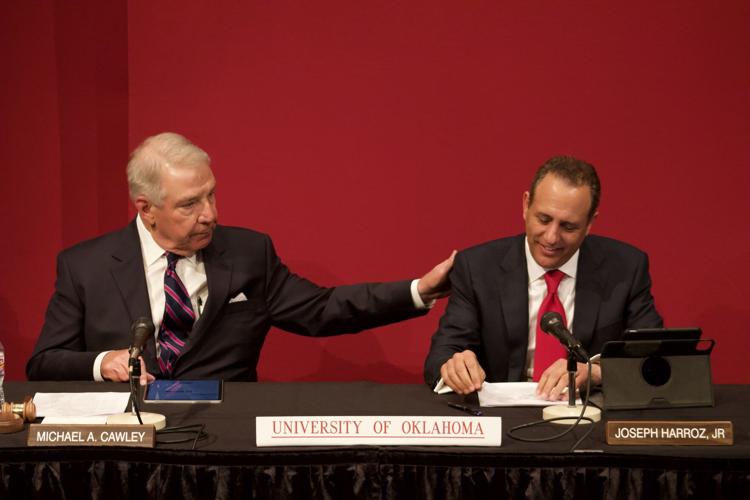

The OU Board of Regents approved changes to its academic service fees despite the opposition of Regent Rick Nagel, discussed plans for a raise proposal, tuition increase and the progress of the Freshman Housing Master Plan, and appointed Frank Keating as its chairman during its Wednesday meeting.
The 2022-23 OU Tuition & Fee Simplification initiative — which is set to reduce fees, improve transparency and simplify student bursar bills — continued with agenda item 32, which deletes nearly 700 academic service fees to around 50 and realigns certain existing fees to reduce the complexity of the current billing structure. Regent Anita Holloway said this change has zero impact and cost to students and families.
The item also proposed a $40 per credit hour fee increase in targeted STEM fields, which Holloway said would generate $6 million in additional revenue to the university and will be used to hire at least 30 new faculty in STEM areas. The increase represents the only special fee planned under the institution’s multi-year strategic plan budget, and Holloway said the university finance committee was unanimously supportive of these changes.
President Joseph Harroz said the special fee will ensure STEM professors can teach and do research that falls under the university’s strategic research verticals. He said the regents are mindful of both affordability and excellence, and how both cannot exist without the other.
In looking holistically at OU’s affordability, Harroz said total tuition and fees are down for in-state students by almost 25 percent and are up one percent for out-of-state students, considering waivers and scholarships. He said this increase is not a part of a broader plan but is meant to address need and opportunity, and the regents have been in conversation with Student Affairs and other student groups.
Although the item was approved, in the discussion portion of the item, Nagel encouraged the regents not to vote for the item on the basis that motions to consolidate and increase fees aren’t timely. He said, although he is for fee consolidation and appreciates the inflationary concerns the board posed, he is also sensitive to the needs of students and families putting them through school.

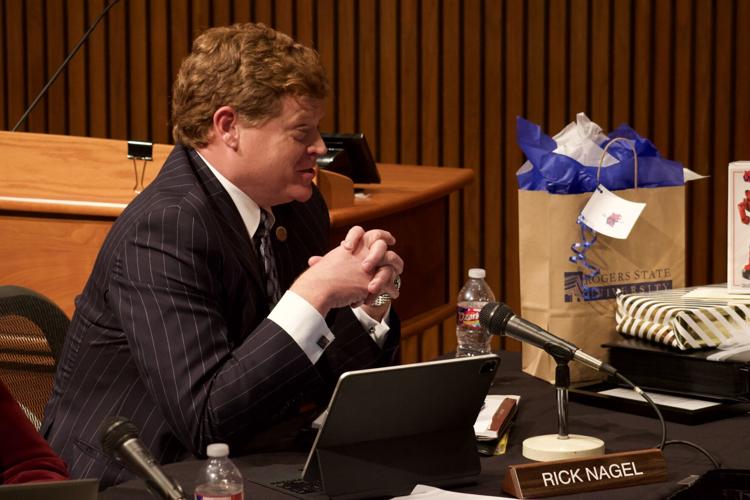
Regent Rick Nagel speaking at the OU Board of Regents meeting March 9.
In the wake of a potential three percent tuition increase pending a few months, Nagel said inflation is on both sides of that. Although the $40 per credit hour fee would provide the university with resources, which Nagel said he has every reason to believe the university will spend them well, he said the university lacks institutional type controls to ensure investments are made.
“I'm a comprehensive solutions guy, and I'm hopeful that university will work more towards comprehensive proposals particularly when fees and tuition increases or are included,” Nagel said. “I view these things as a last resort.”
After voting against the item, Nagel told The Daily that although these investments in STEM align with OU’s strategic plan and Oklahoma’s economic and industrial sector needs, there is more that could be done through the legislature and industry to benefit students. He said the timing is off, as the regents are out of sync with the legislative cycle to reach certain intervals necessary to address fees and get approval from higher education.
“What's unfortunate is that we haven't been able to run a legislative cycle and make a case for those investments and then get to the end, and then react to them either saying, ‘Well, we tried, here's the increase.’ So I think the mechanism, the structure is as much at issue here as anything else. As a new regent, something as a layperson coming off the street, I would have not been aware of. Now that I am, I'm going to start looking at working on it.”
With the potential tuition increase looming, Nagel said he is going to work to get any signaling he can to offset or mitigate tuition increases.
Harroz also said during the meeting that, as a potential three percent tuition increase is considered for the regents’ May or June meeting, he wants to meet that with a raise program proposal.
“There's a need to address present inflation and the realities of the job market today,” Harroz said. “It’s certainly beyond this June, the message has been received that those future raises should come regularly, and they should be tied very clearly to performance.”
Holloway said the financial committee discussed the need for a raise program for faculty and staff that would be based on clear and demonstrable performance standards. She said the committee recognized that raise programs have been viewed in the past as not being performance-based, and the committee aims to change this culture immediately.
Regent Natalie Shirley also discussed the progress of the Freshman Master Housing Plan before the regents went through consent items and approved four firms to further evaluate. Those included, from preference, Flintco/Weitz Company, Whiting-Turner Contracting, Clayco and Manhattan Construction/Turner.
Shirley said the goal of the project is to include updated housing and engage freshmen students in the process in the hopes of increasing retention rates. She said staff for the project visited housing at several high-performing universities and developed the four options for firms.
The plan is staged over a period of years, but the first step will be demolishing one of the current freshman housing buildings. She said the first new building is expected to be online by 2025.
“While there may be things that intervene, this is not a consideration that has fallen on deaf ears and the administration,” Shirley said. “They're working very hard to resolve the freshman housing issues.”
Harroz said in a follow-up interview that, following the construction of the first building in 2025, future installments in the project will “cascade from there.”
In miscellaneous items, the regents also appointed Shirley as its vice chair and Liz Roberts as its vice president for university governance and executive secretary.
The board also approved the appointments of Matthew Brockwell, OU Chief Financial Officer, and Gary Raskob, the HSC Interim Senior Vice President and Provost, as Class U Directors of OU Health and Sarah Ellis, the associate director of the OU School of Music, as the vice provost for faculty.
The board’s next meeting is scheduled for May 12-13 at the Norman campus.


