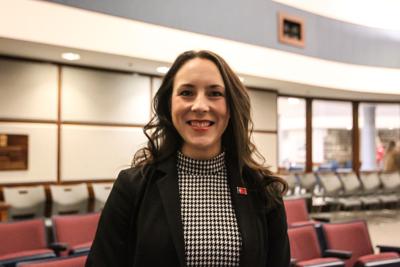

Norman Mayor Breea Clark wasn’t always certain she would pursue a second term after a tumultuous three years in office.
After nearly deciding she would surrender the mayorship after a single term, Clark said support she’s received from community leadership inspired her to run again. Her campaign for a second term, she said, is focused less on restating commitments made in her first three years and more on goals she will pursue, if reelected. Specifically, Clark said she aims to produce long-term facilities solutions for Norman’s homeless population, pass a stormwater utility for Norman and bolster local infrastructure.
The Wichita, Kansas native’s Norman ties began in 2005, when she moved to Oklahoma to attend the OU College of Law after receiving a bachelor’s degree in political science at Wichita State University. She earned a Juris Doctorate in 2008, and became director of OU’s JCPenney Leadership Program in 2018.
After beginning her stint in local government as Norman’s Ward 6 city council member in 2016, Clark defeated opponents Bill Hickman and Evan Dunn in the 2019 mayoral election with 51.43 percent of the vote. Her mayoral tenure became defined largely by the coronavirus pandemic and nationwide policing debate.
Clark faced notable backlash after the Norman City Council voted to reduce a proposed Norman Police Department budget increase by $865,000 in June 2020. While the decision still resulted in an overall budget increase for NPD, the meeting encouraged the formation of Unite Norman. By July 2020, the group attempted to trigger a recall election for Clark and several Norman city council members. Each petition failed to gather enough signatures or was invalidated by duplicate signatures.
“(The office) came at great personal cost to me,” Clark told The Daily. “We make a whopping $100 a month to do this, so it’s certainly not for the money. It’s hard to focus on my professional career when the City of Norman requires so much attention. At one point during the pandemic, I called our city manager (Darrel Pyle) and said, ‘Darrel, I am like 99 percent sure I’m not running again.’”
Members of a Facebook group opposing Norman’s COVID response sent Clark death threats online in May 2020, and Clark said she was continually targeted and harassed online throughout the pandemic. Eventually, her supporters in city government and the community at-large led her to reconsider.
“(They asked), ‘Why would you want … the progress you’ve made to be undone,’” Clark said.
Clark highlighted Norman’s perfect score on the 2021 Human Rights Campaign Municipal Equality Index — a measure of how supportive municipal governments are of their 2SLGBTQ+ residents — as a notable accomplishment of her term. She said her experience in guiding Norman through the COVID pandemic and directing funding from federal sources, like the CARES Act and federal grants, will also be vital as Norman looks to emerge from the pandemic.
“When it comes to my experience as the incumbent, this is the most unique situation our city has been in in a century,” Clark said. “We have a once-in-a-generation opportunity to stretch those federal dollars, build partnerships and collaborate to solve long-standing problems in our community.”
During her tenure as mayor, the Norman City Council allocated CARES Act funding to local businesses and vaccine distribution.
Affordable housing and homelessness solutions would be prioritized with further federal aid dollars if she is elected to a second term, Clark said.
“Affordable housing doesn't just affect the homeless, it affects people who live paycheck-to-paycheck,” Clark said. “We've got people in Norman right now with Section Eight vouchers and no Section Eight housing available. … Affordable housing has always been the missing piece in Norman, and something that Norman has kind of always struggled with.”
Potential affordable housing solutions under consideration now include single-room occupancy spaces near the intersection of Robinson Street and Berry Road. City officials have also consulted with Griffin Memorial Hospital — which sits on state-owned land under the Department of Mental Health and Substance Abuse Services — about constructing multifamily affordable housing.
Long-term maintenance and staffing of such facilities could pose an obstacle for the city, Clark said. Previous experiences with similar projects and collaboration at the county level could help alleviate those issues.
“The City of Norman has made this mistake before. An example is our animal welfare shelter,” Clark said. “It was built, but we were not prepared for the staffing and maintenance costs. … But, we are the county seat and it doesn’t need to just be Norman’s problem, because it’s a countywide problem, it’s a nationwide problem. The more we can collaborate, the more we can stretch our dollars to do the most good.”
Clark also praised NPD’s efforts in interacting and building relationships with Norman’s unhoused residents, and said she hopes to pass additional funding to help the department staff its community outreach services.
Norman remains the largest city in Oklahoma without a dedicated stormwater utility. Funding the project has been a lengthy process featuring multiple failed proposals. Clark said the issue remains too important to continue administering “band-aid” solutions.
The city’s unique position as the only Oklahoma municipality required to vote on the creation of a public utility poses a challenge for city officials to create an easily understandable, equitable funding solution, Clark said. Part of that solution should involve more collaboration between rural and urban Normanites, she added.
“We’re not your typical city that just has an urban feel to it … if you look at our map, it goes way past Lake Thunderbird,” Clark said. “I would like to create a rural commission to educate the ‘city folk,’ if you will, on issues facing our rural community — because I don’t know what it’s like to have livestock and run a farm as my profession, and I don’t pretend to know. I think we could have a ward-specific citizen commission, and experts in stormwater infrastructure and water quality combine again and make a proposal.”
In 2019, propositions for stormwater utility bond projects and a stormwater utility fee received 42.62 percent and 39.68 percent “yes” votes, respectively.
“We’ve had issues with deciding is it a flat fee, is it based on water usage, is it based on impervious surface,” Clark said. “The second attempt had more support than the first, so I’m hopeful we can get it across the finish line. … We’ve never addressed this, ever. It’s about long-term water quality and supply, it’s also about our stormwater drainage pipes, which we have never looked at, so there’ll be lots of replacement, and then lots of maintenance.”
Clark said the rise in partisan politics that has saturated notable Norman City Council issues for the past year has no place in local decision making, and that she’s glad to see candidates run with a focus on minimizing those influences in municipal government.
“I know there’s a candidate (Bob Thompson) trying to say that we shouldn’t be red or we shouldn’t be blue, and I absolutely agree,” Clark said. “I don’t make partisan decisions, because partisan politics don’t fill potholes. There’s no room for political ideology or political party in local government, because we’re not tackling issues like abortion or gun rights. We’re trying to clean water and build roads.”
Gov. Kevin Stitt’s endorsement of mayoral candidate Nicole Kish is a “wildly inappropriate” breach of municipal governments’ non-partisan nature, Clark said.
Her portrayal as “a raging liberal” by campaign opponents is “wildly untrue and inaccurate,” Clark said, given her voting record and past political experience.
“I tend to be right about in the middle. Every election cycle, someone will point out I started out in Norman as a registered Republican,” Clark said. “I interned for (former President) George W. Bush, and at the state capitol of Kansas.”
Ultimately, despite what many have characterized as a year of polarizing local politics, Clark said she is grateful more Normanites have been interested in local participation.
“One of the silver linings of the pandemic is people really did start paying attention to local government more, and regardless of what side you're on, I don't think that's a bad thing,” Clark said. “I think accountability is always good, and voter education. I find it sad that local government has the lowest voter turnout, because the decisions we make on the second and fourth Tuesday at the city council chambers impact Normanites’ lives way faster and more directly than any decisions you're going to see at the state and federal level. So I'm glad that people are watching and participating.”
Mayoral and city council elections will take place Tuesday, Feb. 8. In-person absentee voting takes place Thursday and Friday, Feb. 3-4. If no candidate receives 50 percent of the vote, the runoff election will take place Tuesday, April 5. For more information on where, when and how to vote, visit the Cleveland County Election Board website.


