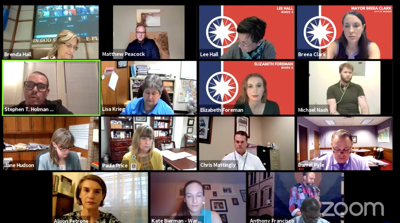

The Norman City Council approved a $55,000 allocation of CARES Act money to fund free COVID-19 vaccination services for “targeted residents” and amendments to a city grant program during its Tuesday night meeting.
Norman Mayor Breea Clark said the allocation will target specific areas to make vaccines “equitably available” and to meet residents where they are. She said the city will partner with Norman Regional Health Systems and the Norman Police Department to identify "areas of need."
“We know people don't have vehicles, and we know our bus system doesn't go everywhere we want it to,” Clark said. “So we're really hoping to take the vaccine straight to our residents who need it most.”
Jason Olsen, the city's recreation superintendent, said some of the expenses related to this project are printing and marketing materials, vaccine supplies and funds to help reimburse some of the costs Norman Regional Health systems will face.
“The first weekend that we're doing these vaccinations, we're targeting about 1,400 vaccinations between a city park, a neighborhood and a few churches,” Olsen said. “We're not ready to announce those yet, because we want to make sure that the vaccinations are targeted in those specific neighborhoods and churches. We don't want that information getting out too far ahead, where people that we're not targeting from other communities come … and try to take up the spots.”
Olsen also said the program has explored providing vaccinations to members of Norman’s homeless, homebound and senior communities. He said once the Johnson & Johnson vaccine comes out, the city can directly and efficiently provide single shots.
Clark said she plans to better target communities affected by this allocation by recruiting council members to knock on doors and notify people of their eligibility.
Ward 6 Councilmember Elizabeth Foreman voted against the resolution after noting President Joseph Biden’s promise to have enough COVID-19 vaccines for every adult by the end of May. She said many of her constituents reached out to her to say they would rather see this funding go toward small businesses.
Clark said studies have shown marginalized, minority and lower socioeconomic status communities are not receiving vaccinations, despite being widely available, and she hopes to target these communities.
“I personally feel it is a good use of the CARES Act funding given those disparities that have been proven now by data,” Clark said. “So, hopefully, we can do a better job of reaching everyone in Norman — not just those who, again, are equipped with internet service and solid and reliable transportation.”
The council approved the resolution with a vote of 7-1, with Foreman as the only opponent.
The council also held a public hearing on amendments to Norman’s Community Development Block Grant Program, which identifies and addresses the needs of low-to-moderate-income residents in Norman. The amendments substantially reduced and eliminated some projects in the program so the council could propose a tree removal and pruning program in response to the effects the October 2020 ice storm had on low-income neighborhoods.
The first amendment allocated $67,250 to the project, with $60,000 coming from an acre reconstruction project that was completed by alternative funding and $7,250 from a canceled alley reconstruction project. The second amendment allocated $47,340 toward a tree-planting project, with $25,000 coming from a canceled land acquisition project and $24,340 from the reduction of an ADA improvement project.
Lisa Krieg, the city’s grant manager, said the canceled projects were deemed unnecessary, and the need for tree removal and pruning was great.
"There were substantial amounts of tree damage, not just to the CDBG target area, but citywide,” Krieg said. “I’ve heard numbers upwards of $6 to $7 million that was paid to help remove some of the debris, as well as address some of the trees within the public right away. … I know I had to hire someone to deal with some trees, as did most of you, and it's not cheap — it is rather expensive. So we looked at these projects that had funding that was available and looked towards reprogramming this to offer the owners of occupied properties within the target area an opportunity to have these trees addressed.”
The council unanimously approved the amendments. Ward 4 Councilmember Lee Hall praised the program for its “creative approach.”
"Not only (can we) help our neighbors out, but also (we can) have a really targeted approach to investing and reinvesting in rebuilding our tree canopy after that damage we all suffered," Hall said. "So, I think it serves a really important individual need that may not be met, or cannot be met in any other way, but it also is an investment in maintaining our tree canopy as we go forward."
Applications for occupied households in the CDBG target area to receive aid will be available on the city’s website April 5.


