


OU Chief COVID Officer Dr. Dale Bratzler said on March 2 that case numbers in Oklahoma have plateaued — with a seven-day case average of 712 cases four days later — and COVID-19 is a disease people should begin to learn how to live with. The long-term effects of COVID-19 have been acknowledged by experts, who say eradicating the virus is not feasible, and 2022 will usher in an era of learning to live with the virus.
Some OU faculty with comorbidities, immunocompromised loved ones or who are at a higher risk of contracting severe illness if infected with COVID-19 don’t have that luxury. As OU announced its flexibility plans for staff, allowing fully on-site, hybrid remote and fully remote options to “bolster the institution’s competitive advantage,” instructors like OU political science professor Michael Givel, 67, have to risk his and his immunocompromised son’s health by teaching in person.
When Bratzler implemented a two-week mask mandate at OU, as the highly transmissible omicron variant triggered climbing COVID-19 case numbers in Oklahoma, instructors wished for an extension. Yet, three weeks later, the university rescinded the mandate after a university spokesperson wrote to The Daily that, although OU’s interpretation of Executive Order 2021-16 and Senate Bill 658 barred the institution from implementing a general mask mandate, "ambiguity in the interpretation of what constitutes a public space” permitted the temporary mandate.
The feeling is all too familiar, as the past two years have been defined by fluctuating COVID-19 cases, the implementation and revoking of mask mandates and shifting CDC guidelines.
When OU’s mask mandate was removed on Jan. 31, instructors like Givel were left wondering what made February 2022 different. Would Feb. 1 mean the pandemic’s “magic end,” or another “Groundhog Day of (OU’s) own making?”
During the spring 2022 semester, 90 percent of lower-division courses and 88 percent of upper-division courses are being taught in person. As instructors attempted to secure the remote teaching accommodations distributed to the remaining spots, faculty said they have and continue to encounter difficulties in receiving clear accommodation standards that apply to the pandemic and felt their lives are being put at risk because of a “lack of clear leadership from upper administration” while criteria were clarified for staff for the sake of competition.
Misha Klein, an associate professor of anthropology, first applied for accommodations in fall 2020 when OU relied on an accommodations system under the Flexible Teaching Plan through the Office of the Provost.
To request a remote teaching accommodation, faculty and graduate teaching assistants had to email a request to their department chair and Committee A, which consists of two elected members of tenured and tenure-track faculty who serve two-year staggered terms. The committee prepares and transmits formal recommendations to the chair.
The request indicated whether it involved an instructor, their immediate household or someone for whom they are the primary caregiver with an increased risk for severe illness from COVID-19 or another reason. Instructors also had to file a request through the Americans with Disabilities Act process with OU Human Resources if the request was made for their health.
Instructors had to state if they fell under Category A, B or C instead of providing additional health or personal information to their department. Category A accommodations covered individuals with medical conditions that could put them at an elevated risk for serious COVID-19 complications, Category B covered individuals who lived with or cared for someone with a medical condition and Category C was for reasons that did not fall under the first two categories.
All requests for accommodations submitted before the deadline were either granted or instructional flexibility within units was accomplished, the university spokesperson wrote in an email. In July 2020, OU Interim Senior Vice Provost Jill Irvine announced that 97 percent of remote teaching accommodation requests were approved for the fall.
An open records request noted that there were no responsive records regarding The Daily’s request to view the number of accommodation requests granted by OU’s Category A, B and C policy. The university no longer refers to the categories, as it relies strictly on the legal criteria of ADA, which is evaluated through human resources processes, according to an email from the university spokesperson.
OU Human Resources Norman ADA Administrator Vanessa Llach determines and manages employee accommodations.
Although her request was approved, Klein had to supply a letter from her doctor to receive accommodations and said she felt violated in having to share her private medical information with her employer to work remotely. She said OU’s continued application of ADA standards to work accommodations through its human resources department during the pandemic is a “complete misuse of the law.”
The ADA is relevant to pandemic preparation by regulating employers’ disability-related inquiries and medical examinations — including those who do not have ADA disabilities — prohibiting covered employers from excluding individuals with disabilities from the workplace for health or safety reasons unless they pose a direct threat and requiring reasonable accommodations for individuals with disabilities, according to the U.S. Equal Employment Opportunity Commission.
Employers are prohibited under the ADA to make disability-related inquiries, which refer to questioning likely to elicit information about an individual's disability. A disability-related inquiry includes weak or compromised immune systems associated with conditions like cancer or HIV/AIDS, according to the commission.
During employment, the ADA prohibits employers from making disability-related inquiries unless they are job-related and consistent with business necessity, according to the commission. Generally, these inquiries can be made when an employee’s ability to perform essential job functions is impaired by a medical condition or if they pose a direct threat due to a medical condition.
A direct threat is a significant risk of substantial harm to the health or safety of the individual or others that cannot be eliminated or reduced by reasonable accommodation. As of March 2020, the COVID-19 pandemic meets the “direct threat” standard.
A reasonable accommodation is a change in a work environment that allows an individual with a disability to have equal opportunity to apply for a job, perform a job's essential functions or enjoy equal benefits and privileges of employment, according to the ADA.
Accommodations pose an “undue hardship” if they cause significant difficulty or expense for the employer, taking into account the nature and cost of the accommodation, the resources available to the employer and the operations of the business. Employers are not required to provide a particular accommodation if it would result in an undue hardship, but they must consider other accommodations that do not.
OU Law professor Donald Bogan, who teaches a course focused on health law, wrote in an email to The Daily that he is in the process of applying for an accommodation as an employee who is over 65 years old with comorbidities that the CDC defines as putting him in a high-risk category for severe illness with COVID-19.
The Equal Employment Opportunity Commission issued a guidance in May 2020 stating that employees over 65, who live in nursing homes or of all ages with underlying medical conditions were eligible to apply for a workplace accommodation. Under the ADA, Bogan wrote that an employer must provide accommodations for an employee who suffers an impairment unless it is essentially unfeasible for the employer to accommodate the worker’s impairment effectively.
ADA guidelines currently state that although individuals who are 65 years or older are at a higher risk for severe illness, accommodations cannot be provided based on age alone. Employers are allowed to provide flexibility regardless of federal requirements.
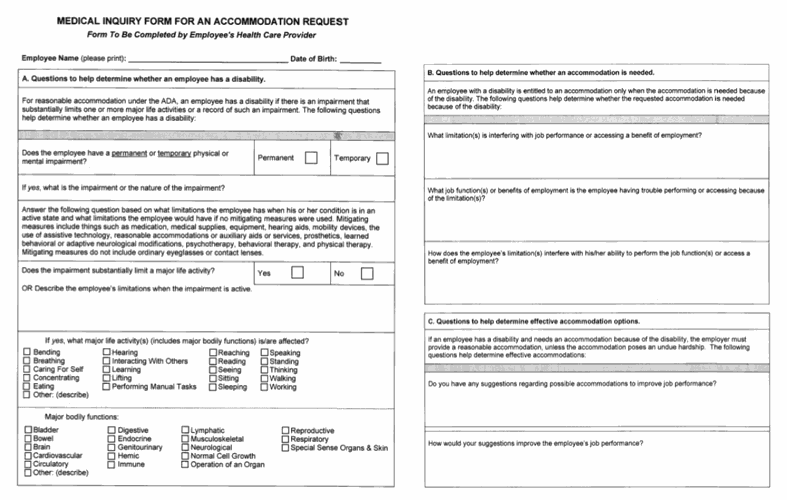
A Medical Inquiry Form is issued through OU Human Resources for employees to file as an application to receive an ADA accommodation. The form asks if a worker suffers a permanent or temporary “impairment” and asks for a description of the nature of the impairment and how the worker’s impairment limits one or more major life activities to “determine whether an employee has a disability.”

The university's medical inquiry form for ADA accommodation requests. The form is filled out and signed by the employee's medical provider.
The form also asks the worker’s medical provider to describe how their physical impairment affects their ability to perform various activities and what job functions the employee is having trouble performing due to the impairment. The form must be signed by the worker’s health care professional.
The university spokesperson wrote in an email that OU follows guidance provided by the Equal Employment Opportunity Commission in interpreting the ADA. Under the ADA, a physical impairment includes “any physiological disorder or condition affecting one or more body systems.” A mental impairment includes “any mental or physiological disorder.”
They wrote that information regarding when COVID-19 is considered an impairment under the ADA can be found on the U.S. Equal Employment Opportunity Commission’s website.
When asked about what discretion is used in providing accommodations to individuals who are at higher risk for severe illness due to COVID-19, the spokesperson wrote that all accommodation decisions are made on a case-by-case basis after considering each individual's circumstance. They may be considered for reasonable accommodations if they can provide current and sufficient medical documentation to substantiate their request and if their position’s essential functions can be performed remotely.
Bogan told The Daily this response was “a lot of blah, blah, blah” as it doesn’t address which federal guidelines from the Equal Employment Opportunity Commission it follows to define impairment. By asking about a current impairment that prevents an individual from doing their job in its medical form, Bogan said OU’s policy seems designed not to cover someone who is at risk of being disabled by COVID-19 but is not currently suffering from symptoms.
He said the law school is a perfect example of this as, although faculty are fully vaccinated, they still want accommodations because of their age, comorbidities and immunocompromised family members.
“Among the older faculty members, other faculty members were really worried about transmitting the disease to others within their family who were at high risk. They were being turned down for an accommodation, and I think still are,” Bogan said. “So you've got a faculty member that lives with an 80-year-old grandparent that's got comorbidities or with a young child that has got asthma and can't get vaccinated. Those people were very worried about bringing home the infection and getting someone in their family very sick, and they have been denied accommodation to teach remotely.”
Employers are not entitled under the ADA to provide accommodations to employees without a disability based on the disability-related needs of a family member or other person with whom the employee is associated, according to the Equal Employment Opportunity Commission.
ADA is a “brilliant law,” Klein said, but vulnerabilities to COVID-19 in the workplace is a labor issue where ADA does not provide appropriate coverage. She compared it to public smoking as, when rules changed about smoking on airplanes and in restaurants, it was not because people disclosed they were immunocompromised, but because of the dangers smoking posed.
“It didn't matter whether you had asthma or bronchitis or other vulnerabilities because we know that secondhand smoke makes people sick,” Klein said. “The reason I think that comparison is important is that's the approach that we need to be taking here. It's about a workplace that exposes us to something that can make us sick, not about preexisting illnesses. So the use of the ADA is completely misplaced. It's an abuse of the ADA, and it doesn't address the real issue.”
ADA is an important process for providing accommodations for staff and faculty with long-term and documentable disabilities, Givel said. Disabilities have to be long-term and proven by a medical doctor for faculty or staff to receive accommodations.
The Office for Civil Rights of the Department of Health and Human Services and the Civil Rights Division of the Department of Justice issued an addendum under ADA in July 2021 to define “long COVID” as a disability under Titles II and III, which covers state and local government and public accommodations. Long COVID symptoms include tiredness, fatigue, difficulty thinking or concentrating, shortness of breath, headaches, dizziness on standing, heart palpitations, chest pain, coughing, joint or muscle pain, depression, anxiety, fevers and loss of taste or smell.
Givel said although Section 504 and 1557 of the ADA allow individuals to seek accommodations with proven long-term COVID symptoms, it doesn’t say anything about people like him or his immunocompromised son.
“None of us necessarily have a disability under ADA, but the CDC has us at higher risk and a high-risk category,” Givel said. “ADA by itself does not necessarily — there are always case by case facts — cover people like ourselves.”
Because requests have been handled by OU Human Resources following the ADA accommodations process, the university spokesperson wrote that the Office of the Provost does not have records of the number of faculty, staff and teaching assistants who have received accommodations during the pandemic. They wrote that the university does not keep an aggregated report of accommodation requests.
The ADA accommodation process is important, but when related to the pandemic, Givel said OU is “forcing” instructors to go back into the classroom, regardless of personal risk and vulnerable family members. He said OU recognized the risk when they implemented the Category A, B and C system, but because that isn't in place, there have been no signals from the university on how they will protect instructors other than “go apply for ADA.”
Givel said when the university provides accommodations, it should note the difference between people labeled “at-risk” by the CDC versus those who have a proven disability.
“OU is using a very restrictive definition to approach a very serious health problem, and this definition does not cover what the situation is,” Givel said. “It covers, in part, long-term COVID symptoms, but most people who receive ADA accommodations have personal health issues going on right now. What happens if you walk into a classroom and you're 67 years old and a professor and you contract the omicron variant, and you're healthy until you do that. ADA doesn't cover that.”
Klein returned from a spring 2021 sabbatical to OU for an in-person semester in fall 2021 because, although she was offered accommodations by her chair, she wanted to defer to people with more serious vulnerabilities. She said she had 100 percent of her students masked and noted that she feels a majority of students at OU would rather be protected, and only a “vocal few” are pushing back.
In the spring, Klein was given a classroom with a capacity limit of 69 students for her 68-student class. She requested a larger room that seated 165 people and allowed her students to socially distance. Her course saw two COVID-related absences in the first week of classes, meaning she had to extend her mask mandate into the third week of classes, based on OU’s two-week mask mandate policy, which is put in place when a student tests positive.
She said she empathizes with students’ stress during the pandemic, as they manage everything from their families losing income, getting sick and losing loved ones. She said she changed her assignments to avoid fieldwork and is flexible with deadlines.
Through all of these difficulties, however, Klein said she found it difficult to accommodate her students in a hybrid setting, as she and other professors don’t receive tech support from OU IT to manage students on Zoom and in person. She has had Zoom classes break down online as she tried to present PowerPoint slides, resulting in her decision to send slides to individuals who miss class based on illness or other situations.
Just coming home from work is dangerous, as Klein said she also converges with her son, a student at Norman Public Schools. Although he double masks and is vaccinated and boosted, she said her whole family is concerned because vaccination and masking requirements are not in place at OU or NPS.
“We've all done as much as we can and, thankfully, as far as we know, none of the three of us have gotten sick,” Klein said. “That's good, but I know, especially with this omicron variant, so many people have gotten sick. And again, the vaccine isn't for individual protection — it's a public health measure. It works at the level of population — not necessarily the level of the individual. The idea, of course, being that we don't allow the virus the opportunity to create new variants.”
Emerson Jones, a professor who requested anonymity because they said the university asked them to take down social media posts critiquing its COVID-19 policies, taught online during the fall 2020 semester but returned in person next fall. Their courses have been “blended synchronous,” a modality not technically defined by the university, which they said is divided into in-person and online learning.
They said they believe the university keeps the definition purposely vague.
“There's the official, out loud version of what the university says and then the behind the scenes thing,” Jones said. “The official out loud is ‘Teach in person as much as possible, blah, blah, blah.’ Behind the scenes are much more accommodating. But you're not allowed to say that, and that's why I was asked to take those (posts) down, kind of, is because I was saying what has been said behind the scenes out loud.”

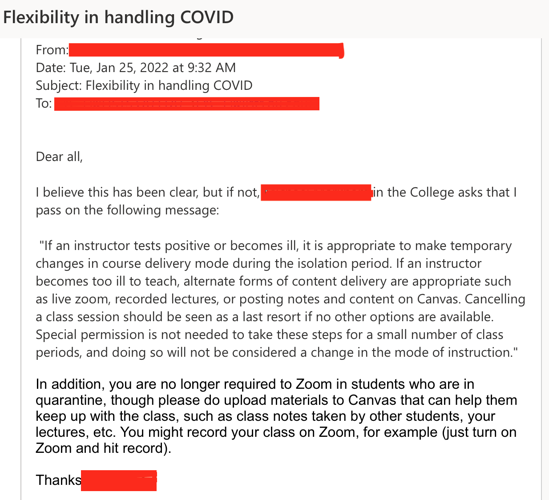
An email from Jones’ chair noting that, during the two-week mask mandate, if an instructor tests positive or becomes ill, it is appropriate to make temporary changes to the course. Doing so doesn’t require permission and will not be considered a change in the mode of instruction. Jones said they considered this an example of “behind the scenes accommodations.”
At the beginning of the fall 2021 semester, Jones said they experienced various challenges. Because the definition of blended synchronous was hazy, they said they decided to teach classes in person a few times but held most of the semester online.
The first day of class was held in a small room where 15 students were packed tightly, Jones said. They requested a larger classroom, and only four students came because the remainder felt uncomfortable. Jones decided to accommodate their students based on their comfortability and several positive COVID-19 tests.
“I decided that not only because of the pandemic, but because I surveyed my class (individually), and all my students said we would rather do it (online),” Jones said.
Jones said they have a friend in another college who tried to follow the same mode of teaching as they have, and her dean sent people through classrooms to make sure professors were teaching in person. They said there is not an across-the-board university policy regarding accommodations.
“If your chair or dean is supportive and recognizes this, they'll support you. If they're not, they won't support you to the point of checking in on you in that kind of way, which is terrible,” Jones said.
Regarding the university’s ADA policies, Jones said it is difficult because, instead of offering options without question, instructors are being forced to disclose disabilities or expose the statuses of their immunocompromised loved ones to human resources. In trying to protect their loved ones, Jones has felt like they risked getting fired.
Andreana Prichard, the Wick Cary associate professor of honors and African history, has endured the difficulties of teaching during the pandemic, all while acting as a parent to a young child born during its beginnings on March 18, 2020. In the spring of 2021, Prichard said she requested to move online and teach asynchronously so she could serve as her son's primary caregiver.
In the fall semester, Prichard sent an email a few weeks before classes began to inquire if accommodations would be made for faculty based on the vaccination status of dependents. Prichard’s son was, and still is, too young to receive the COVID-19 vaccine, but the answer from OU was “generally and uniformly no.”
Correspondences with OU Faculty Senate Chair Keri Kornelson revealed to Prichard that fall accommodations would be based strictly on the CDC’s ADA requirements, which Prichard felt didn’t fit her situation. She decided that, despite the risk, she wasn’t going to push for accommodations because the pathway to send in requests wasn’t clear.
Prichard said, although she felt privileged to be in a situation that wasn’t the “most difficult out there,” she was worried because she couldn’t enforce any basic public health standards in her classroom. Stress also carried into her home life as she managed caring for her son and sending him to daycare where, because he is under two, he can’t wear a mask.
“There were days in the fall that he had a fever and couldn't go to school and not having that flexibility to move class online if needed to or to cancel, to kind of change modalities is difficult. … It adds an extra layer to an already really stressful situation,” Prichard said.
Currently, Prichard is on research leave, meaning her job consists of 40 percent research, 40 percent teaching and 20 percent service. While she attends search committee meetings, her husband takes care of her son, she takes him in the afternoon, and they both work at night.
Prichard said she feels accommodated in some ways as, throughout the pandemic, her son has been a welcome guest in some of her committee meetings when her husband isn’t available to care for him. Yet, she said she still feels there are groups of faculty like herself who aren’t clearly included under university accommodations.
“The university came out with a work policy for people with school-age kids. This was in response to Norman and OKCPS closing, but I don't know if they define kids under two as school-aged,” Prichard said. “So there's this very liminal space for people with kids under two or kids under five, where it does feel sometimes, not just in the university's response, but more generally, that it's kind of a group of people who have been forgotten.”
OU Human Resources was not adhering to a strict age range for children in this policy, according to an email from the university spokesperson. Supervisors were encouraged to consider remote work options, as appropriate, for employees with children in area school districts that implemented distance learning or those whose childcare settings have been disrupted as a result of COVID-19. If working remotely is not an option, the employee should take paid time off, the spokesperson wrote.
As Prichard and her husband juggled caring for their son and managing their work lives, Prichard said she is grateful her son is tiny, as she hopes he will come to forget coming into a world where children’s schooling and routines were interrupted. When he was born, he wasn’t held by anyone but herself and her husband until he was four months old. She hoped then that he would never have to wear a mask but, as his second birthday approaches, she said the pandemic will become more of a reality for him.
Ultimately, Klein said she wished the university extended its masking requirement from January to protect students, faculty and staff, not just for the sake of public health, but to take the burden off instructors to be public health leaders in their classrooms. Yet, Klein said professors don’t feel safe or empowered to speak up on their own behalf.
“It's a long-standing issue on this campus. There was an article in Inside Higher Ed some years ago about cronyism under Boren, and nobody would speak on the record. That kind of oppressive environment has deeper roots than just the current administration, but it tells you that, as much as we are supposed to have academic freedom, (in) what we teach and how we conduct our classrooms, we don't. It's being violated in a number of ways. … I don't know that people fully understand how critically important that is to the health of the institution, and academia in general. … So we have to prioritize education over politics and need to prioritize our health, but our ability to educate has been undermined.”


