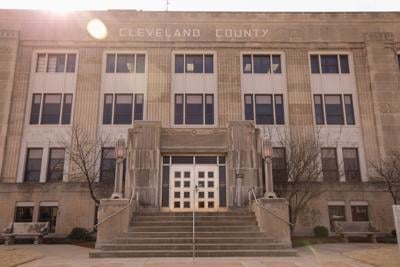

Cleveland County District Judge Thad Balkman granted a temporary restraining order on Thursday in a hearing for a newly filed lawsuit seeking to cancel an August special election on the proposed Norman entertainment district project plan.
On Wednesday night, OU Daily obtained documents of a lawsuit filed by former Norman mayors Bill Nations and Dick Reynolds aiming to cancel the special election. The lawsuit cited issues, including the Norman City Charter requires all special elections be called by ordinances, yet the Norman City Council called the special election by resolution on June 11.
The defendants in the lawsuit are the City of Norman and the Cleveland County Election Board.
The hearing took place at 12:30 p.m. Thursday. Lawyers Sean Rieger, Daniel Sadler, V. Glenn Coffee, Denise Lawson and Michael Fields represented the plaintiffs.
Rieger, of Rieger Sadler Joyce LLC, represents the OU Foundation, which owns the land the proposed project would be on.
Kristina Bell, assistant district attorney representing the Cleveland County Election Board, said during the hearing that it would be viable to proceed with the special election at a later date.
“I haven't heard anything today to suggest there's any reason why (the election) couldn’t be on the November election,” Bell said. “I don’t think they’re getting irreparable harm to the election not happening on August 27.”
During the hearing, Lawson said an important factor to consider in determining the validity of the resolution was the ballot title could be confusing to readers because it says “shall the City adopt a plan,” and that the word “shall” is misleading.
“A reasonable voter, taking a step back, would think in reading (the title) that I am actually voting as to what the City Council must do on this measure,” Lawson said. “It makes it sound as if the project plan has been fully adopted by the city council when, in fact, we know that the actual documents finalizing the project plan have not been fully funded.”
The $1 billion entertainment district, announced in September 2023, would include an arena to succeed Lloyd Noble Center as the home of OU basketball and women’s gymnastics programs as well as a district for businesses and residences in Norman’s University Park area adjacent to Interstate 35. A statutory review committee approved the project plan on May 23.
It would divide the district into two tax increment financing districts, or TIFs, which are used to support redevelopment, infrastructure and community-improvement projects within a certain area to stimulate private investment in the area in need of economic revitalization.
On June 11, the Norman City Council voted to approve a special election for residents to vote on the TIFs for the proposed entertainment district. However, the state’s Local Development Act doesn’t require voter approval for a TIF to be established.
On June 12, Mayor Larry Heikkila issued a Special Election Proclamation and Notice of Election, directing the proposition to be placed on the ballot for an election on Aug. 26 or some date thereafter, according to the document. However, during the June 11 meeting, the city council stated that the election would occur on Aug. 27.
According to the documents, the City Council called the special election by resolution, did not call the special election on a certain date and failed to follow the procedures of passing an ordinance.
The ordinance also has to specify the object and time of the election, according to the Norman City Charter.
Even if the resolution was done as an ordinance, the document states that under the Norman City Charter “no ordinance shall be adopted on the day of its introduction before the council; but all ordinance, after being introduced, shall lay over for at least one week before being finally voted on and adopted.”
The lawsuit also mentioned the potential costs of a special election. On June 10, Jo Robinson, assistant secretary at the Cleveland County Election Board, told OU Daily it would cost an approximated $20,000 to hold a special election in Norman but the cost may be greater.
During the hearing, Balkman said it would be unlikely that the amount spent on the special election would be recouped due to it being a substantial cost.
According to Bell, absentee ballots for the Aug. 27 election were printed and received to be sent on Friday, as the Military and Overseas Empowerment Act, as well as state and federal law, requires that all ballots be sent 45 days before an election. The cost to print the ballots totaled $3,905 according to Bell.
At this time, no new date has been set for an election for the proposed entertainment district.
OU provided the following statement about the filed lawsuit:
“The University of Oklahoma’s support for the entertainment district and its positive impact on the city of Norman, including the creation of new jobs and housing options, is unwavering. We look forward to seeing its positive impact come to fruition.”
This article was edited by Ana Barboza and Taylor Jones.


