


Editor’s note: This story was updated at 2:25 p.m. on July 11 to include this statement from OU sent to OU Daily:
“The University of Oklahoma’s support for the entertainment district and its positive impact on the city of Norman, including the creation of new jobs and housing options, is unwavering. We look forward to seeing its positive impact come to fruition.”
Two former Norman mayors have filed a lawsuit in hopes to cancel the special election for the proposed University North Park Rock Creek Entertainment District Project Plan, the Daily confirmed via documents obtained Wednesday night.
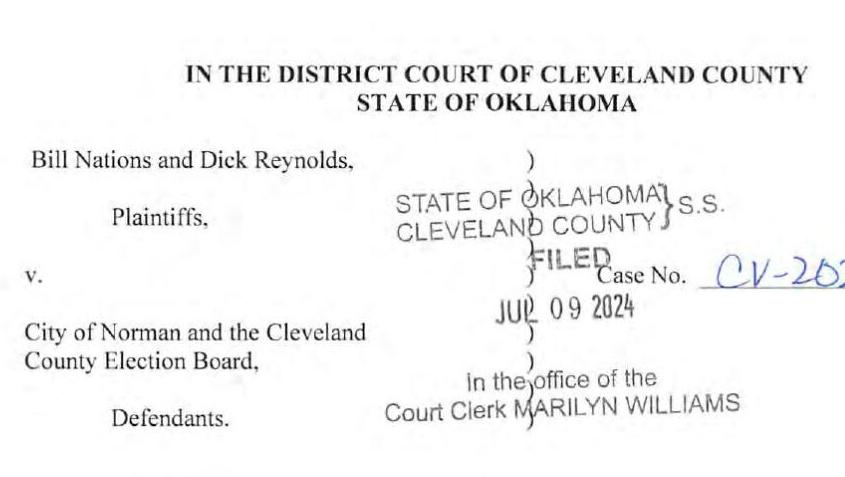
The plaintiffs listed in the document are Bill Nations and Dick Reynolds, and the defendants are the City of Norman and the Cleveland County Election Board.
A hearing for the lawsuit is scheduled for 12:30 p.m. Thursday at the Cleveland County Courthouse.
The $1 billion entertainment district, announced in September 2023, would include an arena to succeed Lloyd Noble Center as the home of OU basketball and women’s gymnastics programs as well as a district for businesses and residences in Norman’s University Park area adjacent to Interstate 35. A statutory review committee approved the project plan on May 23.
It would divide the district into two TIFs. A TIF is used to support redevelopment, infrastructure and community-improvement projects within a certain area to stimulate private investment in the area in need of economic revitalization.

Rendering of an event day at the proposed University North Park entertainment district.
The arena’s total cost would be $330 million, with $230 million proposed to come from public funding and $100 million from OU. The estimated amount the city would pay for the broader entertainment district is $600 million, a subject that’s driven deep community debate and led to the advisory community vote now being legally challenged.
On June 11, the Norman City Council approved an Aug. 27 special election for residents to vote on the tax increment financing districts, or TIFs, for the proposed entertainment district, however, the state’s Local Development Act doesn’t require voter approval for a tax increment finance district to be established.
On June 12, Mayor Larry Heikkila issued a Special Election Proclamation and Notice of Election, directing the proposition to be placed on the ballot for an election on Aug. 26 or some date thereafter, according to the document. However, during the June 11 meeting, the city council stated that the election would occur on Aug. 27.
According to the documents, the Norman City Charter requires that all special elections be called by ordinances and, in the June 11 meeting, the City Council called the special election by resolution, did not call the special election on a certain date and failed to follow the procedures of passing an ordinance.
The ordinance also has to specify the object and time of the election, according to the Norman City Charter.
Even if the resolution was done as an ordinance, the document filed by Sean Rieger, Daniel Sadler, V. Glenn Coffee, Denise Lawson and Michael Fields states that, under the Norman City Charter “no ordinance shall be adopted on the day of its introduction before the council; but all ordinance, after being introduced, shall lay over for at least one week before being finally voted on and adopted.”
Rieger, of Rieger Sadler Joyce LLC, represents the OU Foundation, which owns the land the proposed project would be on.
Because of these, the plaintiffs asked for the resolution to be declared invalid and strike the provision from the Aug. 27 ballot and/or issue other equitable relief as deemed appropriate.
The lawsuit also mentions the potential costs of a special election. On June 10, Jo Robinson, assistant secretary at the Cleveland County Election Board, told OU Daily the last special election in Norman had a cost of around $20,000 but the cost for one after July 1 may be greater.
The document states that the resolution and proclamation contain two fatal defects under state law and, for these reasons, both should be declared void and of no effect.
“First, the City Council plainly did not possess the requisite statutory authority to place the measure on the ballot as that power is reserved to the people and may only be exercised in tandem with the statutory process for initiative and referendum petitions. And second, the Proclamation's inclusion of an inaccurate election date constitutes defective notice under the plain requirements of 26 O.S.§ 13-102(A),” the document states.
In a sit-down interview with OU Daily in April, OU President Joseph Harroz Jr. said that while he’s hopeful the proposed entertainment district would stay in Norman, the university would look to partner with other cities, like Moore or Oklahoma City, to build the development, if necessary.
Community members and experts criticized that stance, saying such an ultimatum undermines the goals of college athletics and makes no sense.
This article was edited by Taylor Jones.


