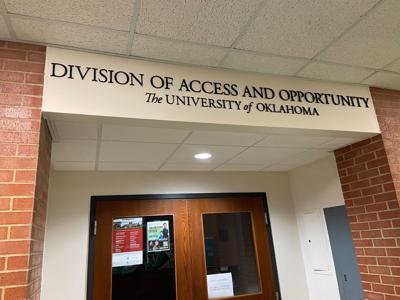

The Division of Access and Opportunity sent a memo on the first day of classes to OU deans, directors and department chairs via the Office of the Provost advising instructors to avoid course content that could fall under diversity, equity and inclusion.
Vice President for Access and Opportunity Belinda Higgs Hyppolite wrote in the email, which was independently obtained by OU Daily, that as federal and state interventions shape the approach to course content in higher education, faculty members should be cautious in how they teach material related to race and gender.
“While some areas remain unclear, recent executive orders, state legislation, and agency letters provide evaluation tools for faculty and colleges to consider when reviewing courses,” the email reads.
The email lists three considerations for faculty, including risk of scrutiny, course requirements and content presentation, and advises instructors to be prepared to explain the relevancy of course content that could “risk being challenged as discriminatory or ‘illegal DEI.’”
The memo clarifies that universities can still teach racism and sex-based issues with caution.
“Courses must avoid methods that could be construed as discriminatory or hostile,” the email reads. “For example, privilege walks, race- or sex-based assignments, or requiring students to affirm certain beliefs may trigger enforcement action.”
The memo’s suggestions diverge from the university’s previous stance on academic freedom. In 2022, OU President Joseph Harroz Jr. announced the university would adopt the Chicago Statement, a set of principles that emphasize the importance of freedom of expression on college campuses.
At the time, Harroz wrote the statement was “fully consistent” with OU’s policies on free expression and academic freedom.
“In a society permeated by deep political and social divides, there is a common misplaced assumption that honoring the principles of free speech and celebrating diversity, equity, and inclusion cannot coexist, or that one infringes upon the other,” Harroz wrote. “At OU, we do not accept this false choice or narrative.”
Following Gov. Kevin Stitt’s executive order banning DEI in Oklahoma higher education, the Office of the President released guidelines for how OU was planning to comply with the executive order at the time, answering frequently asked questions about what might change at OU.
Under the question “may professors discuss race, ethnicity, sex, gender identity, sexual orientation or other DEI-related topics in their course instruction,” OU had answered yes.
“The Executive Order specifically states that it does not apply to academic course instruction,” the website reads. “Faculty retain their academic freedom and retain the right to provide instruction in their course and design their curriculum as they see fit, if the subject matter is related to the subject the faculty member is teaching.”
OU Daily sent several questions to OU Marketing and Communications Wednesday, including what was the motivation behind the memo, if it would impact courses that contain key words such as "race," "gender" and "ethnicity" in its name or description and if the university had any statement to share regarding the memo. OU Marketing and Communications did not respond to the questions and wrote that the memo serves as an evaluation tool.
“As the memo references, it is designed as an evaluation tool and provides links to applicable state and federal guidance including U.S. Attorney General Pam Bondi’s July 29th memo,” an OU spokesperson wrote.
OU Daily emailed Hyppolite Tuesday for more information on the memo. Hyppolite referred the Daily to OU Marketing and Communication’s statement.
Melody Rowlett, an OU political science professor, said she would often use the privilege walk as an instructional tool in her American Federal Government course, a general education requirement for students.
“I thought it added to the course and that is why I included it,” Rowlett said. “It was useful for students and broadened their ability to think critically.”
Rowlett believes the memo’s suggestions inhibit conversations among students with different experiences and backgrounds.
“The provost is saying that there is less value in understanding different perspectives,” Rowlett said. “I am going to try to work the best that I can in my class to still have people have open dialogues that respect each other’s opinion.”
The email includes links to multiple federal directives and state bills referred to as “relevant guidance,” including President Donald Trump’s executive orders, the U.S. attorney general’s guidance for recipients of federal funding, and Oklahoma Senate Bills 796 and 991.
The memo also includes a link to the U.S. Department of Education’s February “Dear Colleague” letter, which warned schools they could lose federal funding if they continued to consider race when making scholarship or hiring decisions.
Background
The email comes nearly a year after an OU education course — Schools and American Culture — was criticized by the Heritage Foundation and Stitt after a Daily Caller article claimed the course was “defying” Stitt’s executive order banning the use of state funds for DEI initiatives.
Two days after the article’s publication, Heritage Action, a sister organization of the Heritage Foundation, posted the article on social platform X.
Stitt responded to the post, sharing his thoughts.
“Universities are more focused on pronouns than they are prepping for the workforce,” Stitt wrote. “Left-wing accreditation monopolies that peddle DEI curriculum hide out of sight and let liberal faculty call the shots.”
Universities are more focused on pronouns than they are prepping for the workforce. And left-wing accreditation monopolies that peddle DEI curriculum hide out of sight and let liberal faculty call the shots.
— Governor Kevin Stitt (@GovStitt) November 18, 2024
It’s time to clean this up. https://t.co/CPkeyiyOg6
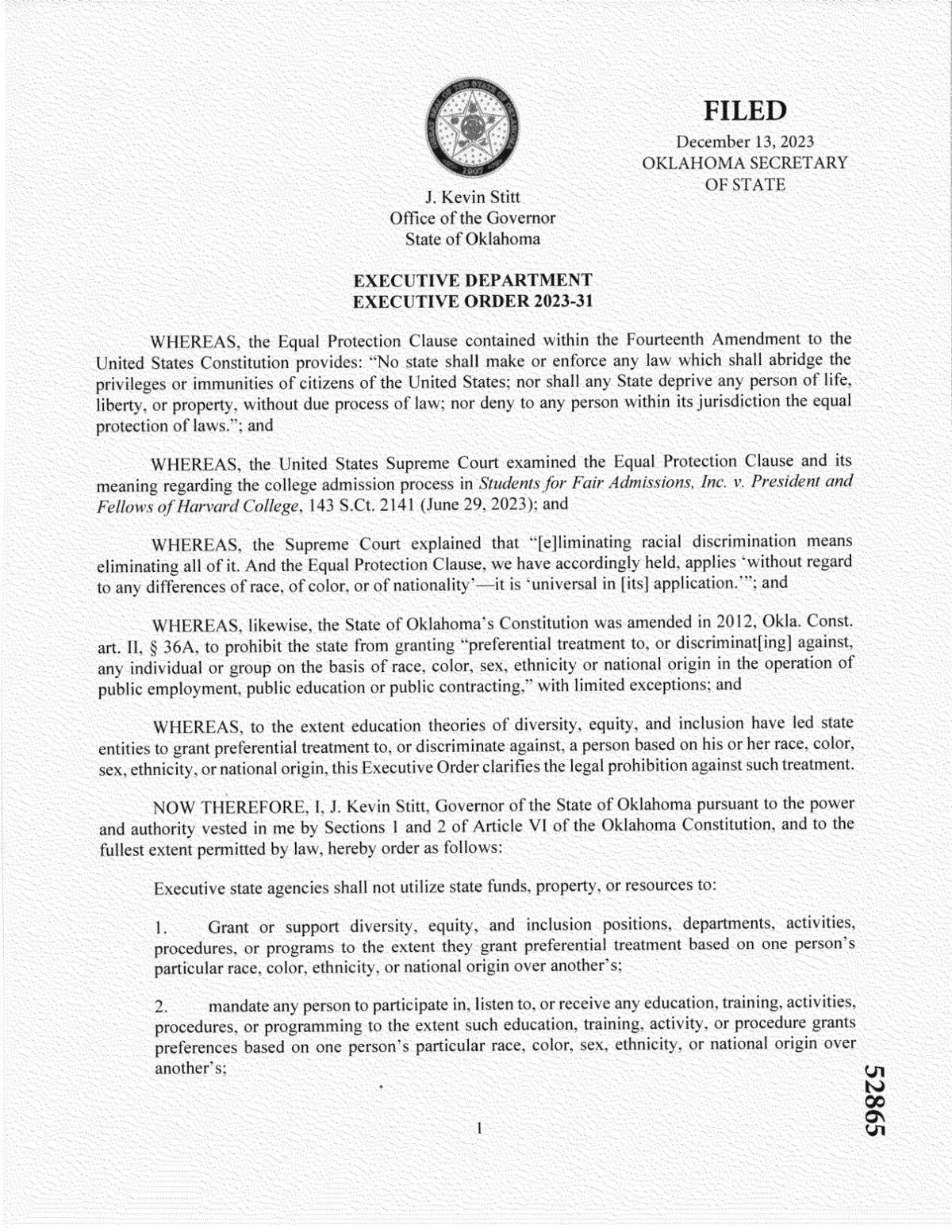
In December 2023, Stitt ordered a formal review of diversity, equity and inclusion in Oklahoma higher education, requiring state agencies and universities to review the necessity and efficiency of related positions, departments and programs.
The order barred institutions from creating mandated education or training to the extent that they grant preferential treatment based on race, ethnicity, sex or national origin.
Following the order, OU renamed the Office of Diversity, Equity and Inclusion to the Office of Access and Opportunity. The Gender + Equality Center, which focused on supporting 2SLGBTQ+ students, was replaced with the Office of Advocacy and Education.
This story was edited by Ana Barboza, Natalie Armour and Thomas Pablo. Tori Pham and Sophie Hemker copy edited this story.


