
An article from a right-leaning news organization criticizing an OU education course has sparked conversations about the specific exemptions in Gov. Kevin Stitt's executive order banning diversity, equity and inclusion.
The Daily Caller is a right-leaning news and opinion website founded by former Fox News host Tucker Carlson and conservative political adviser Neil Patel. On Nov. 16, The Daily Caller published an article detailing the structure of OU’s course Schools and American Culture, writing it “may be defying” Stitt’s December 2023 executive order.
Two days later, the article was posted on social platform X by Heritage Action, a sister organization of conservative think tank The Heritage Foundation.
“DEI policies have nothing to do with equity or inclusion but instead perpetuate the very discrimination and division the Left claims to be fighting,” Heritage Action wrote in the post. “The Sooner State must work to remove the wasteful and toxic DEI agenda in higher education and protect the civil rights of its students.”
Stitt’s office is quoted in The Daily Caller article and later shared his thoughts on X.
Universities are more focused on pronouns than they are prepping for the workforce. And left-wing accreditation monopolies that peddle DEI curriculum hide out of sight and let liberal faculty call the shots.
— Governor Kevin Stitt (@GovStitt) November 18, 2024
It’s time to clean this up. https://t.co/CPkeyiyOg6
Stitt’s executive order required state agencies and universities to review the necessity and efficiency of diversity, equity and inclusion positions, departments and programs. The order barred those institutions from creating mandated education or training to the extent that they grant preferential treatment based on race, ethnicity, sex or national origin.
The order further prohibits mandating loyalty oaths, pronoun disclosure and employee DEI statements.
“Our universities need to be preparing students for the workforce, not indoctrinating them with liberal ideology,” a spokesperson for the governor’s office told The Daily Caller. “It’s insane that this is a required course. It’s time to look at the accreditation entities that are pushing courses like this and bring common sense back to the classroom.”
The governor’s office did not return the Daily’s request for further comment.
OU President Joseph Harroz Jr. told OU Daily on Friday he hasn’t been in direct conversations about course reviewing, but the provost has been involved in ensuring OU is following the executive order.
“I believe we’re in compliance,” Harroz said.
OU Marketing and Communications wrote in an email to OU Daily the university is committed to ensuring courses follow applicable laws.
“OU never shies away from complex or difficult topics. We are committed to the presentation of materials that are viewpoint-neutral and non-discriminatory, and we continue to be dedicated to teaching our students how to think, not what to think,” the email read. “The rich history of the United States is complicated and unique, and it’s appropriate that coursework reflects that.”
Executive order and academic freedom
On Dec. 13, Stitt signed the executive order calling for a review of all DEI programs in universities and state agencies. The executive order specifically notes eight exemptions:
• A policy, practice, procedure, program, class or activity required for compliance with state or federal laws, rules or regulations for obtaining or retaining institutional, academic or discipline-specific accreditation or licensure.
• Academic course instruction; the academic freedom of any individual faculty member to direct the instruction within his or her own course.
• Scholarly research or creative work by an institution of higher education's students, faculty or other research personnel, or the dissemination of that research or work.
• An activity of a student organization registered with or recognized by an institution of higher education.
• Guest speakers or performances on short-term engagements.
• Academic support, tutoring and career services and student success centers, so long as the programming is designed and implemented without regard to race, sex, color, national origin or ethnicity.
• Data collection.
• Access programs for military, veterans, Pell Grant recipients, first generation college students, students from low-income families, students with unique abilities or underserved student populations.
The Office of the President released guidelines for how OU will comply with the executive order, answering frequently asked questions about what might change at OU.
Under the question “may professors discuss race, ethnicity, sex, gender identity, sexual orientation or other DEI-related topics in their course instruction,” OU answered yes.
“The Executive Order specifically states that it does not apply to academic course instruction,” OU wrote. “Faculty retain their academic freedom and retain the right to provide instruction in their course and design their curriculum as they see fit, if the subject matter is related to the subject the faculty member is teaching.”
Michael Givel, president of OU’s chapter of American Association of University Professors, told OU Daily academic freedom is a form of free speech, but does not mean absolute free speech.
“A professor, under academic freedom, is free to choose based on their expertise … the course material,” Givel said. “Academic freedom protects the professor from being influenced or pressured from teaching these materials.”
Givel said the academic freedom exemption was straightforward, meaning under the order, faculty members have their own discretion without interference to conduct their classes as long as an accreditor recognizes the material.
“I think the governor is very confused,” Givel said. “The part of the executive order that talks about exemptions … it’s very clear.”
Since the executive order was signed, OU renamed the Office of Diversity, Equity and Inclusion to the Office of Access and Opportunity. The Gender + Equality Center, which focused on supporting students with advocacy for gender-based violence and support and programming from 2SLGBTQ+ inclusion, was replaced with the Office of Advocacy and Education in April.
OU opted to close the National Education for Women’s Leadership program, implemented new protocol for faculty syllabi, canceled plans to conduct a course called Leadership in LGBTQ Studies and did not require greek organizations to take DEI training.
In a press release from May, OU-AAUP called these changes “detrimental, intentional, and excessive.”
“OU has not justified why they have engaged in a pretty significant crackdown,” Givel said. “It’s pretty outrageous. One has to ask, what’s the motivation for this?”
Schools and American Culture
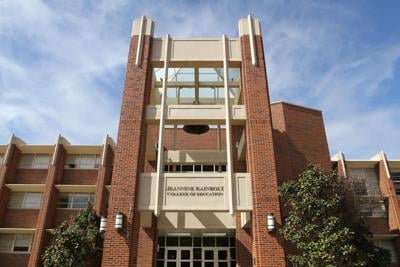
The course Schools and American Culture is required for all undergraduate students seeking a degree in the Jeannine Rainbolt College of Education. OU Daily analyzed the course checksheets for all undergraduate degrees, which are publicly available through OU’s general catalog, confirming the course is listed as a requirement under “professional education.”
The Daily Caller included a copy of the syllabus for this year’s Schools and American Culture course, which OU Daily independently verified through a student currently enrolled in the course.
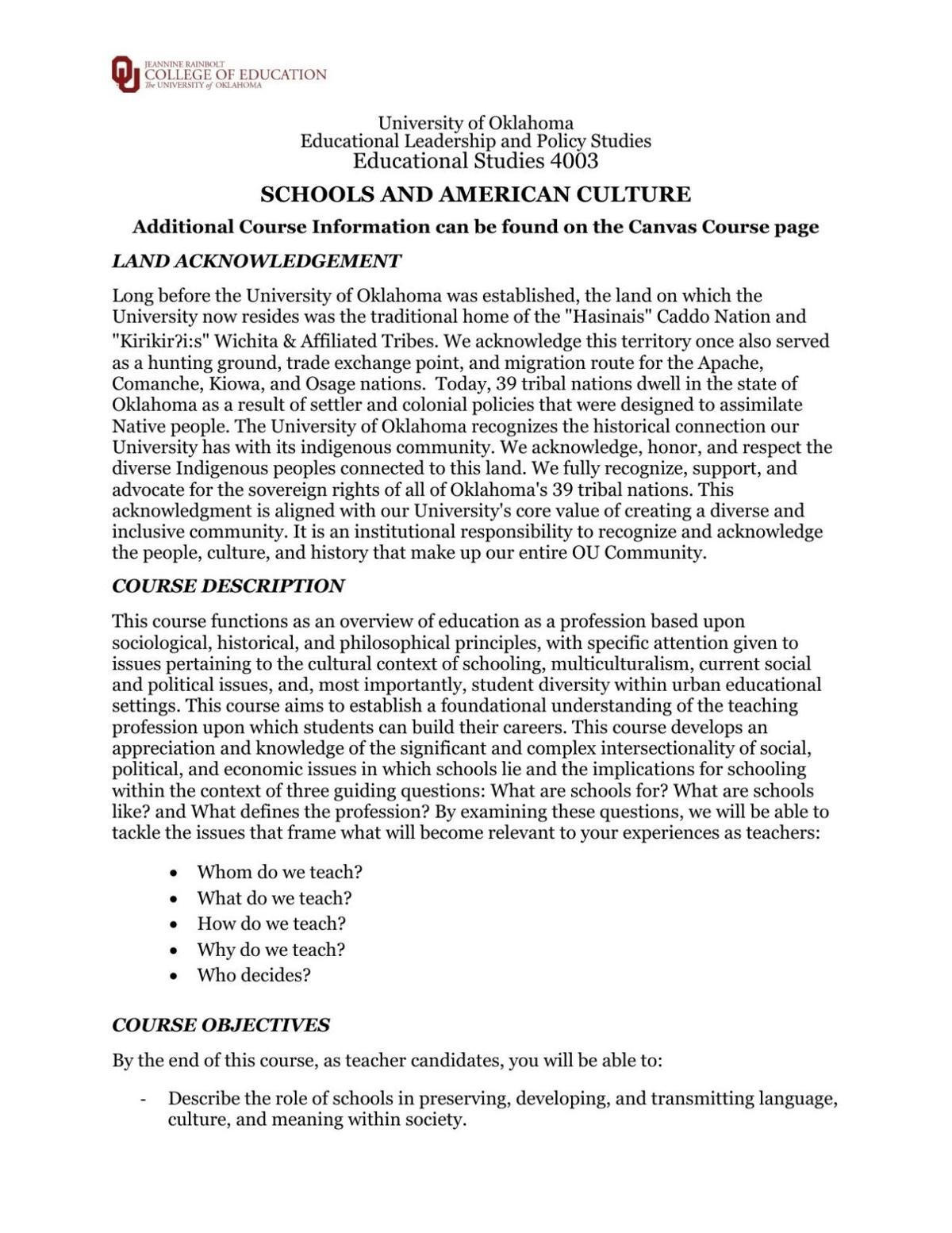
According to the syllabus’s course description, students will learn the intersectionality of social, political and economic issues that impact schools. Course objectives as listed in the syllabus are:
• Describe the role of schools in preserving, developing and transmitting language, culture and meaning within society.
• Critically reflect on personal biases and analyze how these biases can affect teaching practices and student interactions.
• Evaluate the relationship between schools, their communities and the larger society.
• Analyze how schools contribute to economic development and the preparation of students for the workforce, examining the interplay between economic and educational inequalities.
• Analyze how various student differences — such as race, gender, class, sexual orientation and ability — impact educational experiences.
• Identify and explain the sociopolitical powers, institutions and forces that shape and impact the content of school curricula and learning.
• Evaluate the importance of recognizing and responding to individual student differences and propose strategies for addressing diverse needs in the classroom.
• Evaluate the importance of teachers’ responding to individual student needs and how perceptions, attitudes and actions contribute to creating a welcoming and inclusive environment for all students.
• Investigate complex reasoning and nuanced understandings over curricular content and be prepared to discuss and strategize around the nature of these conflicts.
During the 16 weeks of instruction, topics taught include the historical foundations of public American education, critical whiteness in education, critical race theory in education, microaggressions in educational spaces, supporting diverse learners, 2SLGBTQ+ youth in schools and teaching in turbulent times.
The course addresses one standard of the National Council for Accreditation of Teacher Education, or NCATE: knowing the economic, social, political, legal and organizational foundations and functions of schools.
NCATE was founded as a nonprofit, non-governmental accrediting agency in 1954. In 2010, NCATE and the Teacher Education Accreditation Council agreed to establish a new accrediting body, the Council for the Accreditation of Educator Preparation, or CAEP.
In 2016, CAEP accreditation standards were fully implemented, and NCATE standards were no longer used for accreditation purposes.
“Candidates understand the intent of OU’s Mission Statement,” the syllabus reads. “Moreover, the candidates understand and respect individual differences, including those of culture, race, gender, religion, ethnicity, and sexual orientation, as well as individual commonalities, including those of heritage and environment. The candidates understand the role the teacher plays in promotion and achievement of social justice.”
OU’s mission statement states the university will provide the best educational experience for students through excellence in teaching, researching and creative activity in service to state and society.
One assignment, the social justice curriculum, instructs students to work in groups to create a curriculum that addresses a social justice issue using state-mandated content standards. The assignment includes a student-written reflection that should answer the questions, “Why is it important to embed social justice, equity and inclusivity into your K-12 classroom?” and “What issues do you imagine encountering when you bring these conversations into the curriculum?”
The Daily Caller argued that public school teachers in Oklahoma are prohibited under state law from teaching that “members of one race or sex cannot and should not attempt to treat others without respect to race or sex.” House Bill 1775, the law The Daily Caller is referencing, is under a partial preliminary injunction, meaning parts of the law cannot be enforced while litigation is pending.
In 2021, the American Civil Liberties Union, ACLU of Oklahoma, the Black Emergency Response Team, OU-AAUP and the Oklahoma chapter of the NAACP filed a lawsuit challenging HB 1775.
OU Daily reached out to all three instructors who teach the course in the fall 2024 semester for comment. Only one responded, who referred the Daily to OU Marketing and Communications.
In an email to OU Daily, OU Marketing and Communications wrote the course is structured to prepare future educators to teach in settings that reflect the students of Oklahoma.
OU Daily asked OU Marketing and Communications how the university has evaluated courses under Stitt’s executive order and if the Schools and American Culture course had been evaluated, but did not receive an answer.
“This course on education studies is designed for professional educators and teacher candidates and offers a comprehensive overview of the complex history of American education, including key court cases and educational theories. It is specifically constructed to prepare educators for the public school classroom in both rural and urban settings with students who reflect Oklahoma’s citizenry,” the email read.
That includes preparing these teachers with primary sources, facts, a broad analysis of perspectives and experiences, and the context to help them respond to challenging ideas with all the tools and resources they need to be effective in future classrooms.”
This story was edited by Anusha Fathepure, Ismael Lele and Ana Barboza. Mary Ann Livingood copy edited this story.


