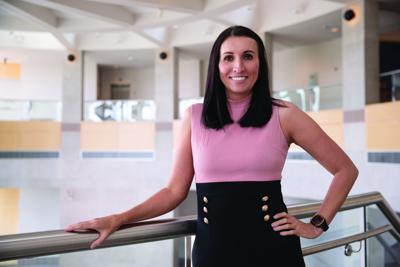

Elizabeth Foreman was always drawn to making a difference in the Norman community.
Foreman saw different opinions about city issues on social media and felt that local leaders were not listening, which prompted her to run for city council in 2019.
“If (I was) going to plant roots, I wanted it to be in a community that is supportive and listens to us,” Foreman said. “I just went in headfirst — I was sold.”
In 2020, Foreman won the Ward 6 seat, beating incumbent Bill Scanlon with 52.5% of the votes. Foreman was reelected in 2022, beating candidate Alexander Torvi with 53.5% of votes cast.
Norman Mayor Stephen Tyler Holman sat beside Foreman at the council dais for four years while serving as Ward 7 council member. Holman noted that Foreman often brought her daughter to council meetings after picking her up from school.
“It was important to Councilmember Foreman to set a good example for her daughter of being involved and participating in local government,” Holman said.
During Foreman’s first term as a council member, the country was grappling with the effects of the COVID-19 pandemic and a summer of Black Lives Matter protests following the in-custody death of George Floyd.
Foreman said it felt like the world was on fire.
Feeling pressure from all sides, Foreman said it took mental and emotional work to deal with the fallout from voters.
“People don't know who I am — they just know that I’m on city council and I'm the enemy,” Foreman said about her first term in office. “It was exhausting to stand apart from the rest of my council and be seen as an individual and not (as a) collective.”
In 2020, Foreman voted against cutting $865,000 in funding from the Norman Police Department’s proposed budget increase and reallocating the funds to a community outreach program. Council approved the reallocation and later reapproved it in 2021.
However, the council later voted to fund nine additional officer positions and provide extra funding for existing salary increases in 2022.
“That was a very divisive time for the city of Norman. It ripped us in two, …” Foreman said during a public forum in 2024. “When it came to refunding the police, I refunded the police.”
Even with hard or divisive decisions, Holman said that Foreman always firmly stood for what she believed in.
“She never shied away from explaining her votes, why she was going to vote for something or vote against it,” Holman said. “(She) made sure the public understood, even if they didn't agree with her, … and I think that's a good sign of a leader.”
Despite initial challenges, Foreman said she has no regrets about her time on city council.
“I would make those same votes again, even on the hard ones,” Foreman said. “I voted my conscience, and I'm proud of myself that I can walk away and say that I was never intimidated or pressured into voting one way or another.”
In 2023, Foreman announced she would not run for reelection to pursue new interests and career avenues.
Shifting from city to campus service
During her final year as a council member in 2024, Foreman turned her focus to running for the Oklahoma Senate. Though she lost to Republican candidate Lisa Standridge, Foreman said running for Senate felt like a dream come true.
“I was happy to talk to everyone, and everybody was really supportive,” Foreman said. “It didn't go in my favor, but I just knew that that was OK, the right thing was going to happen.”
Foreman said the loss made her think about returning to OU. Now, she works as the director of human relations and finance for the Sam Noble Museum of Natural History and serves on the OU Staff Senate.
The Staff Senate serves as the elected voice of OU’s employees, representing their interests and concerns across the university. Foreman, who applied for the role at the recommendation of Janet Braun, director of the Sam Noble Museum, said joining seemed like an obvious decision.
“It was just a no-brainer to want to do. I feel very pointed toward public service and serving people and getting to do that at the University of Oklahoma is just a win all around,” Foreman said. “Not to sound cheesy, but I really do love it.”
Fundraising and staff governance are main aims of the Staff Senate. Despite being a part of the Staff Senate for only a few months, Foreman said fundraising for the group is a struggle.
“There's funding issues across the board at the university, …” Foreman said. “I don't think it's unique to Staff Senate, but (we have to) make sure we're able to maintain the same level of experience for staff, and then try to improve.”
Foreman is the chair of an ad hoc committee for fundraising and development. Foreman said she is also a member of the Policy Review Committee. Drawing on her experience fundraising as a council member, Foreman said she intends to organize events such as a 5K race to raise money for the Staff Senate.
From a university employee’s perspective, Foreman said it can be a scary time to navigate university politics with intense scrutiny of education on a state and federal level.
In September, OU Daily reported the Division of Access and Opportunity sent a memo on the first day of classes to OU deans, directors and department chairs advising instructors to avoid course content that could fall under diversity, equity and inclusion.
Belinda Higgs Hyppolite, vice president for Access and Opportunity, wrote in the email that as federal and state interventions shape the approach to course content in higher education, faculty members should be cautious in how they teach material related to race and gender.
“Courses must avoid methods that could be construed as discriminatory or hostile,” the email reads. “For example, privilege walks, race- or sex-based assignments, or requiring students to affirm certain beliefs may trigger enforcement action.”
This follows Gov. Kevin Stitt’s executive order issued in 2023 banning DEI in Oklahoma higher education. The move prompted the Office of the President to release guidelines for how OU planned to comply with the order, answering questions about how it may impact the university.
In the first days of his second term, President Donald Trump issued a series of executive orders targeting DEI in higher education. Trump has also filed lawsuits and threatened to cut funding from universities relating to DEI in academic curricula.
“Universities are in a really difficult position, and they're having to make these hard decisions,” Foreman said. “Just like on (city) council, on the surface something might seem very obvious … (but) you have to weigh the stuff that usually people don't consider. Could we lose our funding? Would we close?”
Though she is involved in university politics, Foreman said she does not want to re-enter the sphere of city politics, jokingly dubbing herself a “recovering council member.” Still driven by a duty to public service, Foreman said the experience forged something within her.
“It's made me stronger and much wiser on how to approach things, and (taught me) how to be effective at communicating and negotiating,” Foreman said. “When you have those skill sets, you can't help but want to use them.”
This story was edited by Ana Barboza, Anusha Fathepure and Thomas Pablo. Larkin Bock and Mary Ann Livingood copy edited this story.


