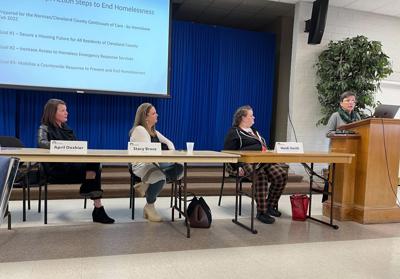

The First Presbyterian Church Norman and the Xenia Institute for Social Justice hosted a panel Sunday to increase awareness of homelessness and encourage the Norman community to start conversations, advocate and volunteer.
Panelists included Heidi Smith, Stacy Bruce, April Doshier and Lee Hall who all spoke about their experiences working with homelessness in Norman.
The discussion opened with remarks from David Spain, president of the Xenia Institute, who spoke about the importance of civil discourse. He said the purpose of panels like Sunday’s are so everyone can listen to the concerns of Norman residents and gain insight.
“We don’t want to shoot salvos at each others, we want to hear each other,” Spain said.
Carol Waters, First Presbyterian Church’s pastor for faith formation, acted as a moderator for the event.
Smith, operations managers at Thunderbird Clubhouse, a community to support people recovering from mental illness, spoke on behalf of the Cleveland County Continuum of Care, which the Thunderbird Clubhouse has been the collaborative applicant of since 2022.
The Continuum of Care program promotes communitywide engagement to end homelessness through funding, state and local governments involvement and supportive services.
Bruce, executive director for Bridges of Norman, an organization dedicated to empowering high school students facing housing insecurity, spoke about the necessity of helping youth succeed throughout homelessness.
Bruce emphasized the importance of education in breaking generational poverty cycles.
“If you don't know where you're going to put your head at night, you're not worried about your English paper or your math test or your history assignment, so we really want to help students find safe, supportive and stable housing while they're working on their high school education,” Bruce said.
According to Bruce, the teenagers Bridges sees are experiencing homelessness because of factors like child neglect, family homelessness and lack of acceptance of gender or sexual identity.
Doshier, executive director of Food and Shelter, spoke about misinformation surrounding homelessness.
It is important to understand that homelessness is a spectrum, Bruce said.
“If we believe that homelessness is a choice, then we perpetuate that idea throughout our community because it helps us to justify our inaction. It justifies our ability to turn away from making big investments in people’s opportunities,” Bruce said.
Hall, a former Ward 4 Norman City Council member, spoke about her time on council and addressing homelessness in Norman.
Hall emphasized the lack of affordable housing options for some of the most vulnerable members of the community as developers create more student housing and businesses.
Last month, the Norman City Council voted to replace the OU Motel with a new student housing complex. The OU Motel has long served as an affordable housing complex in Norman.
During a city council meeting last October, Ward 4 Councilmember Helen Grant said 15 percent of Norman homeowners spent over 30 percent of their income on rent.
In July last year, a Norman homeless encampment in University North Park was driven out to develop a shopping and dining area with little notice. Sean Rieger, the representative of the applicate Subtext Acquisitions LLC, said the decision was partly made as a possible need for increased housing options as OU transitions to the Southeastern Conference in 2024.
Barbara McEndree, a landlord that rents to Section 8 housing, which provides low-income, disabled and elderly people with safe housing, asked the panel about her difficulties with case management. McEndree cited one specific situation involving a tenant with a mental illness.
The panel advised her that preventative measures she can take before renting is working directly with agencies like Food and Shelter or Thunderbird Clubhouse for case management.
Another audience member asked if raising the minimum wage might help decrease homelessness.
Doshier said raising the minimum wage is neccessary so citizens can maintain a normal standard of living. Oklahoma’s current minimum wage is $7.25 per hour, but according to Masschusetts Institute of Technology’s Living Wage Calculator, a liveable wage in Oklahoma for an adult with no children in $15.49.
“We have to close the gap between what it costs to live and how much money people make,” Doshier said.
The event concluded with Waters requesting the audience make a commitment to help ease the burden of homelessness for others.
“If there's one takeaway that you go away with today is how important it is for us as the community, all of us, our elected officials, our nonprofits, our community, compassionate, caring people, like all of you, we have to solve this problem,” Hall said. “This is immediate. It was yesterday. It's today. It's tomorrow."
This story was edited by Alexia Aston and Karoline Leonard.


