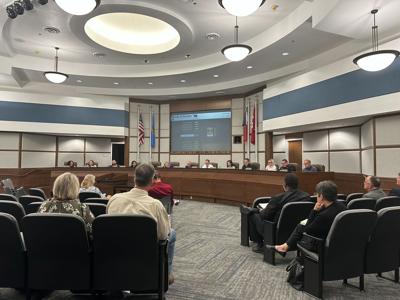

The Norman City Council held a town hall meeting on Wednesday to discuss affordable housing in Norman.
Affordable housing is defined as paying no more than 30 percent of income on housing. In 2021, Norman’s average median income for a family of four is $73,200. For a single person, the median income is $53,000, according to the slideshow provided by Grants Manager Lisa Krieg and Executive Director of Norman Housing Authority Karen Canavan at the meeting.
Ward 4 Councilmember Helen Grant, who hosted the town hall, said 46.92 percent of Norman renters who are of low or moderate income are cost-burdened because they are paying 30 percent or more of their income on rent. They said 15 percent of homeowners are spending more than 30 percent of their income on rent, according to the slideshow.
“If you’re spending more than 30 percent of your income on housing, you’re not spending … the old, usual and customary amount of your income on consumables, those things that generate sales tax that help support the city’s general fund,” City Manager Darrel Pyle said.
Norman is about 9,000 affordable housing units short of the demand, Pyle said.
There are 44,915 households in Norman, 19,215 of which are at or below 80 percent of the area's median income, which would qualify them for affordable housing, Pyle said.
Pyle said 55.8 percent of the households are owner occupied, 44.2 percent are renter occupied, while 15 percent of owners with a mortgage pay 30 percent or more of their income, according to the slideshow.
The wage required to rent a fair market two-bedroom apartment in Cleveland County without being cost-burdened is $16.37 an hour, according to the slideshow. For someone making the Oklahoma minimum wage of $7.25 an hour, they would need two or three jobs to afford housing, Pyle said.
Pyle said federal funds and capital investments may keep the cost of housing down. The American Association of Retired Persons delivered funds to Norman for investing in affordable housing, and $6.4 million of that funding is prioritized by the council for affordable housing.
“(Affordable housing) helps you to actually participate in all the things society has to offer here in Norman … if you're not spending more than 30 percent of income just keeping the roof over your head,” Pyle said.
The Norman Housing Authority has 173 public housing units, and a program consisting of scatter sights, which are family unit duplexes throughout Norman, Canavan said.
Norman Housing Authority has 1,203 regular vouchers and 30 emergency housing vouchers, which are typically used for individuals experiencing homelessness. The vouchers allow the Norman Housing Authority to pay the remainder of rent for those people, Canavan said.
The Section 8 voucher program allows clients to receive eligibility to become a voucher holder before they take the paper to the property owner and ask to lease the property, Canavan said.
“Affordable housing houses people who have jobs, and they house homeless people too, because sometimes that homeless person now has a job, and they can afford to rent a unit,” Canavan said. “It concerns me whenever we attach the stigma of this person being homeless … When someone’s housed, they’re not homeless. We’re talking about affordable housing, and it is for a broad category of individuals.”
Affordable housing developer Richard McKown said the need for affordable housing is overwhelming and absolutely tremendous. Roughly 6,000 individuals under the age 18 are housing unstable between Oklahoma City Public Schools and Putnam City Public Schools.
McKown said if Norman holds on to inherited rules of housing from the past, there will continue to be an extreme separation of incomes that won’t allow an integrated community with true diversity of housing sizes and incomes.
“What happened over the last two years drastically changed the way that people buy (homes),” local realtor Shavonne Evans said. “These same people have so much less buying power today, which makes things much less affordable.”
Nonprofit financial consultant Heidi Smith said affordable housing needs to be paid for because Norman taxpayers will be paying for individuals experiencing homelessness regardless through medical costs, police involvement and the city’s cleaning encampments.
Ward 7 Councilmember Stephen Holman said he’d like to make property owners more comfortable with accepting the Section 8 voucher system.
Canavan said there may be a mitigation fund that would incentivize property owners to accept the Section 8 voucher system.
McKown said part of the housing crisis is due to the generation of millennials all turning 33 years old within the next three years, which reflects when the generation of Baby Boomers started buying houses in the 1970’s. Millennials are the biggest generation since the Baby Boomers.
“Let’s be the research innovative hub that Norman is known for,” McKown said.


