
Overturning Roe v. Wade puts at risk privacy and personal autonomy rights recognized by the U.S. Supreme Court over the past 50 years, according to an OU law professor, including more recent rights such as same-sex marriage and 2SLGBTQ+ health care.
Conversations regarding protections for same-sex marriage resurfaced the day Roe v. Wade was overruled June 24 when U.S. Supreme Court Justice Clarence Thomas wrote a concurring opinion arguing that the Supreme Court “should reconsider” its past rulings codifying rights to same-sex relationships, same-sex marriage and contraception.
At OU, student leaders like Zack Lissau, president of the Student Government Association, said the Dobbs v. Jackson decision, which determined the U.S. Constitution does not protect the right to an abortion, should be a “wake-up call” for young people in the United States to vote. A spokesperson for OU's Students for Reproductive Justice said this is “a time of anger and mourning” and the decision is “dehumanizing.”
“Our understanding of what freedom is … evolves as we grow and mature as a society. We can learn from history, but we shouldn't be bound by history, and we certainly shouldn't repeat the mistakes of history,” OU Law professor Joseph Thai said.
The history and tradition test

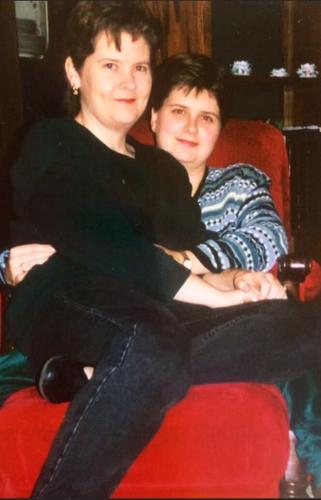
Sharon and Mary Bishop-Baldwin’s first photo together in 1996. Photo provided by Sharon and Mary Bishop-Baldwin.
Thomas' opinion is rooted in a reading of the U.S. Constitution that would protect only those liberties deeply rooted in U.S. history, Thai said.
He said the court is backpedaling to the 18th and 19th centuries to evaluate which rights were recognized. This history and tradition test benefits only a very privileged, narrow and undemocratic group of people: white American men, Thai said.
This interpretation of the Constitution could roll back some rights that have been shared by all in recent decades, Thai said, like abortion, interracial marriage, contraception and same-sex marriage.
In an article from Bloomberg Law, George Washington law professor Robert Tuttle warned against looking solely to history to provide answers to “the most consequential questions of the day.” The history-and-tradition test is “entirely ambiguous” and is “easily manipulated by judges to foster their own agenda.”
Thai said society tends to put the Supreme Court on a pedestal in modern times. He said people think the court is the protector of rights and the guarantor of equality.
“What we're seeing really is what the Supreme Court has been for a lot of its history. It’s not been a progressive institution, it's been a regressive institution,” Thai said.
Overturning Obergefell
Same-sex marriage became legal in Oklahoma on Oct. 6, 2014, when the 10th U.S. Circuit of Appeals lifted its stay on same-sex marriage — about one year before the Supreme Court legalized same-sex marriage in the Obergefell v. Hodges case.
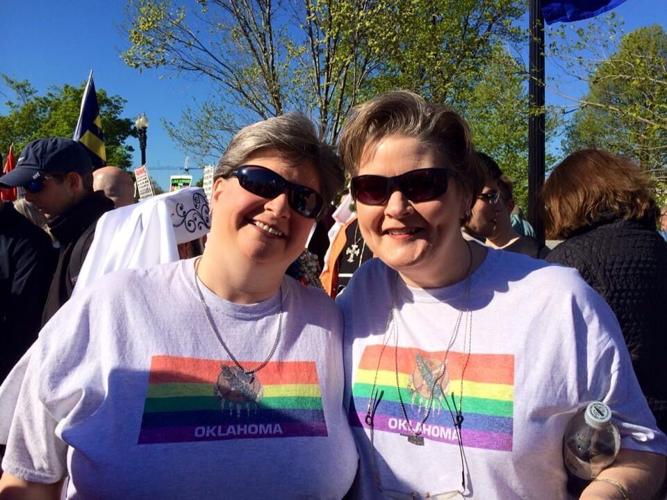
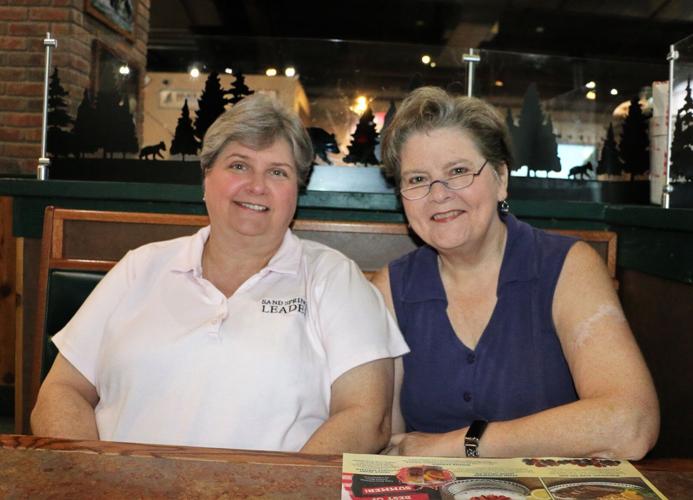
Sharon and Mary Bishop-Baldwin, the state’s first same-sex couple to receive their marriage license, recounted their decade-long fight to marry nearly eight years after it was legal for them to do so in Oklahoma.
Sharon, a 1992 OU alumna, and Mary began their lawsuit against Oklahoma in November 2004. In January 2005, federal district Judge Terence Kern ruled Oklahoma’s ban on same-sex marriage unconstitutional, but the ruling had been stayed, meaning Oklahoma couples couldn’t get married, pending ruling from a higher court.
It wasn’t until 10 years later, on Oct. 6, that Sharon and Mary became the first same-sex couple in Oklahoma to receive a marriage license when the 10th U.S. Circuit of Appeals lifted its stay. The couple married the same day.
“We spent $1,300 to (get married). (We got) all of the rights out of that documentation for $50 in a marriage license,” Sharon said. “We spent $1,250 more than we should have had to spend to get all of those legal rights.”
Thai, who served on the legal team of the Bishop-Baldwin suit, said while Thomas’ opinion this past summer would target couples like Sharon and Mary’s ability to legally marry, he’s unsure if there are five votes on the current court to overturn Obergefell.
But the possibility frightens him.
“Even if there aren’t five votes, I think that cloud of uncertainty is not something that married couples should live with or that unmarried LGBTQIA people should live with,” Thai said. “(They’re) wondering whether someday their right to marry the person they love may be taken away from them, just like abortion was the rug pulled from under their feet.”
Although Mary said she and her wife will resume their fight for marriage equality if necessary, Sharon said they thought they were done fighting in their older years.
“We're not gonna stand back and let them take this right away that we, and so many others, have worked so hard and so long for,” Mary said.
“They're not taking my marriage unless it’s from my cold, dead hands,” Sharon said.
Health care access
At least 43 abortion clinics in the U.S. have shut down after Roe v. Wade was overturned, according to a study by the Guttmacher Institute. The closures are concentrated in the South and Midwest, where states have banned or restricted abortion access.
Alabama, Arkansas, Mississippi, Missouri, Oklahoma, South Dakota and Texas have enacted complete bans on abortion, and Georgia, Ohio, South Carolina and Tennessee have implemented restrictions on abortion after about six weeks of pregnancy.
Collectively, the 11 states had 71 abortion clinics. Now, only 28 remain, according to the study.
If these health clinics are forced to close, services like sex education, birth control and gender-affirming treatments will also be lost, said Michael Robertson, president of the Norman PFLAG chapter.
Gender-affirming care consists of medical, surgical, mental health and non-medical services for transgender and nonbinary people, according to the Office of Population Affairs.
For transgender and nonbinary children and adolescents, early gender-affirming care is crucial to overall health and well-being, as it allows the child or adolescent to focus on social transitions and can increase their confidence while navigating the healthcare system, according to the office.
An analysis by the Human Rights Campaign released in June found that 39 percent of lesbian people were more likely to have experienced an unwanted pregnancy, compared to 27 percent of heterosexual women and 29 percent of bisexual women.
A 2019 study conducted by the Harvard T.H. Chan School of Public Health found that bisexual women were three times more likely than heterosexual women to have had an abortion.
Another 2019 study in California found that over one-third of transgender, nonbinary and gender non-conforming people who had been pregnant considered ending the pregnancy on their own without clinical supervision due to a lack of insurance coverage and affirming health care.
Norman PFLAG hosts a support and social meeting every Tuesday, Robertson said, which typically attracted about 10 to15 people. Now, meeting attendance has doubled because people are scared.
“It felt like we were finally getting past the barriers of health care. We were finding medical facilities that were accepting the community. We were adding those resources to our website and we still are. … It's frustrating that we're now having to face this issue,” Robertson said.
2SLGBTQ+ in the Legislature
Oklahoma has faced a recent uptick in anti-2SLGBTQ+ legislation, including Senate Bill 2, which prevents trans girls and women from joining women’s sports teams at public K-12 schools and universities, and Senate Bill 615, which requires restrooms or changing areas in schools to be used by individuals based on their assigned sex at birth.
Members of the 2SLGBTQ+ community’s fears stemming from Roe v. Wade are exacerbated by these recent bills, Robertson said.
“I think Roe v. Wade just made an even bigger impact on top of the other local legislation because it's not just happening on a state level that we typically see in a conservative state like Oklahoma,” Robertson said. “Now, we're seeing it on a national level.”
Nicole McAfee, the executive director of 2SLGBTQ+ advocacy group Freedom Oklahoma, said they believe Oklahoma’s lack of 2SLGBTQ+ legislators causes compounding harm to the community, including the recent policies aimed at the 2SLGBTQ+ people.
They said the Legislature doesn't have anywhere near the amount of 2SLGBTQ+ lawmakers representing the full spectrum of gender and sexuality that exists in Oklahoma.
“It’s really hard to talk to a lot of (legislators) about the impact of any of these decisions on our (2SLGBTQ+) community when so few of them are in the community,” McAfee said.
According to Victory Institute, the U.S. Congress has 11 out members from the 2SLGBTQ+ community, and 15 more would need to be elected to achieve equitable representation. There are also 189 out state legislators who identify as 2SLGBTQ+ but voters would need to elect 224 more for equitable representation.
There are only two out 2SLGBTQ+ Oklahoma legislators, or 1.3 percent, representing the 3.8 percent of adults in the state who identify as 2SLGBTQ+.
One of those legislators, Oklahoma District 88 Rep. Mauree Turner (D-Oklahoma City), is Oklahoma’s first nonbinary and first Muslim legislator. Turner said they entered the position aiming to address the issue of systemically underrepresented Oklahomans being ignored by the Legislature.
The other, Senate Minority Leader Kay Floyd (D-Oklahoma City), is the first lesbian to serve in the Oklahoma Legislature.
The misconception that Oklahoma doesn’t have a big 2SLGBTQ+ community is partially due to its members feeling unsafe in the state, McAfee said.
“They have built these bubbles away from our community that have always existed here, and it still exists here in our region in resilient ways all across the state in our rural communities, in Indian Country and in our metro areas,” McAfee said.
Moving forward
When Roe v. Wade was overturned, debates arose surrounding the language used in conversations on abortion and reproductive health care. Organizations like the Centers for Disease Control and Prevention, the Cleveland Clinic and the American Cancer Society have moved from language solely referencing cisgender women to including everyone who can become pregnant.
McAfee said the transition isn’t an attempt to be inclusive, its intent is to be accurate.
They said the recent push around accurate language is to better reflect the reality that people all across the gender identity spectrum are impacted by the lack of access to abortion care.
“It's important that we're … opening a broader spectrum of people's eyes to all of the different folks who are impacted by any of these decisions, McAfee said. “I think it starts with the discourse around, ‘Where else are we leaving folks out? How are we not thinking about people who we've excluded because of language in the past?’ I think that the accuracy of that more inclusive language is critical.”
Sharon said the 2SLGBTQ+ community is standing on the shoulders of 2SLGBTQ+ rights pioneers like Harvey Milk, the first openly gay man to be elected to public office in California, and gay liberation activist Marsha P. Johnson.
As a pioneer in modern times, Sharon offered her shoulders to the younger generation of 2SLGBTQ+ activists who she said too often face attacks on their civil rights.
“I am proud that I'm somewhere on that pyramid of people standing on the shoulders of other people,” Sharon said. “I'm glad I didn't sit back and hide when I had the choice to hide or fight, and I'm always going to be proud of the people who stick their necks out.”


