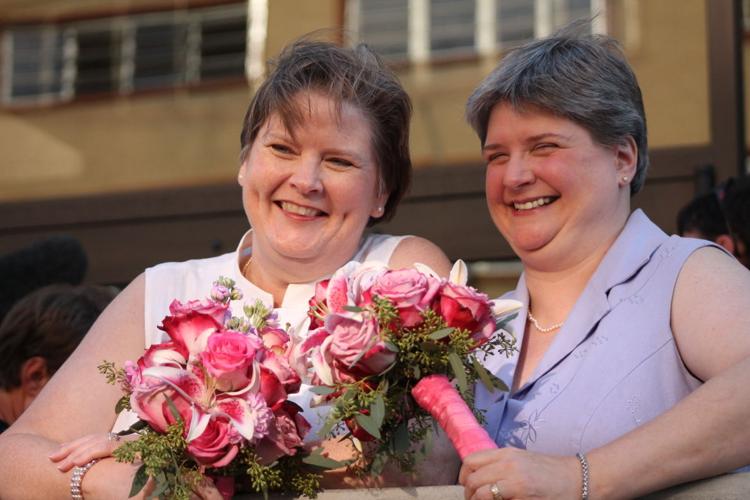


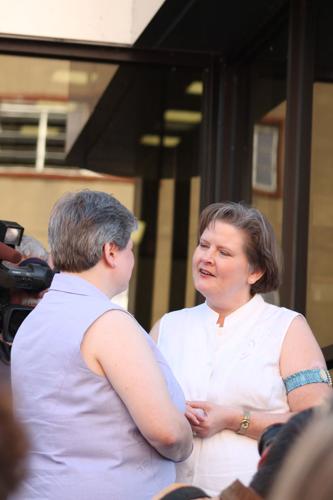


TULSA — After a decade-long suit, Sharon Baldwin and her partner — now wife — Mary Bishop became the first same-sex couple in Oklahoma to get a marriage license at the Tulsa County courthouse Monday. But Baldwin’s LGBT activism didn’t begin when she sued the state for her right to marry. It all started at OU after she and a few of her friends were kicked out of a bar on ladies' night.
Baldwin, an OU alumna who graduated in 1992, was a member of the campus’s gay student group. She started attending meetings, and one night she and a few other women, all of whom were lesbians, decided to visit a bar across the street from the meeting and south of Oklahoma Memorial Stadium, for ladies' night.
“The owner decided that we weren’t the type of ladies that she was trying to get in with that promotion, so she kicked us out,” Baldwin said.
The group responded with protests and picket lines.
“If you want to talk about the genesis of my activism, that was really a great experience in terms of saying, you know, you don’t have to treat me this way. So yeah, OU was a pretty special place in terms of my development as a lesbian, if you will,” Baldwin said.
Baldwin and Bishop, alongside Gay Phillips and Susan Barton, began their lawsuit against Oklahoma in November 2004. In January, federal district Judge Terence Kern ruled Oklahoma’s ban on same-sex marriage unconstitutional, but the ruling had been stayed — meaning Oklahoma couples couldn’t get married — pending ruling from a higher court.
The 10th U.S. Circuit of Appeals lifted its stay on same-sex marriage a little before noon Monday, shortly after the U.S. Supreme Court denied appeals from five states — including Oklahoma — that would prohibit same-sex marriages. Since the federal appeals court lifted the stay, Oklahoma same-sex couples, like Baldwin and Bishop, can get married, and that’s just what Baldwin and Bishop did.
Bishop said when she woke up Monday morning, she wasn’t expecting to marry Baldwin until at least June because she assumed the U.S. Supreme Court would choose to hear one of the same-sex marriage cases and prolong her wait. Bishop said the couple hadn’t even picked out clothes to wear to their wedding.
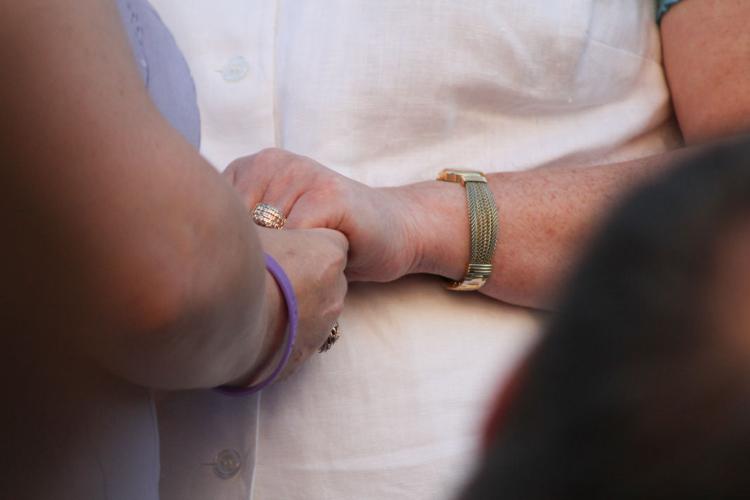
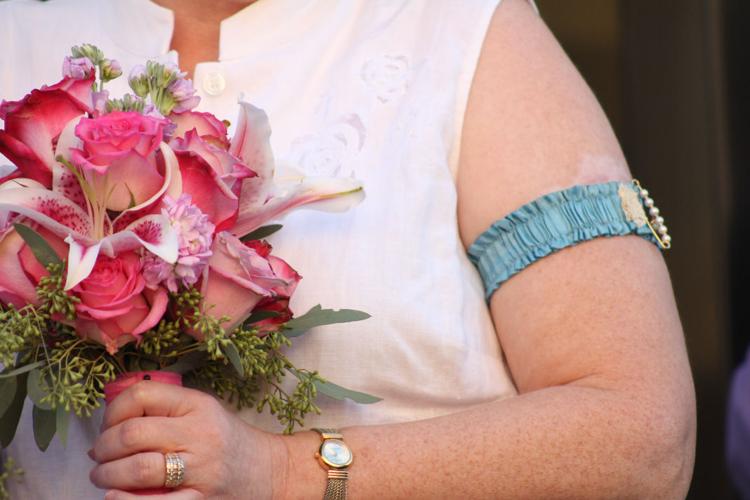
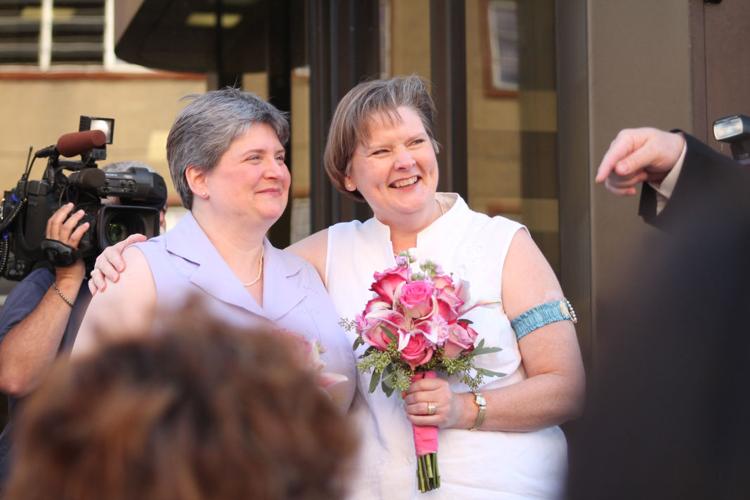
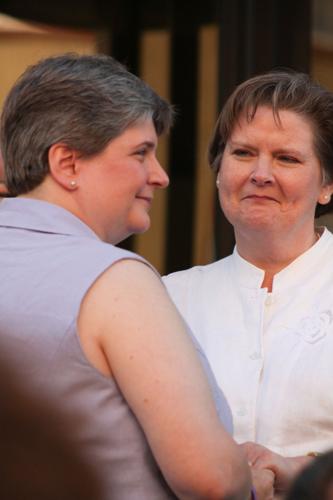
Despite the lack of planning, the couple was married Monday, wearing clothes they picked out from their closets and their mothers’ pearls. Bishop wore a garter that her mother wore on her wedding day.
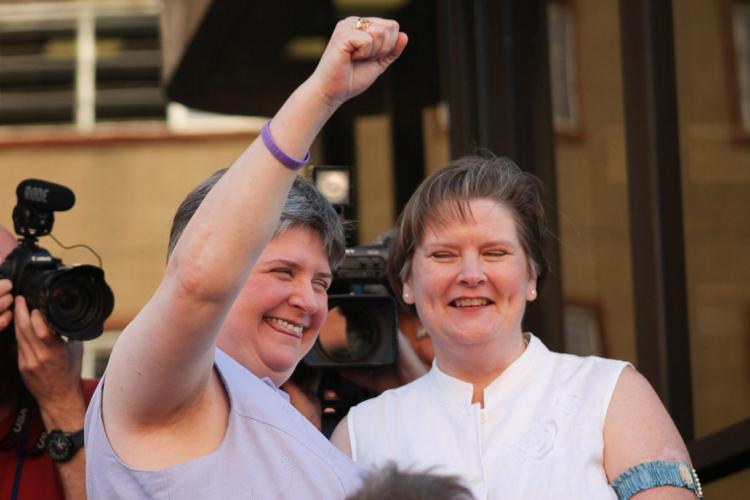
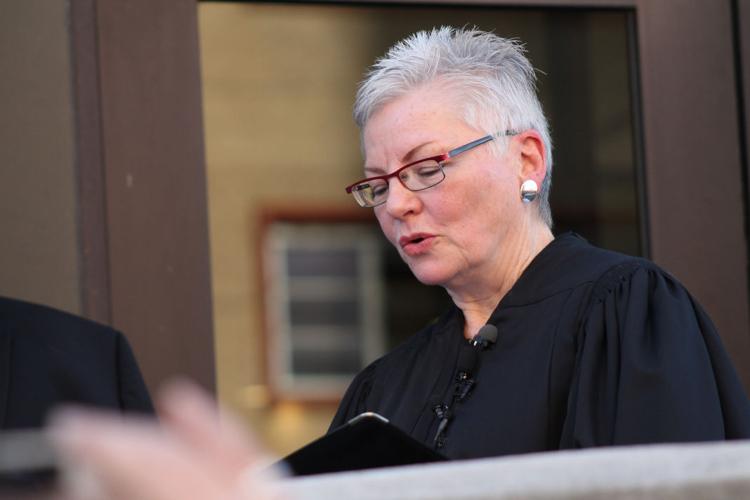
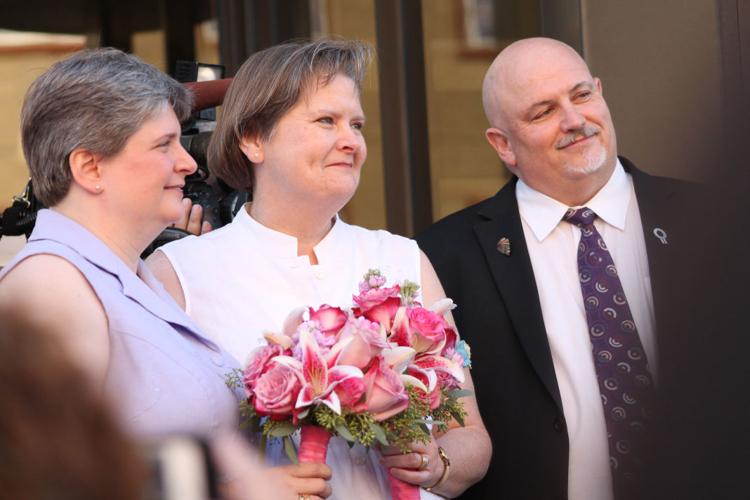
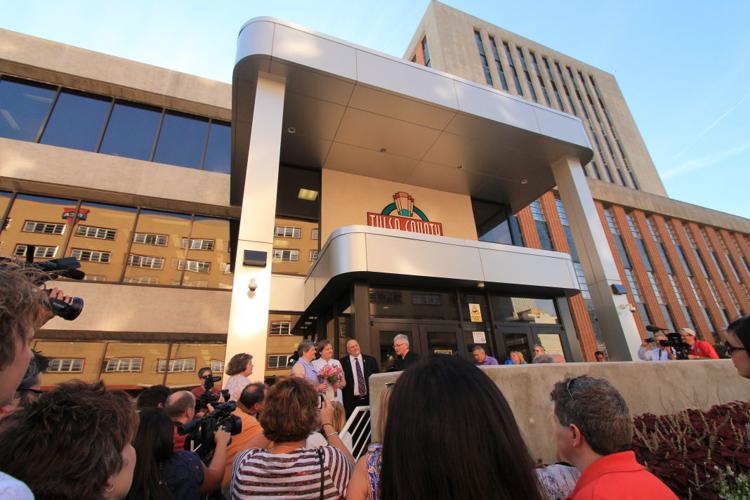
The ceremony began on the sidewalk outside the Tulsa County Courthouse among a gaggle of media and other couples who had come to get their marriage licenses. The marriage was officiated by Jane Wiseman, an Oklahoma Court of Civil Appeals judge.
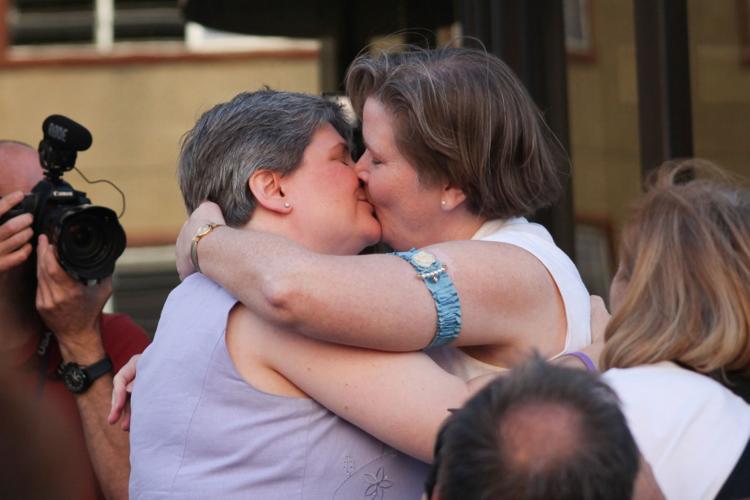
As the ceremony ended and the two were officially announced spouses, Baldwin fist pumped in the air. Then she and Bishop kissed and embraced for several seconds before finally turning to the crowd. Each had tears in their eyes.
After the wedding, Toby Jenkins, executive director of the Dennis R Neill Equality Center in Tulsa, said, “It’s a great day to be gay in Oklahoma.”
Bishop said she hadn’t had much time to gauge public reaction to the federal district court lifting its stay on same-sex marriage, but that she had seen a statement from Oklahoma Governor Mary Fallin.
Fallin’s statement said the U.S. Supreme Court’s decision to reject the state's appeal of the ruling striking down the Oklahoma constitutional provision that defines marriages as between a man and a woman — thus effectively making same-sex marriage legal in Oklahoma — was undemocratic and a violation of states’ rights.
“Today’s decision has been cast by the media as a victory for gay rights. What has been ignored, however, is the right of Oklahomans — and Americans in every state — to write their own laws and govern themselves as they see fit,” Fallin said in the statement.
Bishop and Baldwin, despite being happy about their marriage, are ultimately unhappy with the Supreme Court’s decision, too — but for a different reason.
Baldwin said her main concern with the court's decision to not rule on her case is that there isn't a cohesive ruling on same-sex marriage throughout the country, meaning other states won't be required to honor her Oklahoma marriage once she’s married.
"So, we cross the border into Missouri, we’re suddenly not married, and that’s just not good," Baldwin said. "That’s not good for anybody."
Of the six states currently bordering Oklahoma — Colorado, New Mexico, Kansas, Arkansas, Missouri and Texas — only three recognize same-sex marriage. Those states are Colorado, New Mexico and Kansas.
Baldwin’s activism journey started at OU, and she, Bishop, Phillips, Barton and members of their legal team visited campus Friday to discuss their case.
Baldwin said the event had a good turnout and students’ questions and responses were indicative of society’s changing attitudes toward same-sex marriage.
“You know, the attitude from 2004 has really shifted. Public sentiment is just so far ahead of where it was a decade ago, and we see that in everything from comments on news stories, to just people’s reactions to us,” Baldwin said. “It’s light years different.”