
Mauree Turner was around 7 years old when they first sat at a community roundtable.
The table wasn’t actually round. It was a long, white, folding table common at company picnics or school cafeterias. Turner had practically begged to join their mother at the meeting in their hometown of Ardmore around 1999.
That roundtable discussion was Turner’s first exposure to the 2SLGBTQ+ community. The conversation focused on ways to prevent the spread of HIV and support those who had contracted it or developed AIDS.
Just a couple years prior, HIV/AIDS had been declared the leading cause of death among people ages 25-44 by the U.S. Department of Health and Human Services. In that age group, HIV/AIDS remained the leading cause of death for African Americans.
The epidemic — which has taken the lives of 36.3 million people according to the World Health Organization — was what brought Turner to that rectangular roundtable. It introduced Turner to not just the 2SLGBTQ+ world, but the practice of community organization and action.
“I guess it all started there, in a way,” Turner said.
Turner — Oklahoma’s first nonbinary and first Muslim legislator — continued their involvement with the community long after that meeting. Today, they represent District 88, an area largely between Interstates 44 and 235 north of downtown Oklahoma City, in the State House of Representatives. That position was not their original plan, though.
For as long as Turner could remember, their mom had been attending community meetings. Most of the time, Turner said they would stay with their grandmother during those hours, as their family couldn’t afford a paid babysitter.
Some nights, Turner said they just wanted to spend time with their mom, even if it meant sitting through a meeting most first graders would find stuffy and boring. They tried to carefully follow the conversation, asking their mom questions afterward if they were confused.
They would ask simple questions, like what some new words meant. They would ask more complicated ones, like how someone contracts HIV/AIDS. They would ask hard questions, like how many people died from the disease. Their mom gave them as many answers as she could.
“Radicalization came really early on in life,” Turner said. “It didn’t make me the most popular kid on the playground.”
As Turner grew up, they worked to figure out who they were and who they wanted to be. Like most kids, Turner struggled with what career path they wanted. Were they going to be a doctor? A teacher? An astronaut? All of the above?
Even after graduating high school, they weren’t entirely sure of their path. They enrolled at Oklahoma State University, taking general education classes while trying out various electives.
It was at a predominately white institution their background in community organizing and advocating came into play. Turner found themself pushing back against the school’s administration, feeling like the university didn’t understand the need to work more intentionally to retain students of color.
According to the Integrated Postsecondary Education Data System, in 2014, only 46 percent of OSU’s African American students graduated within six years of beginning their full-time program. Meanwhile, 67 percent of OSU’s white students graduated within that same time.
“It felt like I had to be an activist,” Turner said. “No one can advocate for you like you.”
Turner found themself going further down the path of activism, becoming the regional field director for the Campaign for Smart Justice of the ACLU and working with the NAACP of Oklahoma.
While at the ACLU, Turner convinced themself they’d never run for public office. They insisted that “people at the capital make policies about us but will never have to live on the other side of it.” Turner felt they would be able to find better solutions if they stayed close to the issues.
“Also, Oklahoma politics are just messy,” Turner said.
Despite Turner’s concerns about Oklahoma’s political landscape, they found themself running for the state legislature in 2020.
The decision came after months of prodding from friends and peers. Turner ultimately felt it was their duty to represent the people they care about.
“When people ask you to show up, you do,” Turner said. “I also have a really bad problem (with) saying no.”
‘Here we go’
In July 2020, Turner won the Democratic primary race for District 88, unseating incumbent Jason Dunnington by 250 votes. On Nov. 3, Turner won the seat and officially became the first nonbinary legislator in the U.S.
Turner said they entered the position aiming to address the issue of systemically underrepresented Oklahomans being ignored by the legislature. They wanted to address dozens of policies, ranging from nonbinary gender markers to economic equality among people of color.
Despite their progress, their seat at the state’s roundtable posed some personal challenges.
It wasn’t all bad, especially in the beginning, they said. During freshmen orientation, they were standing in an elevator with a fellow legislator. Turner believes he was at least 65, though they did not share the name of the lawmaker. At first, the silence was awkward. Bad elevator music rang through the small space as the pair waited patiently for their stop.
Then, the man looked at Turner and asked, “So, you said something about pronouns?”
Turner froze, thinking, “Oh, here we go.”
Despite their fears, Turner said they ended up having a pleasant conversation with the man. He asked about how to refer to them appropriately, even requesting that they correct him if he ever messed up.
Turner’s mind was blown. In just a few short minutes, they had found an ally where they didn’t expect one. They had been expecting excuses from the other legislators, claiming age, habit or the culture they grew up in.
“This is how I know people get it,” Turner said. “This is how I know those excuses aren’t real.”
Still, it wasn’t perfect. There are plenty of times they have been misgendered when they go into the office, sometimes mockingly. Many of their coworkers have spoken publicly about how they believe transgender and nonbinary people are mentally unstable.
“Sometimes, I’m just like, ‘Oh, you are bold to say that out loud,’” Turner said.
Turner says they cope with such words and actions in a variety of ways, mostly relying on their support system in and outside of the legislature. Rep. Emily Virgin, the Democratic minority leader representing the Norman area, said she hopes colleagues who “cling to traditional values” don’t push Turner away from the House.
“They are wise beyond their years,” Virgin said. “They’ve lived a lot of life, and that makes them vital to our legislature.”
Progress
In Turner’s first term, they’ve sat in on dozens of interim studies, submitting many of their own to be discussed. As of December, they authored 14 measures in 2021 to be considered by the legislature. There has been some progress with their goals.
In October, the Oklahoma Department of Health came to an agreement with nonbinary Oklahoman Kit Lorelied to allow its residents to replace their gender marker with an “X” on their birth certificate if they are nonbinary. It was considered a welcome change among the 2SLGBTQ+ community in the state.
That progress didn’t last long. A few weeks later, Gov. Kevin Stitt issued an executive order to stop the change. Suddenly, adjustments to birth certificates were halted and nonbinary residents were left wondering if they would get the gender-affirming status on their documents at all.
Turner responded on Twitter, writing they didn’t “expect anything less from” the legislators who supported the governor’s executive order.
Megan Sibbett, an assistant professor in OU’s department of women and gender studies, explained why representatives like Turner are important to the battle for policies related to the 2SLGBTQ+ community.
“Marriage equality wasn’t the end all, be all,” Sibbett said. “There’s plenty of work to be done.”
Even in the House, Turner faces a fight to be seen and recognized in the most basic ways. Virgin explained how the House has a dress code for men and women, stating that both should dress in “professional business attire” without defining what that is. There is no rule for how someone outside of the gender binary should dress.
“It’s a little bit silly to have a dress code as an adult,” Virgin said. “Not to mention the fact that it’s almost an attack on the community (Turner) belongs to.”
Turner and Virgin have worked to update the policy but have found plenty of resistance from other legislators.
“They’ve never met someone like Turner,” Virgin said. “That can make a lot of people uncomfortable.”
In Turner’s time in the legislature, they said they have been most concerned about making sure as many people as possible were working to make even the smallest communities safe and secure in the coming years.
According to the U.S. census, the population in Turner’s district is around 40 percent people of color. As of 2019, 17.5 percent of their district lived below the poverty line.
“In a position like that, you have to be looking at the margins,” Sibbett said. “That’s what Turner does.”
More recently, Turner authored HJR 1050, a bill that would allow Oklahoma voters to decide if the state will end the use of the death penalty. The bill follows state- and nation-wide protests for Julius Jones, a former OU student who was sentenced to the death penalty before Stitt granted him clemency hours before he was set to be executed.
Turner was 27 when they first walked into the Oklahoma State Legislature as an elected representative. Rather than a school cafeteria filled with white, plastic folding tables, the big, rectangular room is packed with wooden desks. They also didn’t have to beg their mother to bring them this time.
“I have — and always have had — faith in our communities to show up to the table and raise our voices,” Turner said. “We’ll push back against the system that was built without us in mind. We’ll make it our system.”
Now, Turner is sitting at their own community round table.

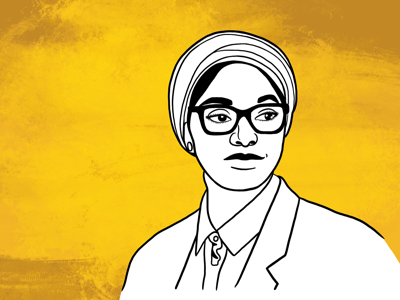
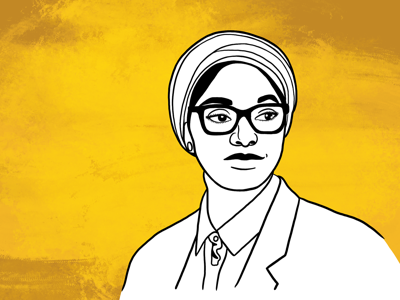
Illustration of Rep. Mauree Turner, D-Oklahoma City, by Megan Foisy.


