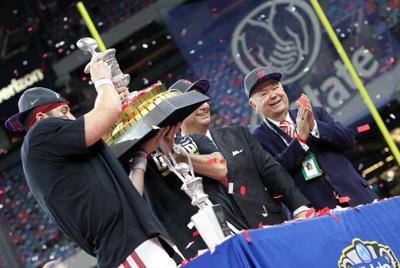

OU President David Boren addressed media following Oklahoma's win over Auburn in the Sugar Bowl, defending the university's decision to keep Joe Mixon on the team after punching a female OU student in August 2014.
Boren discussed OU's background check system, which came into question after the Tulsa World reported Dede Westbrook had been arrested twice before coming to OU.
Read the transcript of Boren's comments in full below, and listen to the audio of the interview here. Boren's comments are in plain text and quotations, and our annotations and notes are in bold. Questions from media members are italicized.
BOREN: "There's also no reason to destroy the lives of young people when they make even a serious mistake at age 18. What you want to do is set those people in the right force and help them with productive lives in the future, and I think that's always the right thing to do. I don't think that should be decided by instant opinion. Opinion changes. At the time, we were far too rough. Now, there are people trying to second guess us. But I hope what won't be second-guessed is that educational institutions — they punish things that need to be punished, people need to learn from their serious mistakes, but we don't want to destroy the lives of young people that can be salvaged.
"I think it'd have been very hard, because I think what Bob (Stoops) is saying is that in 2 1/2 years, a lot of opinions have changed on that subject. My opinions haven't changed. I think it's wrong to hit a woman, no matter what the provocation, no matter what the circumstance. I think that person should always be punished, but on the other hand, I don't want to throw Father Flanagan into the dustbin of history. That wonderful character in the movie, the priest who gave people a chance and who gave young people a chance to learn from their mistakes and to make better lives for themselves. I just read the Pope's book, called "The Name of God Is Mercy," and I'd ask people to think a little bit before they want to reach out and let one single incident when someone has a clean record destroy an entire, productive life. Punish but yes, ruining lives permanently, no."
Boren’s reference to Father Flanagan refers to a Catholic priest who founded the famous Boys Town, an orphanage in Nebraska that is now a center for troubled youth. He’s known for giving second chances. The book Boren references is written by Pope Francis, and as the title suggest, it emphasizes themes of mercy and second chances.
Was public perception a factor in decision to punish Mixon?
"No, not at all. I think we did the right thing at the time, and I think we should've exacted a tough punishment, which we did. Some people talk as if we didn't have a punishment. Well, we did. But I think after that, the job of a university and the job of an educational institution is to put young people on the right path, to learn from their mistakes. I hope that's what we've done. I hope that's what we'll do 100 years from now.
"The moment we saw the video, it was immediate. We didn't even have any discussion about should there be punishment, should there be severe punishment, should he continue to play on the team. At that time, no. We dismissed him from the team, we didn't let him practice, we didn't let him travel. That was a very harsh penalty, but what we did say is, 'If you'll get your life straightened out, if you'll get on the right path and if you'll be constructive from now on out, you do your community service, you get anger management training, you do all the other things we're calling upon you to do, we'll release you to go to somewhere else if you don't want to measure up to these requirements that we're putting on you — that's what was done at the time.
"I'm not one of these people that wants to be involved — as a university president, I want to help young people learn from their mistakes and get on the right path. I'm not in the business, as a university president, of destroying entire lives and entire futures of young people. If they want to get someone else to be university president that's in the destruction business, get 'em. I'm in the education business."
Boren and others in the OU hierarchy have said they wanted to give Mixon a chance to grow from his mistakes by keeping him on the team. Other players, however, have been dismissed from the program since Mixon’s incident for less serious offenses.
Thoughts on strengthening OU's background check system?
"Well, we have one of the strongest in the country and will continue to do that. You know, most universities, many in the country, do not have background checks. We do. In the Mixon case, we did a background check. And you know what we found? His teachers, his classmates, people in his community said he had the cleanest record that they'd ever seen for a young person his age. None of these things are foolproof. You do the best you can. I think we're a national model. We have moved our enforcement section out from under the athletics department, it's separate. It's in the general counsel's office."
The background check system Boren references didn’t find that receiver Dede Westbrook had been arrested twice for domestic violence before coming to OU.
"We have one of the most active model Title IX programs in the nation. We don't tolerate violence against women. We're a model. But what I don't ever want to be a model of is the destruction of the lives of young people and never letting young people learn from their mistakes. I think that's wrong, and I think those people who have second-guessed it and rushed to mob mentality about this are wrong. I think when they sit back and reflect on it, I don't think they want to be in the business of destroying individuals any more than I do, as a university president."
Any regret about SAE reaction, then?
"No, no. You had to, because that was something that was an open shut case. You have to look at every case."
In March 2015, Boren said he expelled two students after video surfaced of members of Sigma Alpha Epsilon singing racist chants on a bus. It was later discovered that the students withdrew from the university.
"What does that have to do with this? The facts of the situation was totally different. So you have to really consider all the facts, and if we want to have a situation where every time something happens, we think there's some immediate answer to it without looking at the facts, without looking at the facts of the situation in every single case, without looking at the background, without looking at what's been happening, then no. You have to look at every case one by one. These are hard decisions.
"How many of you want to get in the business of deciding the future of everybody's life, based upon what they do? It's a hard decision to make. It's totally different. You can not, just like we had a recent situation where we took another action, where we had students who said, 'Let's bring back a weekly lynching on all the campuses,' and there were these emails to freshmen at the University of Pennsylvania — you cannot put up with that. We live in a country that you simply cannot put up with that kind of bias, that kind of racial division in our society."
In November, an OU student was suspended for his involvement in sending racist messages to University of Pennsylvania freshmen. Black students at UPenn were added to a group message rife with racial slurs and graphic images. The student is no longer enrolled at OU, though it is unclear whether the student withdrew or was expelled.
"The situation here had to do with one young person who had an absolutely clean record of every kind before this, and we did all the background checks, and what do they tell us? This tells you background checks are not foolproof either. You have to look at how the students have behaved once they come to the university, and whether or not they've met all the preconditions. And let me say, if he had not met all the preconditions, there would have been zero tolerance for him not doing so. It wouldn't have been a question at all."
Reaction to the parking ticket situation?
"Well, I was disappointed with that. I made my views known about that at the time and I insisted that he not play the next game at the time, so you learn from it. But he is still taking counseling, he is still trying to make himself in a better man. He's learned from it. You all heard yourself what he said the other day."
Mixon was suspended for OU’s Nov. 3 game against Iowa State University after he threw a torn-up parking ticket in an attendant’s face.
"How could the media at the time, who all had the opportunity to see that tape when I saw it, and many of them said we were too harsh. My phone rang off the wall that I was too harsh. I don't think we were too harsh. I think the conditions we put in place were the right conditions.
"On the other hand, I just go back to what I'm saying: How many people do you know, when they were 18 years old and they never had an episode whatsoever, unblemished record, have ever made a mistake? How many people have never made a mistake in their lives? I think it's a sort of rushed judgment, when you say, 'Oh, the answer is, let's destroy people's lives, let's not let them have any kind of future, let's not let them learn from their mistakes.' I don't believe in that. And if you want to say, I thought Father Flanagan, I watched the movies when I was growing up as a young person, I thought that person was very admirable."
Did the Mixon case go before Steve Ashmore in Student Conduct?
Ashmore is the director of Student Conduct at OU, the office that handles disciplinary measures for students.
"The Mixon case, we had several other cases, in fact, if you want to know about my own record, we had a Title IX case involving a player, Frank Shannon — the local judge wouldn't let us enforce our punishment and keep him off the team, so I took the case to the state supreme court. I think what a lot of people don't understand is, I may be the first person in the country to ever go to a state supreme court to enforce a Title IX ruling in our university. That's how firmly we believe in these things and how strongly we want to set a national example."
Former OU linebacker Frank Shannon was suspended for the entire 2014 season after he was accused of sexual assault in January 2014. District Judge Tracy Schumacher granted him a stay so he could remain on the team, a decision Boren took to the Oklahoma Supreme Court. The Supreme Court ruled OU could enforce the suspension and said Schumacher’s stay should have never been granted.
"I think you have to look at every case, case by case, look at the facts of the situation in the individual cases. As I said, background checks are not foolproof. You look at others who've been an important part of our team and again, there's a lot of discussion about that. They've been model citizens at the university since they've been there. Getting the people on the right track — I think one of the most, one of the greatest things, and I've seen this even more since I became president of the university, one of the greatest things about intercollegiate sports, is it is a place that provides equal opportunity for all sorts of people. Whether they grew up in single-parent families, whether they grew up in poverty, whether they grew up without role models, they have a chance by being good citizens at a university, by playing on a team, playing by the rules. It's one of the greatest places in America where people can start at the bottom, if we want to talk about their socioeconomic conditions, and still have the opportunity to make it at the top. We can second-guess all of these things. I think we should have tough rules and I think we should have punishments.
"And I don't know if you can find a case where we haven't made a punishment where we thought a punishment was right. I think we'll be doing something permanently — I appeal to you, as members of the press, you write about it all the time, you broadcast about it — let's not — intercollegiate press is a place of great opportunity for young people who grow up in poverty in the most difficult of circumstances, that none of us can imagine. Let's don't take away that opportunity to rise from humble beginnings and to have opportunities through intercollegiate sports. Let's not swing the pendulum so far in the other direction that we use it to destroy people and snuff out the possibilities from their lives, instead of giving them something to build on. I think we ought to think about that. When people want to play God and push people into the dustbin of future possibilities in their lives, I think that's wrong. I think what's right is set a punishment that is a serious punishment. Set conditions you have to live up to that are serious and demanding, and give people an opportunity for people to reclaim their lives and put it on the right path.
"I think if we stop that spirit in intercollegiate sports, if we become too judgmental in people who grew up in circumstances very unlike ourselves, I think we permanently damage intercollegiate sports, and I think we ought to think long and hard about that."
So the Mixon case did not go before Student Conduct?
"The Mixon case was first a criminal case, and then of course we immediately looked at it ourselves."
So it didn't go before Steve Ashmore's office?
"The person never filed a complaint with Title IX."
OU’s Institutional Equity and Title IX office handles issues related to sexual misconduct, discrimination, harassment, dating or domestic violence and gender equity issues related to athletics. Here, the "person" Boren refers to is Amelia Molitor, the woman Mixon punched in 2014.
Who conducts your background checks, third party?
"The third party is in compliance and it reports to the general counsel's office, not to the athletics department. The third party is the general counsel of the university. The general counsel of the university is where the Title IX office, or rather, where the compliance and athletics resides. You don't have the athletic department judging its own compliance. You have the general counsel's office judging it. There are people hired for the service — come visit our Title IX office. It's considered a model in the country, and there are schools all over the United States coming in to see how our Title IX office functions. It's very confidential in terms of complaints, certainly not like at some other universities where you have to go to the coach to make a complaint or somebody else to make a complaint. You come, you get an objective investigation into it, if you choose to make a complaint. Now, we can't compel people to, but that's where they come."
So, the third party is employees of the university?
"They're employees of the university. They're employees of the general counsel office."
By third party you mean it's just outside of athletics?
"Yes, you know, one of the reforms nationwide has been, the best practice, because for many years, you had compliance inside the athletics department reporting to the athletics director, et cetera. That was deemed to not be independent enough or objective enough, so schools across the country — not all of them — many of them now, who follow the best practices have that compliance function totally outside of the athletics department. We did that several years ago, and I think that's the right thing to do."
OU’s background check policy came into question after the Tulsa World first reported that receiver Dede Westbrook had been arrested twice on domestic violence complaints before coming to OU. In a joint statement to the Tulsa World from Boren, coach Bob Stoops and athletic director Joe Castiglione, they confirmed that OU did conduct a background check on Westbrook, as it does for all incoming student athletes, and nothing was reported.
Jesse Pound and Andrew Clark contributed to this report.


