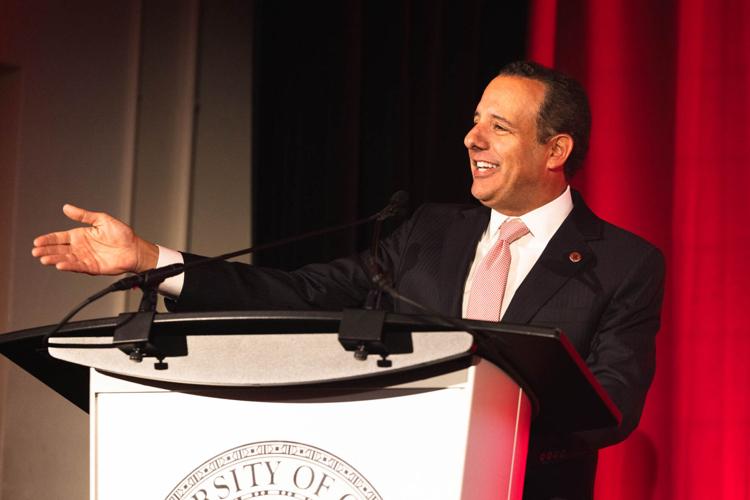
OU President Joseph Harroz Jr. announced a new presidential advisory council on "accountable shared governance" and discussed the university’s approach to artificial intelligence at the annual State of the University address Wednesday.
Harroz stressed that if the university does not police itself on issues like tenure review, state lawmakers may do it instead.
OU president on AI in classrooms during university address
"We've seen across the country the stripping out of faculty and staff senates because there's not trust in them across the nation, and we've seen attacks on tenure (and) the taking away of tenure," Harroz said.
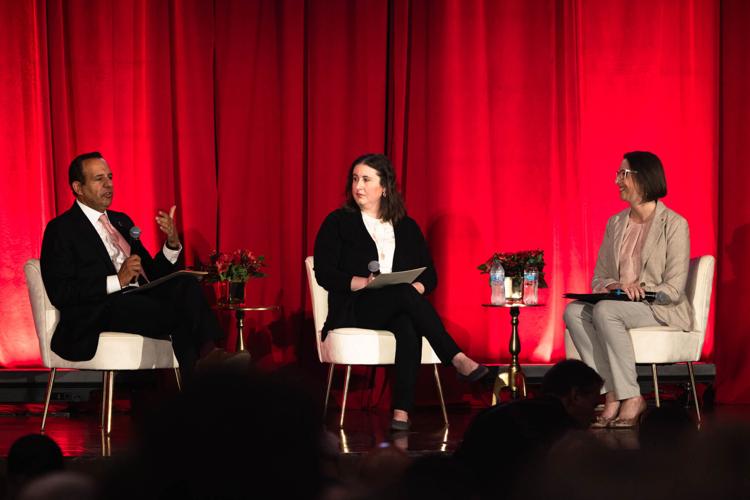
The address was moderated by Faculty Senate Chair Rebecca Anderson and Staff Senate Chair Kelsey Martyn-Farewell.

State of the University address on Sept. 2, 2026.
Harroz also touched on record enrollment, the university's financial situation, the push toward Association of American Universities membership and research partnerships with state and federal government.
Here are some key takeaways from the address:
Shared governance and tenure accountability
Harroz introduced a council tasked with tightening how the university evaluates tenured faculty.
He added that public trust in higher education is falling nationally, and some state legislatures have responded by revoking tenure protections and faculty governance power from universities.
“If we want to continue to gain the public trust, if we don't want the public to take things away from us, we’ve got to be honest about what we are doing right and wrong, and then make those changes in a way that live into our values,” Harroz said.
Over the summer, the Auburn University Board of Trustees eliminated shared governance, the practice of joint responsibility between faculty, administrators and boards to govern a university, and gave itself control over course offerings, curriculum, degree requirements and academic credentials.
Harroz said other university presidents and chancellors have recommended he let the legislature govern the issue of tenure, but Harroz prefers to work together.
“When you look at what we've done around post-tenure review, when you look at what we've done around endowed positions and reviewing them regularly, when you look … around merit-based raises, we have built enough confidence, and we've done the hard work together,” Harroz said.
Harroz said the plan is to have recommendations ready before the next legislative session begins in February.
The council is organized into three categories: direct shared governance, which covers faculty hiring, evaluation and curriculum; advisory input; and informational updates.
“We cannot say we are for shared governance, and then not do this, because it's disingenuous and they will take it away from us, and they should take it from us if we're not accountable,” Harroz said.
Research and government relationship
Over the past six years, the university has grown research efforts by 70% and 18% in just the past two years, Harroz said. He added that research expenditures are at $550 million. The goal is to increase expenditures to $1.1 billion, which aligns with average AAU research expenditures, according to Harroz.
Harroz said over the last several years, state appropriations for OU and OU Health have reached well over half a billion dollars, funding portions of projects including the Stevenson Cancer Center at OU-Tulsa, a new pediatric heart hospital at OU Health and the new Life Sciences Laboratories Building on the Norman campus.
OU is seeking to become home to Oklahoma's first federally funded research and development center focused on severe weather research. Harroz said he has been working with Rep. Tom Cole (R-Oklahoma), chair of the appropriations committee, to secure the federal laboratory.
“We're working on our first federal laboratory, an FFRDC, around severe weather that will change Oklahoma and OU forever if we can land that,” he said.
Harroz said the center could generate $50 million to $150 million annually in research funding if the bill clears Congress this year.
Enrollment and faculty hiring
Last week, the university welcomed its sixth consecutive record-breaking first-year class of 6,437 students.
6,437 strong: OU sets freshmen enrollment record for sixth consecutive year
As class sizes continue to grow to a set goal of 40,000 students, faculty asked what Harroz’s plan is to hire faculty to continue at this pace.
Harroz said funding for new faculty positions now flows directly to growing colleges and departments, which is in line with a policy change from 2022.
Harroz added, however, that many of the fastest-growing colleges are outpacing that model’s ability to keep up with hiring demands. For colleges where growth outpaces that formula, including nursing and business, central funding is used to supplement funds.
AI strategy
Harroz said it’s more important than ever that the university develop a detailed comprehensive AI strategy.
“This has been the fail of the last two years,” Harroz said. “We're not unique in that we aren't there yet.”
Last fall, the university welcomed its first chief artificial intelligence officer, Shishir Shah. Harroz said AI experts both in science and humanities are working to develop a strategy for the university.
Harroz said the university is pursuing “non-traditional ways” to include staff and faculty voices. He added that faculty and staff senate leadership are included in discussions about AI framework.
This story was edited by Audrey McClour. Tori Pham and Sophie Hemker copy edited this story.


