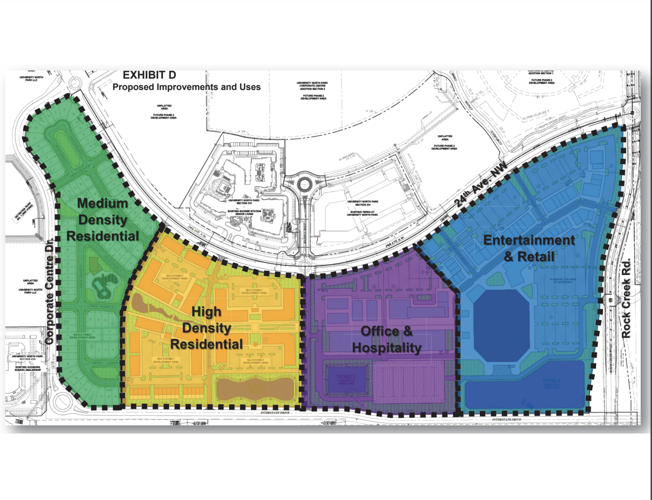

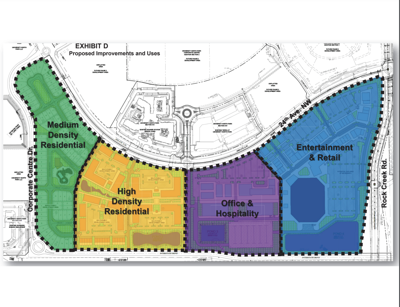
The proposed University North Park entertainment district project statutory review committee met on Thursday to discuss how the project would be funded and the effects it would have on the city.
The proposed plan, introduced as the Rock Creek Entertainment District Project Plan, was first brought to the statutory review committee’s attention on Monday. City Attorney Kathryn Walker explained the proposed plan is to divide the district into two tax increment financing districts, or TIFs.
A TIF is used to support the redevelopment, infrastructure and community-improvement projects within a certain area with the intent of stimulating private investment in the area in need of economic revitalization.
In the proposed plan, one TIF would be a sales or use tax increment district and is expected to be activated on May 1, 2025, according to the minutes from Monday’s meeting. The other would be an ad valorem increment district to be activated on Dec. 31, 2026, to capture the property tax that would begin when the first-year properties in the project area are developed.
The city, OU and Team Norman leaders first proposed the entertainment district on Sept. 6. When initially proposed, Team Norman, a group of leaders focused on preparing the city for OU’s transition to the Southeastern Conference, said the district would be 80% privately funded, and the remaining would come from public sources.
In a Nov. 14 meeting, Norman City Council adopted a resolution forming a review committee for a possible TIF district within the entertainment district.
Neither the city nor the Norman Tax Increment Finance Authority are proposed to finance the project, Walker said in Monday’s meeting. The risk is instead on the OU Foundation. The city and the authority do not intend to use any kind of public debt to finance the project.
Thursday’s meeting revealed the proposed amount of assistance in development financing the project cost would be capped at $600 million. With the roughly $200 million cost of the arena, $600 million is the estimated amount of interest building the project would cost. However, the CEO of Rainier Companies, a national commercial real estate firm hired by OU Foundation, Danny Lovell said $540 million is probably what is actually needed.

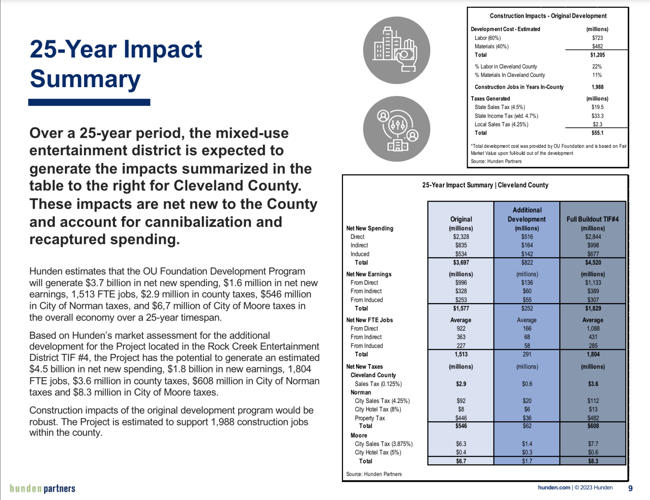
Proposed 25-Year impact of the University North Park entertainment district project.
“The interest rate on the debt that we're borrowing is assumed to be 6%,” Lovell said. “The reason why there's a difference in 540 and 600 million is because we can't lock our rate until this project gets approved.”
The proposed private development within the project is expected to provide up to $230 million in development financing, which will aid the funding of the public arena and parking garage. Lovell said this gives the developers incentive to quickly construct the private developments, such as the residential part of the development.
The committee also discussed the impact this project would have on the city, the country and other entities such as Norman Public Schools.
Norman Public Schools, for instance, may experience growth in enrollment as a result of the project’s creation of opportunities for employment, new residences and other economic impacts.
During the meeting, NPS Superintendent Nick Migliorino remarked this might necessitate redistricting or building new schools.
“We have neighborhood schools in Norman. I think that's one of the things people like about Norman,” Migliorino said. “This is a new neighborhood. We would want to put something in that neighborhood.”
Feasibility studies have shown the project’s impact on local businesses and the economy. According to Thursday’s project plan, the city’s sales tax projections show over $32 million in city sales tax generated over the life of one of the project TIF districts that will not be incremented. The hotel section of the project is anticipated to generate $8 million in hotel occupancy taxes over the 25-year life of the TIF district.
Once the project is completed, the city will become responsible for the maintenance of the public infrastructure and improvements needed within the project as well as the provision of police, fire, parks and other municipal services. However, the arena will operate independently of the city, according to the plan.
The committee has not approved to go to the planning commission. It will continue to discuss the proposed plan on May 23.
This story was edited by Ana Barboza. Avery Avery copy edited this story.


