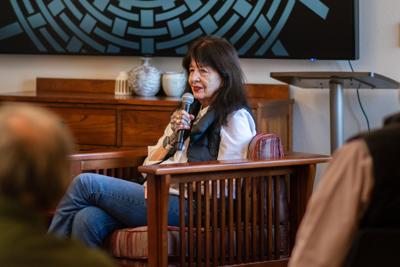

Joy Harjo joined OU English professor Jake Skeets for a conversation about Native American writers and literature in Copeland Hall’s Native Nations Center on Tuesday.
Harjo, an author, musician and member of the Muscogee (Creek) Nation, served three terms as the 23rd U.S. Poet Laureate, being the first Native American to hold the position. Harjo has received the Poetry Society of America's 2024 Frost Medal, Yale's 2023 Bollingen Prize for American Poetry and a National Humanities Medal.
Harjo has written 10 poetry books and released seven music albums. Last year, Harjo received the Gaylord College of Journalism and Mass Communication’s Lumine Lifetime Achievement Award.
‘Pieces of dreams’
Harjo said she never intended to become a poet — the extent of her writing during school was acid rock songs for a failed band. While attending college at the University of New Mexico, Harjo said she saw Native leaders using poetic language to speak about protecting their land after a uranium spill.
Harjo began to write about what happened around her and protests for Native rights. She said her unique style resonated with the community.
For Harjo, each poem she writes is distinct and comes from a different source. Harjo fills pages with prose when she first sits down to write, and later finds the final poem hidden within that draft, she said.
“Things accumulate: pieces of dreams, images, something somebody said, history, something that is urgent to be carried on, or something that wants to emerge because of a series of events going on,” Harjo said. “But that poem just showed up, and it was compelling, and so I had to follow it.”
That poem was “The Dawn Appears with Butterflies,” which Harjo wrote while helping with the burial of her friend, who died from leukemia. His daughter performed a butterfly dance in his honor, and Harjo was inspired by the dance and the sunrise she saw during her visit.
Harjo’s creative process involves writing and listening, she said, and then constructing the “foundation” of the poem by ensuring every line fits in the story. Writing poetry is not as simple as many think, Harjo said, because it requires research and time.
“Poetic language can — and metaphor can — get to places within us that texting language cannot,” Harjo said.
‘I’m an echo’
As she began her career, Harjo could not find any work from Native authors in bookstores, and Native Americans had little to no presence in American writing. Anyone who claimed to be Native was white, she said.
“Even with these ethnic centered groupings, we were always kind of the disappeared one,” Harjo said.
Harjo asked Skeets, a fellow writer, what he had observed in Native literature as a younger author. Skeets said while Native writers face many obstacles, they are strengthened by their community with each other.
“The ability of Native people to create space for themselves is something that's remained consistent, regardless of pressures and aggressions,” Skeets said.
Harjo said writing connects people from all Native Nations, because they find similar themes that resonate with them. Despite their different cultures, having community with each other creates connections that are “nourishing”, Harjo said.
Skeets said his writing is informed by the writers who came before him, and their work gives him a framework for his stories. Harjo calls that lineage an author’s “story ancestors.”
“I'm always trying to remind myself that I'm an echo,” Skeets said. “That reciprocity is a part of the process of being a writer.”
Harjo said it’s more important now than ever to maintain spaces for Native writers and people as diversity, equity and inclusion programs are disappearing.
In December 2023, Gov. Kevin Stitt signed an executive order calling for a formal review of DEI in Oklahoma higher education. In April 2024, as part of the review, OU renamed and restructured it’s Division of Diversity, Equity and Inclusion to the Division of Access and Opportunity.
In November, the university announced it would be conducting a review of the language requirements for the Dodge Family College of Arts and Sciences. During the March OU Board of Regents meeting, Provost OU Senior Vice President and Provost André-Denis Wright told OU Daily that he received the review and would go through it soon.
Many members of OU’s language community, including Native American studies and languages professors and scholars, expressed anxiety at the decision.
Harjo said the disappearance of DEI programs disproportionately hurts Native Americans because their programs are the first to go and many fear repercussions.
“We can't give into that fear,” Harjo said. “I think the lesson here, the challenge is we have to keep gathering, and we have to gather even more.”
Harjo was born on Muscogee (Creek) Nation land in Tulsa and attended high school and college in New Mexico. She also lived in Hawaii, but now lives back on Muscogee land in Oklahoma. Harjo said she left Oklahoma to get away from family, the land’s painful tribal history and hateful rhetoric.
Returning was difficult, she said, but she now feels a sense of belonging. It “clicked” for her, in the way a poem does when it’s complete, she said.
“My work I do, whether it's writing music or whatever, is really the impetus comes from being from my people and also from this need for transformational healing and justice,” Harjo said.
This story was edited by Anusha Fathepure and Ismael Lele. Allie Clift and Sophie Hemker copy edited this story.
PHOTOS: Joy Harjo in Conversation with Jake Skeets

Joy Harjo in Conversation with Jake Skeets on April 22.

Audience at the Joy Harjo in Conversation with Jake Skeets on April 22.

Joy Harjo in Conversation with Jake Skeets on April 22.

Audience at the Joy Harjo in Conversation with Jake Skeets on April 22.

Joy Harjo in Conversation with Jake Skeets on April 22.

Audience at the Joy Harjo in Conversation with Jake Skeets on April 22.

Jake Skeets in Conversation with Joy Harjo on April 22.

Joy Harjo in Conversation with Jake Skeets on April 22.

Joy Harjo in Conversation with Jake Skeets on April 22.

Audience at the Joy Harjo in Conversation with Jake Skeets on April 22.

Jake Skeets in Conversation with Joy Harjo on April 22.

Audience at the Joy Harjo in Conversation with Jake Skeets on April 22.

Audience at the Joy Harjo in Conversation with Jake Skeets on April 22.

Jake Skeets in Conversation with Joy Harjo on April 22.


