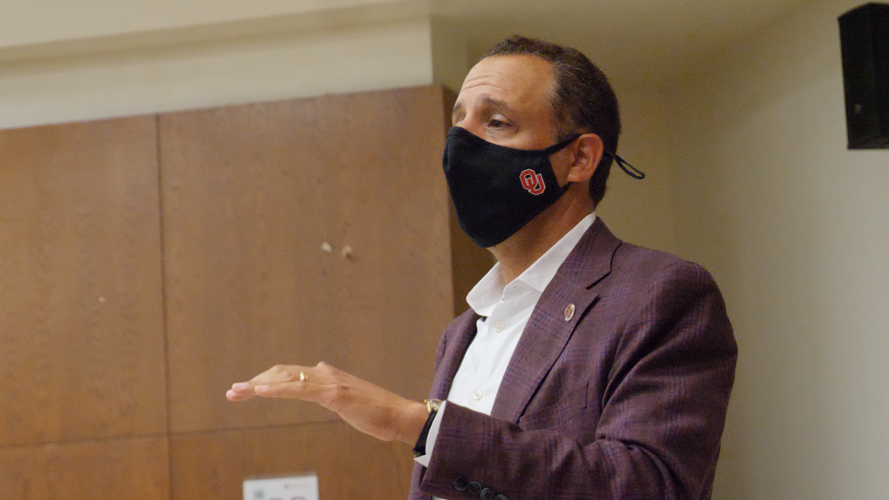

OU President Joseph Harroz taught in the university’s first class to implement its new masking policy Thursday morning as in-person classes continue despite rising case numbers in the state.
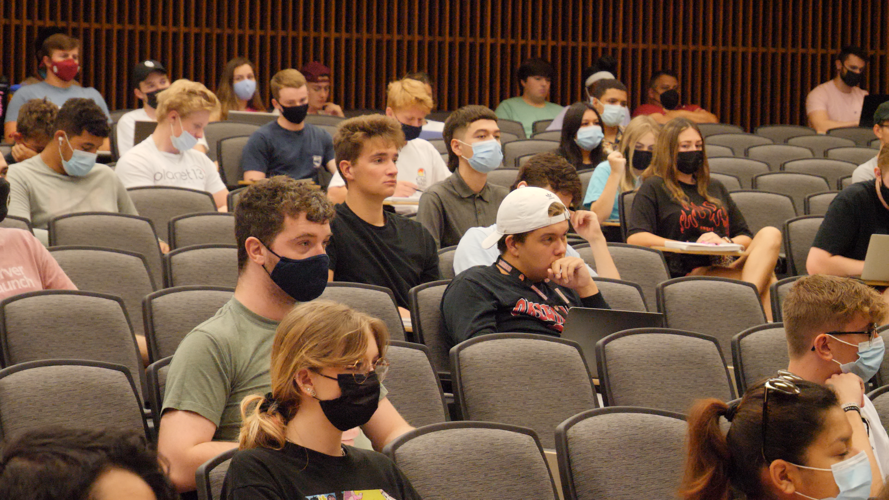
American Federal Government, a Tuesday and Thursday course in Dale Hall with 196 registered students, has experienced multiple positive COVID-19 cases and is now requiring its students to wear masks for two weeks. Multiple students remained unmasked despite the policy and Harroz’s offer of free masks at the front of the classroom.

Students listen to Harroz speak in Dale Hall Sept. 2.
The policy has been criticized by faculty, including OU Law Professor Joseph Thai, who said it “doesn’t make public health sense,” as students who don’t want to mask can choose not to report their infection status. OU Chief COVID Officer Dr. Dale Bratzler also noted in his recent COVID-19 briefing that individuals with the delta variant can remain asymptomatic for two days and still spread the virus.
Harroz’s visit to the class follows his Wednesday State of the University address, where he said the institution will consider a mask mandate in classrooms as much as state law allows. The current seven-day average for Cleveland County is 191 cases, as of Sept. 1.
“We’re trying to figure out how to stay in person, (and) as we look at how to stay in person, we’ve talked about how we handle it whenever there’s a classroom and there’s been a positive in the class,” Harroz said. “In this class, we have had multiple positives, and they’re not here today, and we’re handling that, but the way we stay in person together, not online, is that when there is a positive case, we will have everyone wear a mask in that class for two weeks.”
Classes like American Federal Government are important, Harroz said, because they allow students to become engaged citizens amid politically divisive times. He said disunity is present today in people saying the vaccine is not real or helpful and who believe the 2020 presidential election wasn’t legitimate, and differing views without understanding create vulnerability.
“When somebody says, 'This is my political view, and that’s not yours,' I think you got to say ‘I’m not gonna reject that. Not gonna accept it as a substitute for mine, but I understand,’” Harroz said. “And, if there’s not a rational explanation for it, then what’s underneath? What’s causing that feeling? and then, how do you engage with them? It might change your own view, it might not.”
Harroz said divisiveness is clear in constituents’ approval of their governing officials, as only about 50 percent of people in the U.S. currently have confidence in Congress. He said this “lower rate” reminded him of award-winning journalist David Sanger’s visit to campus, where he discussed mistakes the U.S. has made through foreign policy as a superpower.
He said the nation’s departure from Afghanistan after its 20-year occupation might have been the last opportunity for the U.S. to “get it right.”
In 1985, when Harroz was attending classes in Dale Hall, he said he thought democracy would always prevail, but now he sees it struggling. He said his view on what makes a prospering American society die changed after reading the book “How Democracies Die.”
Historically, Harroz said democracies dissipated after a military leader came in with tanks and weapons, allowing autocrats to take over. Now, he said democracies are killed by fear.
“The new playbook today is not you bringing in tanks, or you bring in other military weaponry or even cyberattacks directly. … But the playbook is that you make people in the country fearful,” Harroz said. “That’s what you do, is that you divide democracies by making people not trust each other by making them fear for their personal security, fear for their resources and money, and they have fear of the other side and people get scared.”
The 2016 presidential election served as an example of fear mongering, Harroz said, as he cited the Russian government’s series of cyberattacks via troll farms.
“Now why would they do that? The answer is obvious,” Harroz said. “If you want to destabilize one of the younger countries, the sole superpower, if you want to take out a democracy, you follow the playbook and you make them hate each other because when you get people fearful and anxious, fear can become hate. Fear becomes distrust.”
Harroz said as individuals work to dissect their beliefs surrounding the issues the U.S. faces, he wonders if they take the time to consider other views.
“Do you understand people that don’t have your political opinion?” Harroz said. “It used to be that you just say ‘I disagree with the other political view, I disagree with it.’ Increasingly, it’s ‘I don’t understand it.’ … Whatever your political views, whether you consider yourself a conservative, a liberal or independent, do we look at those that are in the other party, and do we say, 'I understand what they're thinking and what they’re feeling, I just disagree'? Or do we reject what they’re saying? I have no idea what they could be thinking.”
The university is currently working on a Core V requirement for 2022, which will allow university administration to provide a suite of three-hour First-Year Experience classes, including Gateway to Belonging, Global Perspectives and Engagement and Ethical Leadership development. The courses are meant to address critical thinking, cultural fluency, civil discourse, citizenship and community engagement.
The Gateway to Belonging class was originally a standalone course requirement, but the university restructured the course after Gov. Kevin Stitt signed House Bill 1775 into law on May 7 preventing public universities from teaching certain gender and diversity theories.
Oftentimes, Harroz said he falls victim to not understanding people who are in opposition to his beliefs. He said this view is unworkable, and its consequence is that a democracy that can’t propagate.
“One of my favorite books out there, which is very cliche for someone who is a lawyer, is 'To Kill a Mockingbird,'” Harroz said. “When Atticus tells Scout to really understand someone, you have to walk around in their skin, to really understand them, you have to understand what’s inside of them and what makes them tick. What he didn’t say is 'I’ll be honest, I have no idea what that half of the world thinks, so reject it.'”
Dehumanization is a consequence of giving up on democracy, Harroz said, as its foundation lies in understanding others.
“Great lawyers don’t just learn the other side’s argument,” Harroz said. “They understand it better than the person they’re going up against, and they also don’t just listen to what they’re saying. They listen to what they’re feeling.”
Harroz quoted Benito Mussolini, who said, “if you pluck a chicken one feather at a time, nobody notices.” He said during the U.S. Capitol riots on Jan. 6, he saw the place he used to work in as an employee of the U.S. Senate attacked, following Mussolini’s description of the destruction of democracies.
“I am not much of a crier. I was in a meeting … and pulled up my computer, and I got so emotional I had to end the call I was on, and I cried,” Harroz said. “We can’t hate each other, and we have to understand we are getting played. I mean, that’s the playbook. Let’s make us dehumanize and hate the other because that’s plucking one feather at a time.”
Attending college comes with huge opportunities, Harroz said, as students who have the benefit of education are “lucky” to be positioned toward success and impact. He said college-educated people will soon turn to graduates of OU and ask their views on public policy and voting, which is an opportunity to reflect the characteristics of engaged citizens.
“Twenty-five percent of our freshmen class are the first in their families to ever go to college. That was my dad,” Harroz said. “He went here from an immigrant family of nine kids, if you think about the opportunity that attaches to that. But there's always a flipside in life. With that opportunity comes an obligation, and the collective obligation we have is to hold the democracy together.”


