
Across a roughly 3,500-acre campus with an ever-increasing student population — 32,662 in fall 2025 — OU’s Norman campus is struggling to meet the housing demands of continuous student growth.
Since 2021, the university has welcomed a record-breaking first-year class annually. In 2025, OU marked its fifth-consecutive record-breaking first-year class with 6,229 students.
Current state of OU housing
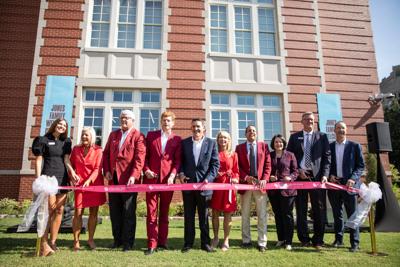
OU currently has eight residence halls: Couch and Walker centers, David L. Boren Hall, Dunham and Headington colleges, Headington Hall, Cross Village and McCasland Hall. The university also has two on-campus apartment complexes, Traditions Square — with East and West buildings — and Kraettli Apartments. This fall, the university will open a new residence hall, the South Building, to complete phase one of its First-Year Housing Master Plan.
Roughly 7,994 students can be housed across all residence halls and apartment complexes.The South Building, once completed, will add over 580 beds.
On-campus residence halls are only offered for first-year students, according to OU’s housing website. Traditions Square and Kraettli Apartments have primarily housed upperclassmen, with Kraettli also open to faculty and staff. However, the annual increase in first-year enrollment and the subsequent housing demand led to the university announcing it will turn Traditions East into first-year housing for the 2026-27 academic year.
OU requires all first-year students to live on campus for their first two semesters unless they are admitted for the spring semester or receive an approved exemption. OU Marketing and Communications wrote in an email to OU Daily that, depending on projected enrollment and overall capacity, Traditions West may also be used for first-year housing.
“These decisions are finalized each year based on available inventory and enrollment projections,” the email reads.
OU’s 2026-27 upperclassmen housing enrollment website shows that a limited number of units will be available at Traditions Square. As of Feb. 16, there were 932 applications on the waitlist for Traditions Square apartments, according to the website.
OU Marketing and Communications wrote that students can use the university’s off-campus housing resource website, which provides listings and contact information for independently owned and operated local properties.
OU’s Architectural and Engineering Services oversees the planning, designing and building of facilities across all three campuses. Former department director Michael Moorman, a licensed architect, served in the role for 18 years before retiring in 2013, leaving OU without a campus architect.
Alan Moring worked as a staff architect for about eight years before stepping out of the role in 2023 to teach at the Christopher C. Gibbs College of Architecture.
Moring told the Daily he worked mainly as a project manager, overseeing the design process, construction and budgeting of several campus projects. He worked on the Jones Family Welcome Center, OU Daily’s Copeland Hall newsroom and the Jenkins Avenue Parking Facility, among other projects.
“Being a campus architect, you’re really working as the owner’s representative. (For) most projects, you have the owner, you have the architect and you have the builder or contractor, and I was really functioning as the owner,” Moring said. “We would interview and hire architects to design the projects and then we would interview and hire contractors to build them.”
Moring said Architectural and Engineering Services would build a team with the college or department housing each project to discuss renovation or construction matters. For the First-Year Housing Project, which he worked on, the department worked closely with Housing and Food Services.
OU Marketing and Communications wrote that housing services works closely with OU Enrollment Management and receives projected enrollment numbers each year.
“Because housing must be provided for incoming first-year students under Board of Regents policy, those projections are central to annual housing planning and space allocation, …” the email reads. “All housing facilities follow regular maintenance and renewal processes, with prioritization based on facility condition, operational needs, and planned capital timelines.”
SEC, AAU universities’ housing demand
OU entered the Southeastern Conference on July 1, 2024. OU President Joseph Harroz Jr. wrote in a June 2024 opinion piece for The Oklahoman that he expected enrollment to continue increasing as its SEC status may attract students, and while enrollment has risen, other schools in the conference are seeing similar trends.
“OU is in regular communication with its SEC and regional peers,” OU Marketing and Communications wrote. “While housing models differ across institutions, a common trend is continued enrollment growth and the need to adapt housing strategies to meet that demand.”
The University of Arkansas, another SEC university, welcomed 6,977 first-year students in fall 2025, for a total of 34,164 students enrolled for the 2025-26 academic year.
The University of Arkansas has 20 residence halls that span community style, suite style and apartment style. Three of those are female-only residence halls and one is for first-year students enrolled in the university’s honors college.
The university can house 6,274 students across all residence halls and is working on building two additional on-campus residence halls, one of which will be completed in 2028 and add over 700 beds.
John Thomas, media relations and core communications director at the University of Arkansas, wrote in an email to the Daily that the university requires all first-year students to live on campus or in one of the university-sponsored off-campus apartment complexes.
“We’ve found that students who live on campus their first year at the university, perform better academically, so that’s a huge incentive for us to support the long-term success of our students,” Thomas wrote.
This finding aligns with Harroz’s belief that requiring first-year students to live on campus can help students have a better transition to college.
“Students who spend their first year on campus are materially more successful than those that don't,” Harroz told OU Daily editors in September 2024. “It's also a reason that flagship on-campus research universities are doing well, it's a big part of the development of freshmen into sophomores.”
However, Thomas wrote that some students may be allowed to live with a parent or guardian within 70 minutes from campus. On rare occasions, a first-year student may appeal to be waived from the residence requirement, including for medical or physical conditions, marriage, custody of children or military service.
Thomas wrote returning or transfer students can live in university-leased apartment complexes near campus. He wrote the complexes are leased by the university but managed and operated by the owners of each complex.
“Students who choose this living arrangement are issued housing contracts with the (University of Arkansas) as if they were living on-campus,” Thomas wrote.
Like OU, the 2025-26 academic year marked the fifth-consecutive record-breaking first-year class for the University of Arkansas and the first time enrollment exceeded 34,000. While the university does not have an enrollment cap, Thomas wrote it has recently set out to take a more controlled approach to enrollment growth by being more selective with the number of out-of-state students accepted each year.
“We are providing more acceptance and scholarship opportunities than ever before to our in-state students, as is our land-grant mission,” Thomas wrote. “While we have set enrollment records in previous years in both overall and freshman classes, our retention numbers have grown as well, which affects the incoming class size.”
One goal listed in OU’s “Lead On, University” strategic plan is to become a member of the Association of American Universities, an invitation-only organization of the nation’s leading research universities credited for life-changing education, research and innovation. Member universities earn the majority of federal funding for research.
The University of Iowa, an AAU public university, saw an enrollment of 5,561 first-year students in fall 2025, for a total of 31,563 students enrolled.
The University of Iowa has 11 residence halls, with one exclusively for returning students. According to the university’s website, about 6,469 students can be housed across all residence halls.
Virginia Ibrahim-Olin, housing administration director at the University of Iowa, told the Daily that first-year students are not required to live on campus but that 93.5% of this year’s incoming students lived on campus.
Ibrahim-Olin said in fall 2025, the university had 1,167 returning on-campus residents, classified as anyone who had previously lived in the residence halls, excluding 169 resident assistants.
The last time the University of Iowa did a housing development was in 2017, Ibrahim-Olin said, when it built Catlett Hall, a residence hall that can hold 1,049 students.
Ibrahim-Olin said the University of Iowa Housing and Dining division works closely with the admissions office to monitor yearly student growth. This academic year, however, Ibrahim-Olin said the incoming class size was a little larger than anticipated.
“We had to make some additional accommodations for students to live on campus, such as opening up some rooms that we had converted to student study spaces,” Ibrahim-Olin said.
Ibrahim-Olin said the University of Iowa has an enrollment management plan with each college to coordinate its target enrollment over the next several years. Like the University of Arkansas, she said the university does not have a cap on enrollment.
“We just do our best to make sure that we can house everybody that would like to live on campus,” Ibrahim-Olin said. “At this time, we are not opening a new residence hall, or we are not leasing space off campus.”
Ibrahim-Olin said student growth can be exciting and believes there are many ways to handle it the right way.
“There’s a variety of factors that would influence a first-year class size and then subsequent first-year class sizes, and so the biggest hope is that the universities are being an active partner with their housing and dining operations,” Ibrahim-Olin said.
Future housing plans, what OU needs
In the 2020-21 academic year, OU saw a drop in student enrollment. Moring said the university had projected a big drop in enrollment by the 2025-26 academic year.
That drop has not happened.
“We were concerned about overbuilding in a way, …” Moring said. “At the time, (Architectural and Engineering Services) were just replacing the beds one-to-one so it wasn’t a net gain or net loss.”
Harroz told OU Daily editors in October when the South Building is complete, the university will begin phase two of construction, which consists of three new housing buildings.
“It’s a really exciting challenge because you need to be up a couple percent a year in our freshman class, …” Harroz said. “With this growth, I’m really happy we’re building these.”
The year prior, Harroz told the Daily that Walker Center will likely be demolished in early 2027, but the administration was “actively debating” on what to do with Couch Center.
“We're still talking about Couch, there's a way to rehab Couch, and there's a way to take Couch down, …” Harroz said in 2024. “Does that work for the students? Does it work overall? That's exactly one of the questions we're looking at.”
OU Marketing and Communications confirmed via email that phase two of construction is planned to replace Walker Center with three new buildings, pending OU Board of Regents’ approval.
The email reads that each building would have a different opening year, with a goal for all three buildings to be completed by fall 2030, pending approvals and construction timelines.
“The removal of older halls and phased construction is part of the long-term strategy to modernize first-year housing, though it creates a temporary reduction in total bed capacity during the transition,” the email reads.
Moring said there is enough space to add more residential buildings south of campus if needed. He said the university does a good job handling infrastructure changes, but emphasized the challenges of not having a campus architect in a leadership role.
“The challenge that comes from not having a campus architect … it’s like if the president was taking legal advice from someone who had been in a courtroom a lot that wasn’t a lawyer or if you were to take medical advice from someone that wasn’t a licensed physician,” Moring said.
Moring said as OU aspires to be an AAU institution, it’s important leaders consider how almost all other institutions have licensed architects as their campus architects. He said the lack of one is a disadvantage to building the campus.
Moring said the way the university creates the campus aesthetic needs to be looked at with a more sophisticated eye.
“We’re spending literally billions of dollars on construction across our three campuses,” Moring said. “It seems like … perhaps we would be taking better care of our donors’ gifts if we had qualified oversight of the campus design as a whole.”
This story was edited by Natalie Armour and Anusha Fathepure. Vanessa Essien and Tori Pham copy edited this story.


