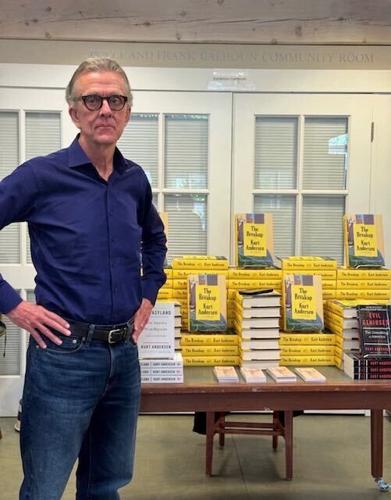
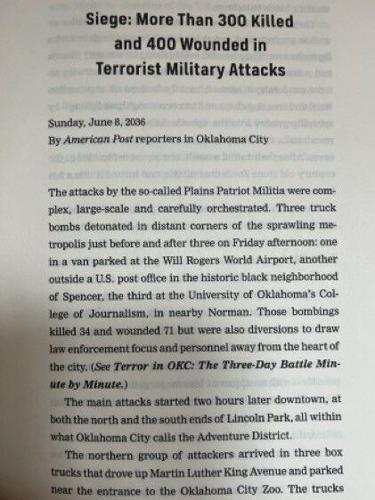

Author and journalist Kurt Andersen’s newest novel, “The Breakup,” pictures a divided America where a second civil war begins with a series of terrorist attacks throughout Oklahoma, including at OU’s Gaylord College of Journalism and Mass Communications and the Will Rogers International Airport.
Andersen has spent decades writing about American culture and politics. In 1986, he co-founded the satirical magazine Spy and later served as the editor-in-chief of New York magazine. He also co-created and hosted the Peabody Award-winning podcast “Studio 360” and wrote the second season of “The World According to Jeff Goldblum.”
Published Aug. 18, “The Breakup” is set in 2045 and follows an American family as they take a cross-country road trip to look at colleges for their younger child.
For Andersen, Oklahoma seemed like a realistic location for the opening attacks.
“Given the story I’m telling, I thought this should be in a red state, a very red state, obviously, where this militia that gets together and does these attacks could plausibly exist,” Andersen said.
Andersen grew up in Omaha, Nebraska, but visited Oklahoma for Nebraska-Oklahoma football games and to visit friends in Tulsa. He said that his time spent in Oklahoma has given him enough familiarity for the book.
While the opening includes several smaller attacks throughout Oklahoma, the main attack is in Oklahoma City. Andersen said he wanted to contrast the diversity of Oklahoma City with the state’s conservative political status.
“That conflict within a red state just seemed right as a plausible thing,” Andersen said. “I could have chosen other places, but I chose it. Once I made that choice and started research … I thought that for the particular story and how I set up this attack, that it was appropriate.”
As he researched, Andersen began adding specific locations to the story.
“I thought that these terrorists make these specific choices about where they attack for various reasons, both kind of tactically and symbolically,” Andersen said. “I thought attacking the university and the journalism part of the university was something people like that might choose to do.”

First page of Kurt Andersen's novel, "The Breakup," describing a series of terrorist attacks throughout Oklahoma.
Will Rogers was also targeted in the book. A Transportation Security Administration spokesperson wrote in an email to the Daily that the agency has evolved over the past 25 years.
“Aviation security today is layered and adaptive and relies on continuous assessment of emerging threats,” the spokesperson wrote. “TSA maintains a highly trained, skilled, and flexible workforce who uses cutting-edge technology to create multiple layers of security to mitigate threats to the nation’s air transportation system.”
The email also stated that transportation threats continue to evolve, including those involving explosives.
“TSA remains adaptive, agile, intelligence-driven and focused on elevating the passenger experience while providing the highest levels of transportation security,” the spokesperson wrote.
Andersen said that the 1995 Oklahoma City bombing influenced him as he viewed it as a precursor to the fictional attacks in his book.
The idea for “The Breakup” came from his earlier nonfiction work. Where his previous two books, “Fantasyland” and “Evil Geniuses,” explore how the U.S. came to be what it is today, Andersen said he wanted to write about where America could go.
“If I were going to write another nonfiction book, it would be, ‘What’s the future going to hold?’ Here’s the past. Here’s how I see the past, and here we are, and how we’re kind of in a screwed up place. Now, I can write about the future,” Andersen said. “But then I realized that I am only interested in doing that as fiction, as speculation.”
Andersen said that he did the research required for a nonfiction book, but decided to write it as a novel through the eyes of a family.
Although the novel presents a dystopian future, Andersen said that he did not intend to write this as a fantasy.
“It’s not like, ‘Oh, you know we’ll be living on Mars and [artificial intelligence] will be our spouses,’” Andersen said. “I just wasn’t that interested in that more fantastical future. I was interested in a plausible future.”
Andersen began writing the novel in late 2022, before ChatGPT had been released to the public. Since then, he said that developments in AI and politics have made parts of the story feel more relevant.
“(Since) three and a half years ago, lots has changed politically and technologically, but fortunately for me, nothing changed so much that I had to be like, ‘Oh my gosh, my whole thing is blown to smithereens,’ …” Andersen said. “It seems more timely today to have a book that’s significantly about AI and an increasingly divisive future in 2026 than it did even in 2022-23 when it began.”
The novel’s 2045 setting was also intentional, as Andersen wanted the story to feel close enough to be believable, but far enough away to leave room for political and technological changes.
Andersen said that he considered moving the story closer to the present once he saw how far AI had come in only a few years, but he ultimately decided that 2045 was the right timeframe.
“It seemed right in terms of not too far, not too close — kind of a Goldilocks moment to write about,” Andersen said.
The future Andersen presents is not necessarily the one he expects.
“I don’t think this is our future, but I think it’s a future,” Andersen said.
Andersen said that uncertainty of the future is one of the reasons why he decided to write “The Breakup” as a work of fiction.
“To me, the future by nature is fiction,” Andersen said. “It’s whatever we think it’s going to be. It’s imaginary because it hasn’t happened yet. ... I just don’t feel the ability or the interest about making such pronouncements or interpretations about the future, so that’s why it’s a novel.”
Andersen said the novel is ultimately intended to make readers consider what could happen, rather than telling them what will happen.
“I think it’s a good story, I hope,... but I think also it’s a good thing to have this laid out as, ‘OK, this is what can happen,’” Andersen said. “Look at it. Deal with it, people.”
This story was edited by Madisson Cameron. Kylie Caldwell and Sophie Hemker copy edited this story.


