
In November 2022, OpenAI launched ChatGPT, an artificial intelligence engine that synthesizes information into human-like responses. Since then, AI engines such as Midjourney and Perplexity have gained popularity among students and professionals in the United States and abroad.
The integration of AI in education at OU is still evolving. Hunter Heyck, an OU history of science professor, said many professors and students are still wondering to what extent people should trust AI, especially when engines are sometimes synthesizing sensitive information.
“Right now, there's a sort of war between (different opinions) of AI,” Heyck said. “Is it some sort of cheap knockoff that can never be good enough, or is it somehow better than what we already are?”
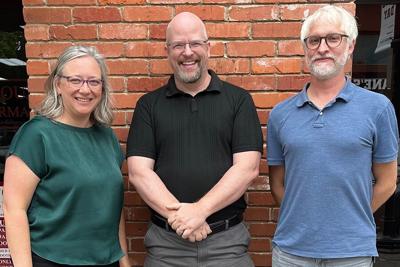
Heyck, along with OU professors Kimberly Marshall and Pete Froslie, will spearhead a new center dedicated to AI and human creativity as co-principal investigators. Heyck will serve as the center’s inaugural director.
The Center for Creativity and Authenticity in AI Cultural Production will open in July with funding from a nearly $500,000 grant from the National Endowment for the Humanities.
Heyck said that right now, he believes AI is in an uncertain place.
“Anytime you have a new technology that is powerful, you have to develop norms and rules for how to deal with it,” Heyck said. “Right now, we're at the point where we haven't developed this yet.”
Heyck said the center will be about “catalyzing work” around AI and its cultural and ethical implications. According to Heyck, creativity, authenticity and appropriation in relation to AI will also be studied at the center.
OU is one of five universities awarded grants to study AI by the National Endowment for Humanities. Heyck said the goal of the center is not to pave the way but to set the example.
“The goal of the center is not to build a big building and create a big mission with a lab like some other kind of center,” Heyck said. “The goal is really to engage people from different fields in conversation and catalyze research groups that will bring these new perspectives to understanding AI and its meaning in society, as opposed to the center doing all the research itself.”
As the use of AI in education has risen in recent years, professors across OU’s campus have responded differently. Casey Nguyen, a supply chain management senior and president of OU’s Artificial Intelligence Organization, a registered student organization dedicated to studying and promoting AI, said some of her professors are still skeptical of AI in the classroom.
“They think it's something that limits the ability of the students to think critically. But if you encourage students to use it correctly, then that is where it's like, ‘OK, they are able to use AI how it’s supposed to,’” Nguyen said. “This is not supposed to be a dangerous thing.”
Some professors, such as Heyck, have incorporated AI in their classrooms to experiment with its accuracy. Heyck said his approach to AI in the classroom is meant to help students recognize and think through problems, rather than applying the first solution that comes to their head.
“This semester, I actually changed an essay assignment where I have them AI generate an initial draft of a very short essay ... and then they write a critique themselves. You know, did (AI) hallucinate something that isn’t generally true? How is the information generated applicable to this class?” Heyck said. “I’m a teacher, I’m not a cop.”
Usman Syed, computer science senior and OU AI outreach director, said he would like there to be less fear surrounding artificial intelligence and for it to be more accepted.
“A lot of people are scared, so how do we regulate new things like AI in a responsible and ethical way while maintaining innovation and not limiting our (human) ability,” Syed said.
In an interview with OU Daily editors on Sept. 25, OU President Joseph Harroz Jr. said university leaders are having conversations about how OU will use AI. Harroz said it’s not reasonable to completely restrict AI, and it’s important to understand how it can be properly deployed across campus.
“It’s exciting, it’s amazing,” Harroz said. “To educate our students for tomorrow, we have to make sure we can use the tools of today, so we’re going to embrace it.”
OU’s AI center will also emphasize the application of AI studies to Native American art, history and culture, something Heyck said was a key pillar of the center to him and the founders.
“There's a vibrant community of Native American artists, and being able to integrate them into this project is absolutely essential, and it was really one of the strengths of the project,” Heyck said.
Heyck said certain aspects, like the integration of Native American art, make the AI center unique. He said posing out-of-the-box questions presents a new perspective on what AI is and its use in today’s world.
“What is the nature of creativity? Is it possible to see the (AI) machine as ‘kin’ in a way?” Heyck said. “The goal is really to have these kinds of conversations that bring people together and launch research. The bounds on rationality make rationality possible.”
These questions and answers come with an urgency. With AI storming onto the scene as other inventions have before, Heyck said the place is here, and the time is right now.
“We can’t wait 250 years to get this right. Right now, AI is a set of technological solutions, and we don’t quite know what problems they are there to solve,” Heyck said. “We have not had that social reinvention to figure out who this is really for, what this is really going to do and how it fits into the ecology of our lives.”
Melody Sharifi, finance and management information systems junior and executive director of Hacklahoma, an OU tech organization that hosts events related to AI, computer science and virtual reality, said this is a time for adaptation.
“It’s an exciting time to be at the intersection of technology and innovation,” Sharifi said. “AI is rapidly evolving, and its role in society will only continue to grow. People should not be scared of AI but should instead adapt the best they can.”
The balance between finding a lasting solution to AI while not disrupting the natural flow of innovation is something that is not new. Heyck said the advancement of technology with the culture of the day creates a unique “dance.”
“Technology and culture—every now and then, they kind of collide like billiard balls. It's more like a dance,” Heyck said. “They're always one leading, one following. There's a lot of back-leading, but basically it's all this sort of mutual interaction.”
Heyck said the center is an example of the importance of universities supporting research in the arts and humanities.
“Building big new labs for STEM is fantastic, but there are also great returns from investment in the arts and humanities,” Heyck said. “Sometimes it gets overlooked because there are fewer zeros on the checks that come around, but we think that we have a very important role to play in framing the questions we ask about technological and cultural AI developments.”
This story was edited by Anusha Fathepure, Ismael Lele and Ana Barboza. Geethika Kollu, Avery Avery, Mary Ann Livingood, Riley McDaniel and Josh McDaniel copy edited this story.


