
Professors at OU discussed how they will approach the rise of artificial intelligence chatbot use as students across the nation reportedly utilize these programs to complete coursework.
Launched in November by artificial intelligence lab OpenAI, ChatGPT is a chatbot designed to generate human-like responses based on user entries. College students have started using this chatbot for schoolwork, according to The New York Times.
James Zainaldin, an OU Classics assistant professor, said he’s had students express interest in using chatbots to hold conversations with historical figures.
“Producing text from the point of view of historical figures … (is) interesting, in a sense, bringing life to these ancient thinkers,” Zainaldin said, referencing the potential of using ChatGPT to hold a conversation with a figure such as Aristotle.
With the possibility of students misusing the chatbot to plagiarize their coursework, Zainaldin said he holds students to an honor code where their work must be their own, so the use of AI won’t be acceptable.
Public school systems in New York City and Seattle already moved to block the chatbot on their networks in 2023, but universities, like the University of Florida, have been more reluctant to instill bans. In a statement to NYT, Joe Glover, UF provost, said they were instead making policy changes to back faculty members’ ability to prevent plagiarism.
According to a university spokesperson, OU currently has no plan to block the use of ChatGPT on campus.
“The IT department will continue working with university faculty and leadership to assess AI's role in education. Existing plagiarism detection tools used by OU, such as Turnitin, have announced upcoming changes in AI detection that will assist in upholding academic integrity standards,” the university spokesperson wrote.
David Song, OU assistant professor of Asian American studies, said he holds “ambivalent” feelings toward ChatGPT.
Song was first made aware of the chatbot sometime last fall through the news. Over winter break, he tested ChatGPT by asking the chatbot to write an essay he would normally assign to students.
“ChatGPT got the essay right but in the more surface-level, uninteresting, banal and superficial way possible, in a coherent structure of language that was understandable, but at the same time showed absolutely zero deep understanding or engagement,” Song said.
Song said he believes the most responsible way to approach chatbots and AI in schools is to openly discuss the use of AI with students and that it does not result in the quality of work most professors are expecting.
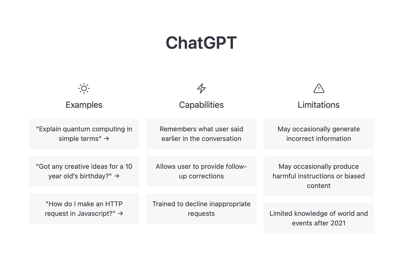
ChatGPT warns its users that the system may generate incorrect or misleading information in its usage, possibly even producing “biased” or “offensive” content. The machine also strongly suggests users not divulge any private or sensitive information while using the software.
He said he plans to address the use of ChatGPT in classes next week with someone from the Office of Academic Integrity and “dispel the kind of mystique around AI without dismissing the potentially constructive and non-plagiaristic uses.”
William Endres, a digital humanist and English assistant professor, said the best way to prevent the use of chatbots for plagiarism is good writing assignments and instructors working through the writing process with students.
“I will continue to do what I have been doing, creating writing assignments that strive to engage students in ways particular to the class and open to their interests,” Endres said.


