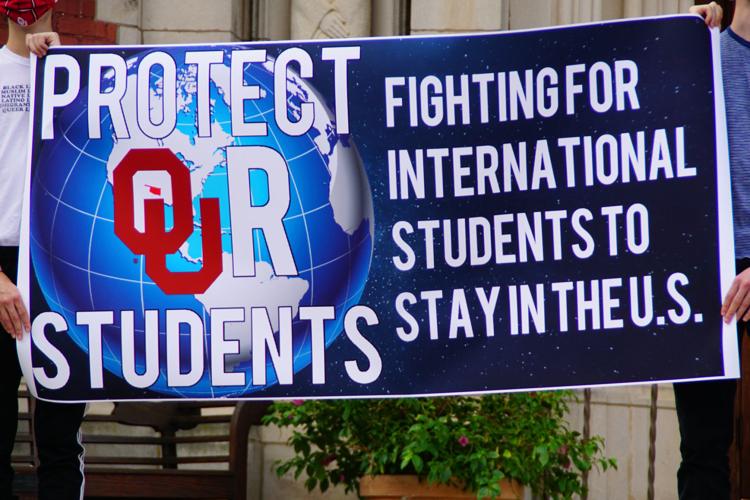


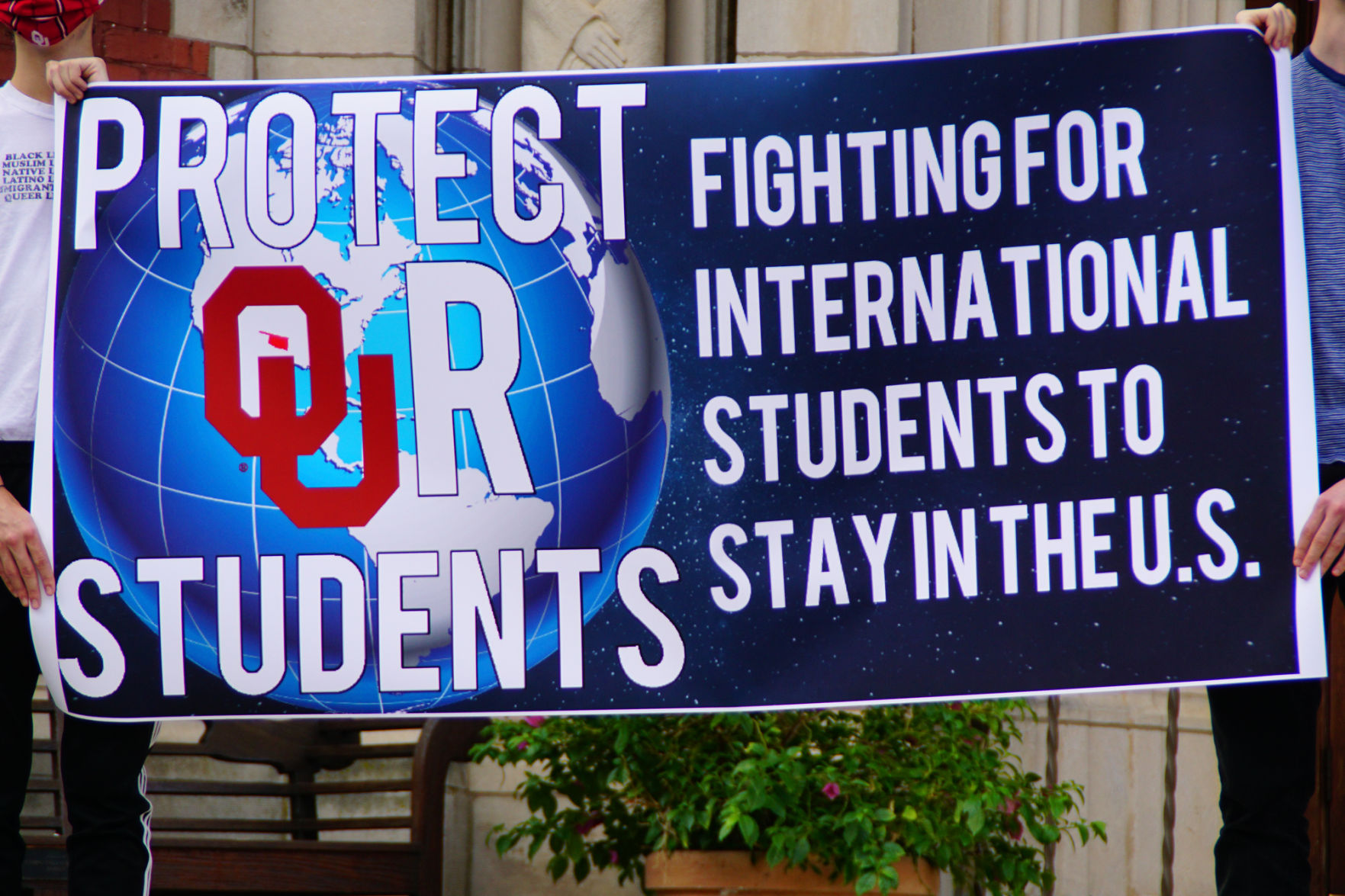
A sign at the rally for international students on July 13.
This story is part of OU Daily’s summer magazine. This publication will be available in mid-April on racks around campus and online at oudaily.com.
One evening, Brinly Jaja sat at the desk in her apartment and scrolled through her Instagram and TikTok.
She would often re-share posts and news articles she found that advocate for issues such as abortion rights or Palestinian liberation, adding her own thoughts in her reposts. As an international student and education officer for the OU African Student Association, Jaja felt it was her duty to spread awareness and educate others.
This time, however, rather than sharing, Jaja scrolled through her posts and pressed "delete," one after the other, until any post relating to political issues in the U.S. were gone.
It was early November — about a month after the militant group Hamas attacked Israel on Oct. 7 — and prominent Republican leaders were threatening to deport international college students and defund universities seen expressing support for Hamas or failing to address antisemitism. However, the leaders were vague on what language was punishable under the proposals, and many have equated anti-Israel and pro-Palestine sentiments as support for Hamas.
When Jaja's father, who lives in her home country of Nigeria, heard of these threats, he called her and told her to stop speaking out on the war in Gaza and other controversial issues in the U.S.
"You don't want to be a target right now," Jaja recalled her father saying during the November phone call. "You need to take that down immediately."
So Jaja did.
"It's very restricting," Jaja said. "I really want to spread awareness. … The more I post, the more people tend to engage, and people tend to get more education.
"I felt like I was not doing the most for people."
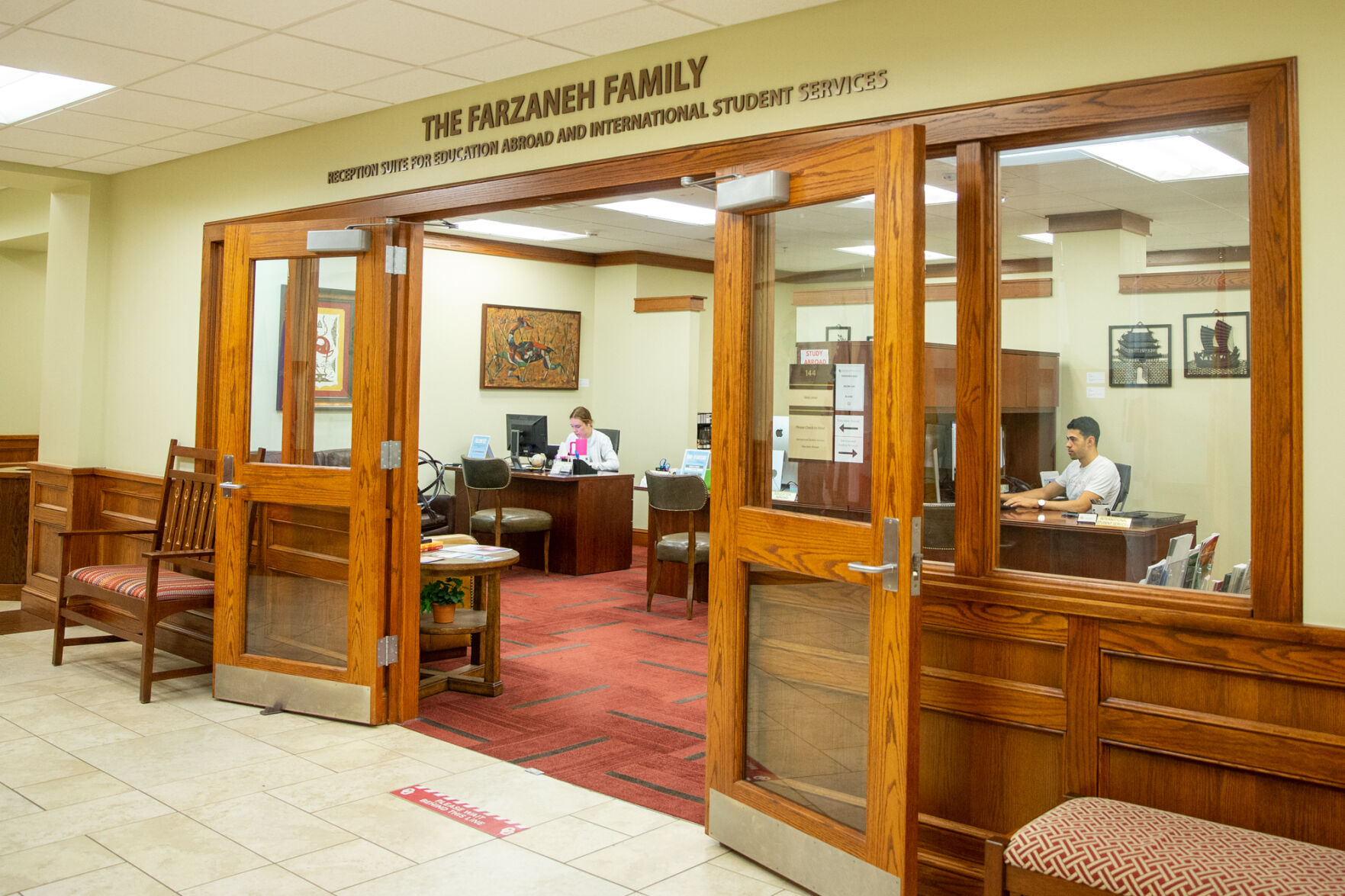
The International Student Services office located in Farzaneh Hall on April 15.
'Constitutionally problematic'
While the U.S. is known for its expansive free speech protections, speaking out comes with an added risk for noncitizens, including immigrants lacking permanent legal status, green card holders, immigrant visa holders and nonimmigrant visa holders, such as international students.
Kit Johnson, an immigration lawyer and professor at the OU College of Law, said while the level of risk is different depending on the noncitizen category a person falls under, the consequences are generally the same.
"The question is, 'Can voicing an opinion alone — can words — result in your expulsion from the country?' And my answer is 'Yes, it can,'" Johnson said.
Under the Immigration and Nationality Act, noncitizens can be deported for failing to meet visa requirements, violating U.S. law and engaging in or supporting terrorist activity, which includes using speech that endorses, espouses or incites terrorist activity.
Political speech not under this category is not a deportable offense alone but can be used by prosecutors to prioritize the order in which noncitizens are removed from the country.
"(There's) lots of reasons … that the government can lodge as the basis for deporting, but then among that you have to decide 'Well, who gets deported first?'" said Eang Ngov, a constitutional and public interest lawyer and professor at the OU College of Law. Ngov said any opinions she expressed in this article are her own and do not reflect the stance of the university.
"The prioritizing can be based on their political views, but it can't be prioritized without a foundational deportable offense. And so that's where the politicians and their comments are a little misleading," Ngov said.
Following a wave of countrywide protests after Hamas' attack on Israel, GOP leaders, including former President Donald Trump, Florida Gov. Ron DeSantis and South Carolina Sen. Tim Scott, called for the federal government to revoke the visas of international students seen as "supporting Hamas," with others going so far as to suggest universities should lose public funding.
Referring to demonstrations protesting Israel’s retaliatory bombardment of Gaza, Trump promised during an October rally in Iowa to send Immigration and Customs Enforcement agents to what he called “pro-jihadist” rallies. Trump added his administration would revoke the visas of "radical anti-American and antisemitic foreigners," such as pro-Palestinian demonstrators.
"Jihadism" is a Western term used to describe militant Islamic movements that are viewed as threatening to the West.
At an Iowa GOP candidate showcase just a few days later, DeSantis pledged to revoke the student visas of "Hamas sympathizers" if elected president, and Scott said he would withhold Pell Grants from universities failing to adequately address antisemitism. Both DeSantis and Scott have since dropped out of the presidential race.
Neither Trump nor DeSantis specified how they would determine who falls into these categories, and many have applied a “pro-Hamas” label to people expressing support for Palestine or condemning the actions of the Israeli military.
Ngov described the politicians' proposals for deporting foreign students based on their speech as constitutionally "half right and half wrong," since the politicians didn't specify what language they were referring to. However, Ngov said it would be unconstitutional to defund a school based on the speech of its students, as viewpoint discrimination is prohibited under the First Amendment.
"That aspect of what they are saying may be constitutionally problematic," Ngov said. "It just sounds like campaign puffery."
'This is the time for citizen allies to step up'
Still, many politicians and universities are taking measures to regulate speech on campuses.
In October, Ray Rodrigues, chancellor of the State University System of Florida, in consultation with DeSantis, wrote a letter to university presidents calling for the deactivation of two campus chapters of Students for Justice in Palestine after the group released a "Day of Resistance toolkit." In the toolkit, the students wrote, “We as Palestinian students in exile are PART of this movement, not in solidarity with this movement.”
In Rodrigues' letter, he wrote, "It is a felony under Florida law to ‘knowingly provide material support … to a designated foreign terrorist organization,’” and that the National SJP “has affirmatively identified” with Hamas’ Oct. 7 terrorist attack on Israel. The U.S. identifies Hamas as a terrorist organization.
In March, Texas Gov. Greg Abbott signed an executive order targeting antisemitism in institutions of higher education. In the order, Abbott wrote that while many Texas universities have acted quickly to condemn antisemitism, “some radical organizations have engaged in unacceptable actions on university campuses.”
The order calls for higher education institutions to review free speech policies to address the rise in antisemitic speech on campus; ensure the enforcement of these policies on campus and that "groups such as the Palestine Solidarity Committee and Students for Justice in Palestine are disciplined for violating these policies"; and include the definition of antisemitism, as listed under the Texas Government Code, in university free speech policies.
The Palestine Solidarity Committee and SJP are student organizations advocating for Palestinian liberation present on some campuses across the U.S.
Florida and Texas are not the only states with speech restrictions on campus.
A Foundation for Individual Rights and Expression analysis found among 489 U.S. universities surveyed, around 85% have policies in place restricting speech.
FIRE gave OU — a university with over 1,500 international students — a "yellow light” rating, meaning it has at least one policy that could be easily applied to suppress protected speech or has policies restricting relatively low categories of speech. The University of Texas at Austin and Oklahoma State University were also given yellow light ratings.
In 2022, the OU Board of Regents adopted the Chicago Statement, a free speech policy statement produced by the Committee on Freedom of Expression at the University of Chicago.
Under the Chicago Statement, the university may restrict expression that violates the law, falsely defames a specific individual, constitutes a genuine threat or harassment, unjustifiably invades substantial privacy or confidentiality interests or is incompatible with the functioning of the university. The statement added the university may reasonably regulate the time, place and manner of expression to ensure it doesn't disrupt university activities.
"These are narrow exceptions to the general principle of freedom of expression, and it is vitally important that these exceptions never be used in a manner that is inconsistent with the university’s commitment to a completely free and open discussion of ideas," the statement reads.
Though international students' speech is protected in most cases, Johnson said the risk of speaking out is often too great.
"This is the time for citizen allies to step up," Johnson said. "This is the time when you have U.S. citizen allies be the ones who lead the fight, because I wouldn't want to take on the risks associated with being a noncitizen in the United States."

'We're already targeted'
Six months later, the war in Gaza continues to be a contentious topic both on campus and in politics, pushing many international students into silence and testing the limits of free speech protection.
When Silma Nurfadhilah, an international studies sophomore from Indonesia, heard of the politicians' proposals to deport international students, she said she feared for her safety.
"I was really scared. I mean, I am physically Muslim," Nurfadhilah, who wears a hijab, said. "What if someone attacked me or said something in my face or something like that? Just because I look a certain way."
In the three months after the war began, the Council on American-Islamic Relations, the U.S.'s largest Muslim civil rights and advocacy organization, saw a nearly 180% rise in complaints of anti-Muslim and anti-Palestinian discrimination and hate, when compared to a similar period in 2022.
Among the complaints filed between October and December, CAIR reported employment discrimination, hate crimes and incidents and education discrimination were the three highest reported categories.
The 2024-25 OU Annual Security and Fire Safety Report, which will report crime statistics, including instances of discrimination from 2023, will not be available until the fall. OU Daily reached out to the OU Police Department for statistics on reports of anti-Muslim and anti-Palestine discrimination, but was told this data is not available.
Ridha Fatima, an information sciences and technology junior from the United Arab Emirates, said speaking out as international students only brings more attention to them, which could lead to harm.
"It's pretty easy to notice an international student, it could just be our color, language, anything," Fatima said. "We're already noticeable in the crowd and by expressing our political opinions or controversial opinions freely and loudly, it just makes us stand out even more. … We’re already targeted.”
Both Fatima and Nurfadhilah said they sometimes limit what they say on social media for fear of losing their visas or risking their safety. Like Jaja, Fatima's and Nurfadhilah's families warned them not to speak out on controversial issues in the U.S.
Fatima said it's hard for her not to share her opinions, particularly relating to issues directly affecting her such as the ongoing battle over abortion rights. Noncitizens don't have representatives in the U.S. government, so there's no one they can call to voice their frustrations to, Fatima said.
Even diversity, equity and inclusion — a topic facing intense scrutiny from Republican lawmakers across the country — is a touchy subject for noncitizens to discuss.
Following Oklahoma Gov. Kevin Stitt's December executive order targeting DEI in higher education, the Black Emergency Response Team and African Student Association, two student organizations at OU, hosted a discussion concerning Stitt's order.
At the event, Jaja said she worried talking about DEI on social media would affect her ability to renew her visa. Others at the event reassured Jaja this speech would be protected, but Jaja said she's still cautious about sharing her own opinions on these matters.
Fatima and Nurfadhilah said they are careful with what they say on social media, asking themselves what the consequences of speaking out may be and if it’s worth the risk before they press post.
Fatima said she not only has to worry about how her words are perceived in the U.S., but how they might be viewed in other countries as well.
For example, Fatima said in the U.S. she felt comfortable talking about Nex Benedict, a nonbinary student who died by suicide last month after experiencing a fight in their high school bathroom. In the United Arab Emirates, where talking about gender is controversial, Fatima said she could not talk about Benedict.
"I live in three different places," said Fatima, who is a resident of the U.S., India and the United Arab Emirates. "I have three different statuses, I have to think about all my three statuses at the same time. I need to maintain all three of them at the same time. So that can be very challenging."
Fatima and Nurfadhilah said they stop posting on social media altogether before traveling, when U.S. Customs and Border Protection agents can ask to search their phones.
At protests, they turn their phones on airplane mode to prevent potentially being tracked through connection to cell towers. They've seen international students in other states doxxed — having their personal information publicly revealed by someone with an intent to cause harm — for speaking out on social media or participating in demonstrations.
"We're conscious of what happened to other international students in other states," Nurfadhilah said. "Like, oh, it could be me."
Since the war began, faculty and students at universities across the country have had their faces displayed on billboard trucks branding them as antisemitic.
The trucks, commonly referred to as "doxxing trucks," are operated by the conservative nonprofit Accuracy in Media to "expose antisemitic students and faculty." Doxxing trucks have been seen at Columbia; Harvard University; the University of California, Berkeley; the University of Colorado Boulder; the University of North Carolina at Chapel Hill; and the University of Southern California.
"You can express your opinion freely as long as they agree with you,” Fatima said. “The moment you do not, that's when you are in trouble."
Some international students at OU said while the Office of International Student Services provides a lot of support, OU needs to do a better job of informing international students of what is and is not permissible for them to do to maintain their visa status.
The Office of International Student Services is very small, Fatima said, making it difficult for the employees there to fully inform individual students of the terms of their visas and U.S. law.
The Office of International Student Services holds 12 staff positions, roughly one employee for every 125 international students.
"That's why a lot of times students and student organizations take up the responsibility of educating," Fatima said.
Both Fatima and Nurfadhilah work with the OU International Advisory Committee, an umbrella student organization that represents international students and coordinates international student organizations.
Fatia and Nurfadhilah said those with the IAC help share information from International Student Services with other international students.
"These (international) students, they're coming from not knowing anything to a whole different government and everything, and it's a lot of information," Fatima said. "Letting students know and making them aware of what they can and what they cannot do is very, very important. Just because, like it might just be the smallest thing that could get someone in trouble."
Noncitizens can't speak out on issues without at least some personal risk, Johnson said. A post made on an account with only a few followers can easily go viral, possibly putting a noncitizen on the radar of someone who wants them expelled from the country.
"Even though we in the United States think of the First Amendment as inviolate — so important, we can all say whatever it is that we want — that doesn't work for noncitizens," Johnson said.
Jaja said the politicians' proposals to deport international students for their speech highlight the hypocrisy of the U.S. boasting First Amendment rights, all the while restricting them for certain populations.
"This country advocates for freedom of speech, but it doesn't seem like there's an indication that that is actually being done in this country," Jaja said. "(International students) also have rights. … Anywhere we go, we're human beings, so we have human rights. … International students should have the right to say as they please."
Read more from summer magazine:


This story was edited by Peggy Dodd, Anusha Fathepure and Ismael Lele. Sophie Hemker, Nikkie Aisha and Mary Ann Livingood copy edited this story.


