
Following the discovery of possibly 100-year-old cadavers on campus, state anatomy experts detailed where and how OU’s modern-day cadaver lab operates.
Cindy Gordon, an OU professor in the School of Biological Sciences, serves as director of the human anatomy program. The program includes two anatomy courses — Introduction to Human Anatomy and Human Anatomy — in which groups of students are paired with a cadaver to work on throughout the semester.
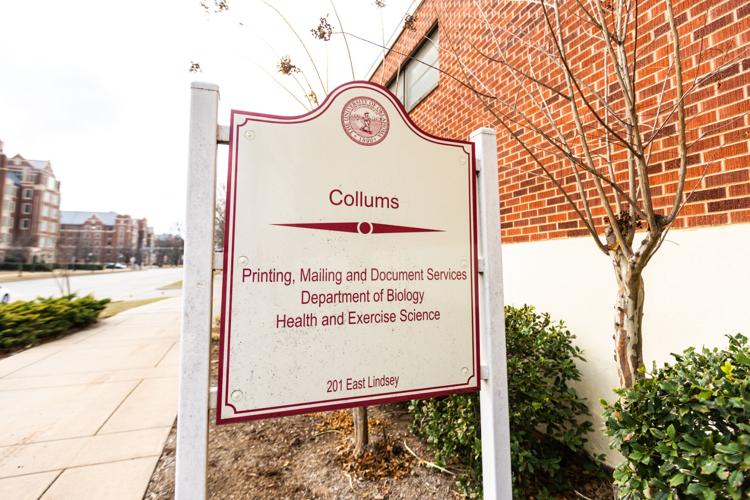
Collums Building near Everest Indoor Training Center hosts the cadaver lab on OU’s Norman campus, according to Gordon. During the academic year, the lab hosts 16 cadavers each semester. During the summer, the lab hosts eight cadavers for education.
“It allows (students) to get hands on,” Gordon said. “It's an opportunity for them to basically learn the body and learn everything about it.”
To take part in either course, students must have completed an introductory biology course and be at a sophomore level or above — a limitation Gordan said is intended to ensure students possess the maturity to deal with dissecting cadavers
“These are people that have willingly donated their body, or their families have donated their body, …” Gordon said. “These are people that willingly did it so that they could be an amazing resource and offer the opportunity for (students) to have this ability to learn.”
Michelle Keppel, administrative manager of OU’s Willed Body Program, said OU Health serves as the centralized location where all cadavers are stored. The Willed Body Program allows individuals to donate their bodies to the College of Medicine for medical education, research and scientific study after death.
Read more about the Willed Body Program:
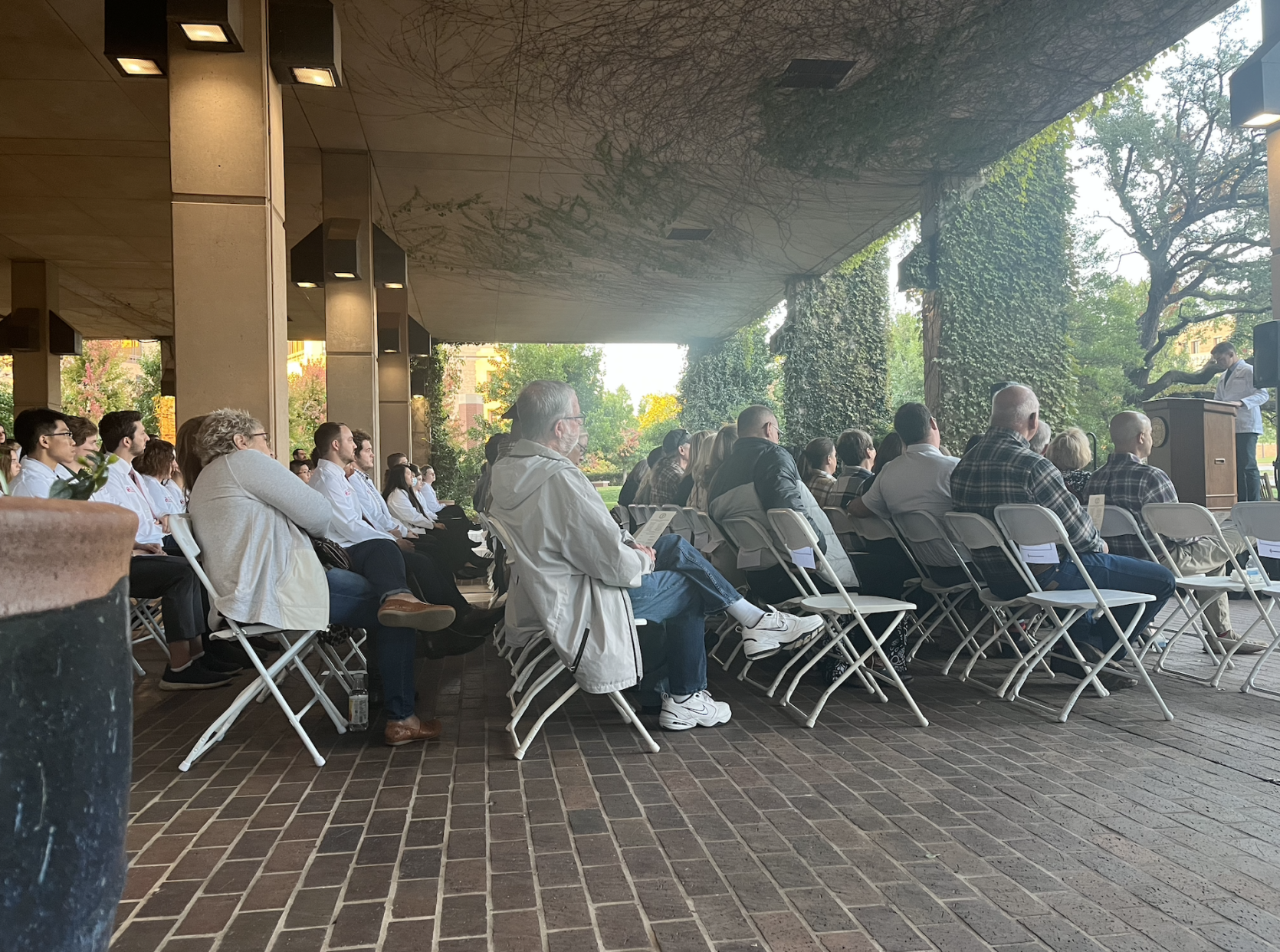
Through the program, OU Health manages the acquisition and care of cadavers and will send donor bodies to OU’s Tulsa and Norman programs, Keppel said.
“Upon completion of coursework or training, the program coordinates the donors' return to the OU Health Campus for cremation and disposition, such as final return to their families or interment, based on the donor’s stated wishes,” OU Marketing and Communications wrote in a Wednesday email.
Gordon said privacy and security are a top priority for those operating the Collums Building lab.
Students in the courses receive special card access to the building only during the select hours classes are held, according to Gordon. If a student drops the class or the semester ends, card access is immediately revoked. Gordon said the dissection room and cooler room for cadaver storage are not visible to the main hallway.
“Anytime we might have to have somebody over there as a visitor, … somebody that's coming in to fix something or whatever, we always close the dissection room door, so that the cadavers aren't visible, …” Gordon said. “Privacy and security are paramount to us over there.”
In February, human remains were found on campus at the construction site of the new Life Sciences Laboratories Building replacing Sutton Hall. OU Marketing and Communications confirmed to the Daily the remains were likely cadavers from the early 1900s.
Kent Smith, chair of the State Anatomical Board, said it wasn’t uncommon for students to bury dissected cadavers on campus grounds in the early twentieth century. Smith said regulations on cadaver care weren’t established in Oklahoma until the State Anatomical Board was formed in 1935.
The State Anatomical Board oversees, regulates and develops policies to govern the use of donor bodies and cadaver specimens for teaching and research. The two donor programs in the state are at OU College of Medicine and Oklahoma State University’s College of Osteopathic Medicine.
“In addition to overseeing the use of the donor for teaching and research purposes, we also make certain that those individuals that are using our donors for teaching and research meet specific criteria,” Smith said.
Smith said while he was studying for his doctorate in zoology at OU in the early 1990s, his anatomy professor confirmed that as buildings were constructed on the west side of campus, human remains were found on the land.
“There were cadavers that were dissected by the medical students, and upon finishing their dissections, they buried them on campus,” Smith said. “That wasn't uncommon back in 1900 when there was no anatomical board at the time.”
In 1900, OU opened its School of Medicine in Norman. By 1907, the school employed 10 faculty members who served as professors in the science department. In 1910, OU’s medical school merged with Epworth University College of Medicine, moving the school to Oklahoma City.

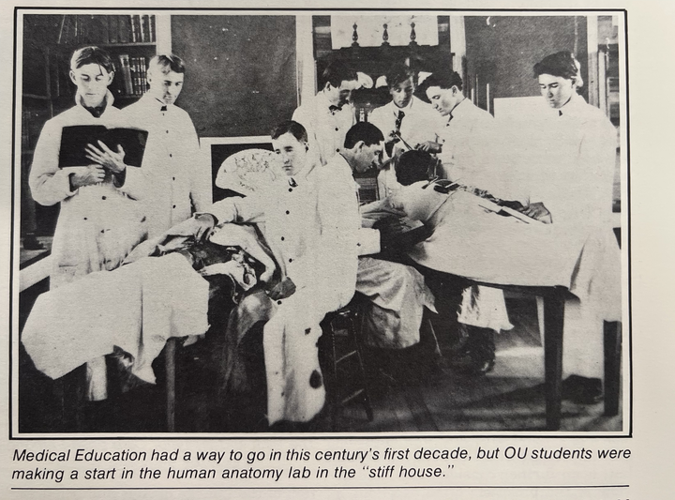
OU medical students printed in "The Sooner Story."
According to a 1951 OU Daily article, construction workers uncovered human heads near Kaufman Hall assumed to be over 40 years old from the original medical school located in Norman. A follow-up article on the discovery predicted there may be more remains in the area.
“Andrews said he believed the construction crew had uncovered only the fringe of the former OU ‘burial ground.’ The section of land south of Brooks street was used for a number of years to bury the medical school cadavers,” the article reads.
The article cites a Dr. J. R. Hinshaw, a staff physician at Ellison infirmary, who confirmed medical students buried bodies around campus.
“Information given by Dr. J. R. Hinshaw, staff physician at Ellison infirmary substantiates the belief that many more bodies probably are buried in this area. Dr. Hinshaw attended the medical school when it was still located in Norman. He was a member of the class of 1921 and, as he recalls, the cadavers were still being buried in this area,” the article reads.
In the first quarter of the twentieth century, OU constructed 14 buildings on its Norman campus. In 1925, Sutton Hall was constructed on the west side of campus behind Old Science Hall, which housed the university’s earliest labs.
Smith said before the board was established, cadavers were commonly unclaimed bodies from hospitals.
“One thing that the formation of the board really did is it organized donors within Oklahoma, and Oklahomans are so, so generous, …” Smith said. “What a wonderful gift it is to provide your body so that future generations of physicians and researchers can improve health and wellness for its citizens, and so I think that's been probably the biggest improvement on cadavers being utilized, is increasing awareness.”

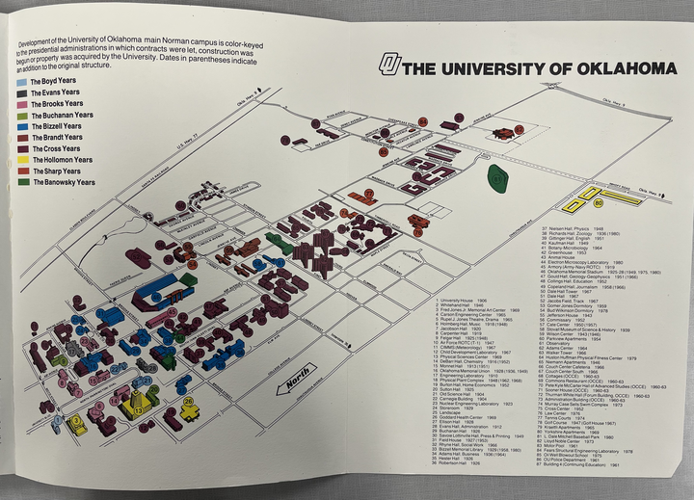
Development of OU Norman campus color-keyed to the presidential administration in which contracts were left from "The Sooner Story."
Gordon said since the discovery of the cadavers at the construction site, she has seen comments online that people think burying cadavers is still common practice.
“I hope that people understand how different things are nowadays, …” Gordon said. “It’s such an incredible gift and something that is used to the greatest amount we can make that gift worthwhile for these (students). Nothing is wasted. It’s an important part of (students’) education, and I hope that people continue to look at that as something they can do for the state.”
This story was edited by Audrey McClour and Natalie Armour. Mary Ann Livingood copy edited this story.


