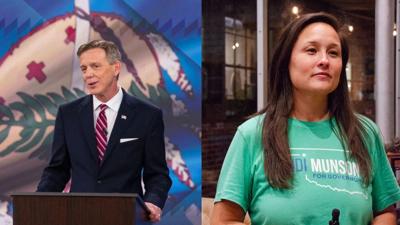
With the election for Oklahoma’s new governor approaching, Oklahomans are wondering how the gubernatorial candidates plan to improve education in the state.
The governor’s role in higher education
The governor does not have direct control over the everyday operations of higher education. However, it is within the governor’s power to issue executive orders, as Gov. Kevin Stitt has done this year with Executive Order 2026-06 regarding tenure reform.
Stitt issued the order in February, prohibiting publicly funded regional colleges and universities from granting lifetime tenure appointments after the date of the executive order.
The governor appoints regents to nine-year terms for the Oklahoma State Regents for Higher Education, with the approval from the Oklahoma Senate.
The Oklahoma State Regents for Higher Education is the coordinating board of the Oklahoma State System of Higher Education. The board’s responsibilities include setting academic standards, determining which courses are offered, allocating state-appropriated funds to institutions and approving tuition and fees within the limits established by the Legislature.
OU political science professor Melody Rowlett said the power the governor holds in Oklahoma is weak.
“The system is set up so that the attorney general is independent of the governor, and the labor commissioner is independent of the governor because we elect them separately, and so that limits the governor’s power,” Rowlett said.
Rowlett believes that if the governor works closely with the legislature, they could have a direct impact on higher education.
“If the governor is dedicated to doing something or creating a change, the governor usually has a lot of sway with the legislature,” Rowlett said.
That influence could determine how Oklahoma funds its public colleges and universities.
Rowlett believes that the biggest problem currently facing Oklahoma’s higher education is a lack of funding.
“Higher education has been systematically underfunded since 2008 in Oklahoma, …” Rowlett said. “Because of that, there are fewer things that can be done to aid students who need help, … that means that we have fewer faculty to offer more things to students and so it just makes for a poorer education all around.”

Mike Mazzei’s approach to higher education
Mike Mazzei has emphasized expanding career and technical education pathways and strengthening relationships with Oklahoma employers. Michael Givel, a political science professor at OU, said that some of those programs include auto mechanics, electricians and plumbers.
Givel added that the Moore Norman Technology Center serves as a good example of one of those pathways that is data-driven and reports progress to taxpayers.
“He would like to see higher education run as a business, so we need measurable outcome results and performance metrics for … professors in terms of graduation rates, the amount of grants they get and all that sort of thing,” Givel said.
Mazzei wants students to be prepared to enter the workforce or higher education programs upon graduation.
“A diploma should represent readiness, not just completion,” according to Mazzei’s campaign website.
Oklahoma literacy rates have slowly started to decline since 2015. The state is currently ranked 47th in fourth-grade literacy. Over 500,000 Oklahomans likely fall below the national average for literacy.
“I will hire a statewide literacy director in my first week in office to replicate the very successful Mississippi model,” Mazzei said at a debate Oct. 1.
Cyndi Munson’s approach to higher education
In her campaign, Cyndi Munson has emphasized making higher education more accessible and increasing funding for public colleges and universities.
Munson has worked with the Regional University System of Oklahoma to update regional university campuses so they align with safety regulations. State funding favors OU and OSU, Oklahoma’s top research universities, leaving smaller colleges to operate with strict budgets.
Munson has also proposed expanding Oklahoma’s Promise, a tuition scholarship for low-income students.
“When I attended the University of Central Oklahoma, I was able to afford it because of Oklahoma’s Promise, and I became the first in my family to graduate from college,” Munson said during her candidacy declaration in April 2025.
She plans to expand its reach to veterans, all public school employees and their respective families. Givel said this would give high schoolers across Oklahoma the opportunity to attend public universities and colleges.
Over 115,000 college students have earned tuition scholarships through Oklahoma’s Promise since the program was created in 1992. Munson’s proposal aims to raise that number.
“It would assist people with low and moderate backgrounds to get a college education. … It would actually increase that opportunity,” Givel said.
This story was edited by Macey Thaxton. Kylie Caldwell, Brooks Davis, Tori Pham, Larkin Bock and Sophie Hemker.


