Oklahoma Republicans retained every seat in the state’s congressional delegation Tuesday, but a Democratic sweep of both chambers of Congress is set to cost the state some of its most influential leadership positions in Washington.
The shift in congressional control will leave Oklahoma’s seven Republican lawmakers in the minority when the new Congress convenes in January, costing several members their committee chairmanships and limiting the state’s ability to shape federal spending, agricultural policy and other legislative priorities
Republican Kevin Hern won the state’s open Senate seat, defeating Democrat N’Kiyla Jasmine Thomas. Hern, who currently represents Oklahoma’s 1st Congressional District, will join Sen. James Lankford in the Senate.
All five of Oklahoma’s U.S. House seats also remained Republican, with Reps. Tom Cole, Frank Lucas, Stephanie Bice and Josh Brecheen winning reelection and Republican Mark Tedford winning Hern’s open 1st District seat.
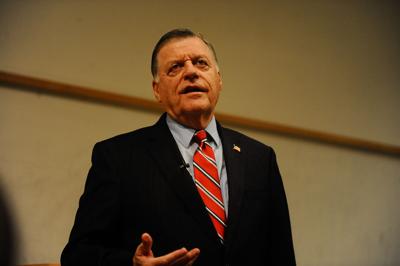
Among the most significant changes will be the loss of Rep. Tom Cole’s chairmanship of the House Appropriations Committee, which oversees federal discretionary spending and plays a central role in determining how federal money is distributed across the country.
Cole (R-Moore) became the first Oklahoman and Native American to chair the committee in 2024. Although he could remain on the committee as its ranking member, he will no longer lead it when Democrats take control of the House.
The change will not automatically affect federal funding already approved by Congress but will reduce Oklahoma’s influence over future spending priorities and negotiations.
During the current Congress, the House Appropriations Committee advanced funding for projects including stormwater and street improvements in Ardmore, a wastewater treatment facility in Newcastle and military facilities at Fort Sill.
Michael Crespin, director of the Carl Albert Congressional Research and Studies Center and a political science professor at the University of Oklahoma, said Cole’s transition to ranking member would limit his ability to shape broader spending priorities but would not necessarily mean significant funding losses for Oklahoma.
“Being chair, you really get to drive things. But ranking member is also an important position,” Crespin said.
Crespin added that Cole’s longstanding relationship with Rep. Rosa DeLauro (D-Conn.), who is expected to lead the committee under the new majority, could help him maintain influence over federal spending decisions.
“I think Representative Cole will still be able to effectively deliver for his district as ranking member,” Crespin said. “Maybe a little less than chair, but it’s not the same as not having someone on the committee.”
Keith Gaddie, the Hoffman Chair of the American Ideal and a political science professor at Texas Christian University, said Cole and Lucas’ influence extends beyond their committee leadership positions.
“These are guys that make the U.S. House go,” Gaddie said. “They are the types of lawmakers [with] a history of being able to work across the aisle.”
But Gaddie raised concerns about Oklahoma’s ability to maintain that influence in the long term, saying newer members of the delegation have yet to establish the same standing in Congress.
“There’s really nobody else in the delegation that’s been building out this kind of portfolio and gravitas,” Gaddie said.
Rep. Stephanie Bice (R-Oklahoma City), who serves alongside Cole on the Appropriations Committee, will also lose her subcommittee leadership positions under the new Democratic majority.
Bice currently serves as vice chair of the Transportation, Housing and Urban Development Appropriations Subcommittee and chairs the House Administration Subcommittee on Modernization and Innovation.
Her appropriations work has helped direct federal funding toward Oklahoma airports, highways, housing and community development, including more than $48 million for 15 projects across the state’s 5th Congressional District in the 2026 fiscal year.
The shift in congressional control will also affect Oklahoma’s representation in the Senate, where Sen. James Lankford currently holds three committee chairmanships.
Lankford chairs the Senate Select Committee on Ethics, the Finance Subcommittee on Energy, Natural Resources and Infrastructure, and the Homeland Security and Governmental Affairs Subcommittee on Border Management, Federal Workforce and Regulatory Affairs.
Those positions give Lankford a significant role in setting committee priorities and overseeing issues involving federal operations, energy policy and infrastructure. Democratic control of the Senate will shift those leadership positions to the new majority, although the Ethics Committee will retain its equal representation of both parties.
Despite those changes, Gaddie said Lankford’s experience and relationships in the Senate could make him an increasingly important figure for Oklahoma.
“Lankford is key,” Gaddie said. “As long as he is around, Oklahoma has a place to play because he’s taken seriously as a lawmaker.”
Oklahoma’s agricultural industry could also feel the effects of the changes.
Rep. Frank Lucas (R-Cheyenne) currently chairs the House Agriculture Subcommittee on Conservation, Research and Biotechnology, which oversees issues including agricultural research, conservation programs and pest and disease management.
Lucas, who has helped shape federal agricultural legislation for decades, will lose his subcommittee chairmanship as Congress works to finalize a new farm bill affecting farmers, ranchers and rural communities.
“We need to finish up the final details on the farm bill, and if we do that, then farm policy is essentially laid down for the next five years,” Lucas said in an election-night interview with Oklahoma Farm Report.
If Congress does not finish the bill by year’s end, negotiations could continue under Democratic leadership, reducing Oklahoma Republicans’ influence over the legislation.
Beyond the loss of committee chairmanships, Oklahoma will also lose representation on the House Ways and Means Committee when Hern leaves the House for the Senate.
“That’s probably more of a loss, right? Because we lose someone on a committee versus just going from chair to ranking member,” Crespin said.
Gaddie added that fewer committee seats could make it harder for Oklahoma Republicans to secure influential assignments.
“We’re going to end up with a lot less influence in the aggregate because the delegation simply won’t be able to get to as many important places,” Gaddie said.
With Democrats controlling committee leadership and much of the legislative agenda, Oklahoma’s Republican lawmakers will have to rely more heavily on bipartisan negotiations to advance the state’s priorities.
Gaylord News is a reporting project of the University of Oklahoma Gaylord College of Journalism and Mass Communication. For more stories by Gaylord News, go to GaylordNews.net.


