
Editor's note: This story is featured in OU Daily's Best of Norman Guide, which is available online and in print. Racks can be found around Norman and campus. Check out the other featured stories at the bottom of this article.
Norman has grown beyond its railroad town beginnings, but traces of the early days remain in its historic homes, familiar streets and the memories of those who’ve watched it change.
The city was named after Abner E. Norman, a surveyor who worked in the area in 1870 whose crew reportedly burned “Norman’s Camp” into a tree. The Atchison, Topeka and Santa Fe Railway selected Norman as a stop, and the first passenger train arrived in June 1887.
Two years later, the Land Run of 1889 opened the surrounding area to non-Indigenous settlement. Norman grew as settlers claimed land and established homes and businesses. OU was established in 1890, bringing students, employees and visitors to Norman, further shaping the city’s identity for generations.
But that familiar account of Norman’s early development is not the whole story.
The transformation of Norman into a settler town also changed life for the Indigenous people whose histories are tied to the land. Understanding the city’s early years means considering both the new community that developed and the people whose lives were affected by that development.
Moore-Lindsay House: a Norman history museum
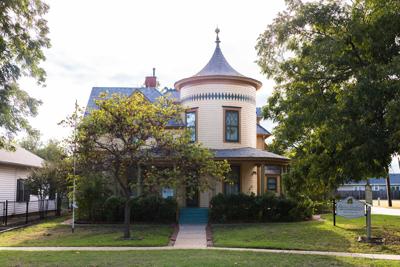
Built in 1899, the Moore-Lindsay Historical House Museum — which now serves as a Norman history museum — is a Victorian home that belonged to members of the Moore and Lindsay families. Their experiences reflected a more affluent side of the community, including dinner parties, women’s social clubs and involvement in charity and politics.
For Savannah Miller, director of the Moore-Lindsay Historical House Museum, the city’s early history becomes more tangible inside a home than on a timeline. To Miller, the Victorian home is one surviving piece of a much larger picture — the Old Silk Stocking neighborhood.
“It was the district where, if you lived here, you could afford to have your stockings made out of silk rather than cotton. So it was kind of the well-to-do neighborhood,” Miller said. “That was pretty significant for how it started out. It obviously continued to grow from that. It does seem to me that this neighborhood has always kind of been really close.”
Over time, the house underwent renovations including electricity and indoor plumbing, shadowing the technological evolutions much of Norman was going through. The house itself holds century-old stories that are just as endearing as they are relatable today.
“Mrs. Lindsay really loved to cook, and her grandkids and great-grandkids would come visit her, and she would cook these huge breakfasts,” Miller said. “To keep the kids from being super hungry while she was cooking the big meal, she would sneak them little ginger snaps, which was just such a grandma thing to do. It’s just very relatable.”
However, there are more stories of Norman outside of the historic house.
Personal histories
Norman’s history is not only found in preserved houses or official records. It also lives in the everyday stories of longtime Normanites.
82-year-old Ardella Loughmiller was born in Norman and has lived here her entire life. She and her late husband, James ‘Jim’ Loughmiller, owned Ardella’s Flowers and Garden Center on Porter Avenue for 33 years.
Throughout her childhood, she remembers days spent at City Park, now Andrews Park. She remembers Saturday mornings downtown with her mother, the days of there being only one high school and traveling around a community whose edges felt much closer than they do today.
Her family lived near Kansas Street and Berry Road, where she remembers a dirt road that, for some time, was outside of city limits.
“Our house faced Berry Road, but the front door faced Kansas Street. So if you called a cab, if you told them your address was 951 Kansas, you could ride the cab for 10 cents. But if you told them 951 Berry Road or corner Berry Road and Kansas, they charged you a quarter,” Loughmiller said.
Other memories point to the ways residents entertained themselves. Loughmiller recalled free tickets for Wednesday matinees at Sooner Theatre, several movie theaters, drive-ins and high school football games played on OU’s field.
What she remembers most about the Norman of her childhood is how easily people connected with one another.
“You walked down Main Street and you knew everybody you met, or they knew you, …” Loughmiller said. “It was nothing to see people out walking, and you probably knew them from school or church or somehow or other. There was a connection there that just everybody spoke to you, or you spoke to them, whether you know them or not.”
Louise Lazalier and her late husband Jim Lazalier arrived in Norman in 1966 when her husband started graduate school. Their three children were young, and the family settled near OU’s intramural fields. Lazalier worked at OU’s continuing education program for 25 years, and their daughter, Kristen, now works at OU as a senior director for the OU Foundation.
Similar to Loughmiller, she remembers Norman as a small city with local shops downtown, movie theaters and drive-ins. At the time, she thought the city’s western edge was around Berry Road. Today, she sees how far development has reached along 24th Street and appreciates the businesses that have grown there.
“We really like Norman, and I think it was because it was small to begin with, and we kind of grew up with it, … ” Lazalier said. “I just think Norman’s a great place to raise children and to live.”
For those who have called Norman home for decades, the city’s history is more than a timeline. It lives in the streets they remember, the places that have disappeared and the community that grew around them.
Military facilities
World War II brought another major change to Norman, as military training facilities drew thousands of service members to the city.
“Part of Norman’s history that I think maybe a lot of people don’t know as well is that during and after World War II, Norman had a naval base here that brought a lot of people in,” Miller said.
In 1942, the U.S. Navy established major training facilities in Norman. This included a naval flight training center at the city’s north base, located at Max Westheimer Airport, and a technical training center known as south base located south of OU’s campus. Thousands of service members trained at the facilities.
Following the end of World War II, the base was decommissioned and all of the land, facilities and operations responsibility was transferred to OU. While the base was operating, sailors filled the city.
“On Saturday nights, they would line up on Main Street from about the railroad down to Porter Street, and there was an interurban trolley system, and a lot of them would get on that,” Loughmiller said. “It would go to the city and then come back, and there was a little diner called Denco Cafe. The drunk sailors would go in there to eat a ‘Denco darling,’ … they would sober up and then go to their post and do their job.”
The university, military facilities and expanding access to Oklahoma City all contributed to Norman’s growth throughout the 20th century. Norman’s population rose from 27,006 in 1950 to 52,117 in 1970 and is now estimated to be 130,943 as of the July 2025 census.
Untold narratives
Growth and preservation raise another question: whose stories are told when a community looks back at its past?
Miller said many historical narratives have often left out voices.
“A lot of people do not know about the history of Norman as a sundown town, which is really significant, but not necessarily talked about as much as it needs to be,” Miller said. “There were a lot of people of color in Cleveland County. I think it would be great to learn more about the women’s stories in Cleveland County. … Especially in frontier towns like this, they have really significant and interesting experiences that we could be hearing about.”
Norman’s past includes residents who built lives and businesses here, but also people who faced barriers to being accepted, represented or able to remain. A fuller history requires looking beyond the most visible landmarks and the memories most often repeated.
Preservation can help open those conversations. Miller said historic buildings give people a way to connect with earlier generations, but she also sees them as a starting point for asking questions about the people who lived in and around them.
“It’s so important to preserve Norman’s history because there is so much that we can learn about humanity as a whole,” Miller said. “From seeing the similarities between people from the past and people now, and how similar they really are, I think really can teach us a lot about ourselves and kind of just who we are.”
For Loughmiller, the most meaningful changes are often the ones that have affected everyday connections. She appreciates what Norman offers now, including its schools, restaurants, shopping and hospitals. Still, she misses the neighborly routines she remembers from earlier years.
“People don’t have time now. I lived in a neighborhood where everybody left in the morning, they came back at five o’clock at night, walked their dogs, go in the house and you didn’t see them till the next day,” Loughmiller said. “I miss being friendly with neighbors, and you know you’d meet in somebody’s front yard or backyard, and you’d sit outside and visit till time to go to bed and make homemade ice cream and have cooked hamburgers out and everything. (For) the last several years, people don’t do that. They don’t have as much time, … people just don’t have time to be neighbors anymore.”
Lazalier also remembers the value of a familiar place. She misses the house and backyard where she once lived, especially her flower garden, and wishes there were more walking trails.
Norman is anything but frozen in time. Residents hold affection for what has changed and what has disappeared, while acknowledging the conveniences and opportunities the city offers today.
Norman’s history remains visible in its railroad, historic houses and older streets, but it also lives in memories of downtown errands, school traditions, family homes and neighbors who knew one another by name.
As the city continues to grow, those memories offer a way to understand not only how Norman has changed, but what has made it home for generations. Preserving that history means looking beyond landmarks and familiar stories to recognize the many experiences that have shaped the community.
“This is home, and I just don’t think there’s any other place for me,” Loughmiller said.
Izzy Fletcher, Tori Pham, Larkin Bock and Kennedy Johnson copy edited this story.


