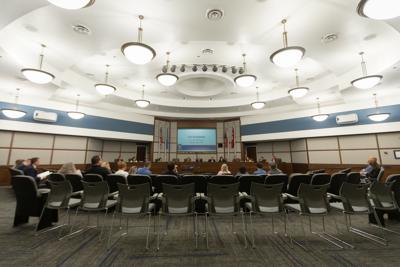

The Norman City Council Community Planning and Transportation Committee met Thursday to discuss service changes in the public transit system and updates on the 2019 Transportation Bond Program.
Service changes in Norman’s public transit system will be effective Oct. 16, over four years after Norman took over the transportation service in August 2019.
Taylor Johnson, transit and parking program manager, said all routes will be reconfigured, which has “opportunities and challenges” to improve service operations and passenger usability.
Routes will mostly operate bidirectionally and route segments will be eliminated and realigned, resulting in new and retired bus stops, Johnson said.
Service changes include all routes being operated out of a new Norman Transit Center located at 320 E. Comanche St., which the council purchased in April 2022 to remodel into a new transit center. Brooks Street Transfer Station is being used as the transfer hub before it is replaced by the new location on Comanche Street.
Remodeling of the new transit center began in March and will be completed by October, Johnson said. Improvements include an indoor waiting area, outdoor seating area, restrooms for both the public and staff, a breakroom for staff, a water fountain and water bottle filling station.
“These are big, bold changes. It’s something our community should have done incrementally over time,” Johnson said.
Ward 7 Councilmember Stephen Tyler Holman said his only concern about the new bus routes was the route on East Lindsey Street since it’s the busiest route and has the most upcoming changes.
With the highest number of riders, Johnson said the route on East Lindsey Street will be an hour long on a 30 minute frequency, split between two buses.
“That’s what we envision for the other hour-long routes,” Johnson said. “With their current resources, certain routes are prioritized.”
On the first day of service, ambassadors will help people get to routes they're not accustomed to and walk them through the changes, Johnson said.
“I hope it’s well-received,” Johnson said. “We did a lot of planning and discussion, and I’m excited to see what happens.”
Two routes will be a comfortable distance from the university, Johnson said. New routes and changes could also be added in the future.
“It’s a long time coming,” Holman said. “One of the advantages of us taking over the transit system when we did was that we get to have a direct say … and craft how it can best serve the city as a whole instead of it just being focused on one specific area.”
Johnson said the city hired Nelson\Nygaard Consulting Associates, Inc. in July 2020 to help update the long range transit strategic plan. In June 2021, the council adopted the Go Norman Transit Plan following 11 months of collecting data and receiving feedback, Johnson said.
The council unanimously approved the public participation process for service changes in September 2022.
The city also received five compressed natural gas buses within the past three months, all in service, Johnson said. Seventeen new vehicles should arrive by the end of this fiscal year.
A new rideshare program Norman On-Demand, which operates at night and on Sundays, was found to have an average walking distance of 0.08 miles, Johnson said. The program’s target was 0.10 miles.
The maximum walking distance for riders is 0.32 miles, while the city’s target goal was 0.25 miles. The average wait time for riders is 16.5 minutes and was targeted to be less than 15 minutes for all routes, Johnson said. He added that 1,633 accounts were created since the program’s launch, 45.3% of which are active.
The 2019 Transportation Bond Program, voter-approved in April 2019, identified 19 projects with input from city council, citizens and the 2014 Comprehensive Transportation Plan, Norman city engineer Scott Sturtz said. The projects include a traffic management center, widening and reconstruction of roads, traffic signals, sidewalks, stormwater drainage and multimodal bike paths.
As part of the Transportation Improvement Plan, a competitive process where individual local projects are rated, ranked and given money from an available $20 million per year, Norman is eligible to apply and receive funding for projects, Sturtz said. No single local government can receive more than 56% of the total funding.
The selection criteria of eligible projects include road widening, bridges, transit, new construction, intersections, resurfacing, bike lanes, sidewalks and safety projects.
The project selection criteria were significantly changed in 2019, right after the 2019 Transportation Bond Program was approved, Sturtz said.
“We were doing really good. We had the whole system figured out,” Sturtz said. “We were probably about the best in the area.”
Holman said the shift in the project selection criteria hurt the projects because the scoring and items were changed.
Liesel Polwort, Olsson lead engineer, said federal funds had been secured for four projects, including locations of the Porter Avenue Streetscape, Gray Street two-way conversion, Jenkins Avenue from Imhoff Road to Lindsey Street and the traffic management center. The project at Porter Avenue and Acres Street is complete and there are plans to move ahead with multiple other projects in the near future, she said.
After utilizing available bond funds from previous projects and removing the Indian Hills Road projects, the city can design and construct Cedar Lane Road and 36th Avenue Southeast with bond funds only, Polwort said.
She said if bond funds could be used for two projects, this would allow the bond program to accelerate and continue the construction of projects through 2025.
The committee meets at 4 p.m. on the fourth Thursday of every month at 201 W. Gray St.
This story was edited by Alexia Aston and Taylor Jones. Mary Ann Livingood and Avery Avery copy edited this story.


