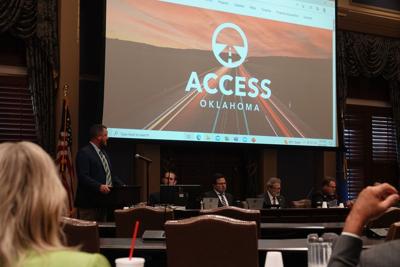

The Oklahoma Turnpike Authority announced Tuesday it will reroute the planned alignment of the South Extension Turnpike expansion, a part of the ACCESS Oklahoma project.
The proposed South Extension Turnpike is an approximately 19-mile highway expansion, which would stretch from the East-West Connector in Franklin to Interstate 35 in Slaughterville. In the original plan, the expansion would have run just west of Lake Thunderbird.
ACCESS Oklahoma is a 15-year, $8.2 billion plan to construct new turnpikes and expand existing highways statewide, including two turnpikes that would run through Norman.
During the OTA’s authority board meeting, OTA Executive Director Joe Echelle said the authority was forced to reevaluate plans for the South Extension Turnpike because the U.S. Bureau of Reclamation did not allow for it to cross federal property at Lake Thunderbird.
“We do know that the preliminary alignment didn’t get permission to cross the Bureau of Reclamation’s property at Lake Thunderbird,” Echelle said during the meeting. “It didn’t align with the intent of the lake.”
In January 2023, the Bureau of Reclamation initially denied the OTA’s application to build the South Extension Turnpike through federal easements near the lake. The bureau did not approve OTA’s application because the plan did not meet the land’s congressionally authorized purposes, according to an email to ACCESS stakeholders.
The Oklahoma Supreme Court allowed the ACCESS Oklahoma plan to proceed in August 2023 after homeowners filed a lawsuit alleging part of the South Extension Turnpike is not among corridors approved in 1987.
The OTA did not have any updates regarding where the South Extension Turnpike plan will be rerouted.
“Since we are just restarting the process on the South Extension, we don’t have much yet to share beyond what’s currently shown on the program and the preliminary alignment,” Echelle said during the meeting.
The original route of the South Extension Turnpike would have gone through the home of Amy Cerato, president of Pike Off OTA, a grassroots anti-turnpike organization. Cerato said the reroute of the expansion has created uncertainty among East Norman homeowners who don’t know if they will be impacted.
“They're going to go through all of the stress and the heartache and the living in limbo that we all felt on the original alignment,” Cerato said. “It takes a toll on the body, and it takes a toll on your family, and it takes a toll on your quality of life.”
Randy Carter, communications director for Oklahomans for Responsible Transportation Foundation, was at the OTA meeting Tuesday. Carter, whose house was potentially affected by the original route of the South Extension, said he is disappointed more people may lose their homes.
“Many of the people that live in Norman in Ward 5 moved out here and have spent a lot of time and money to build and maintain (their homes) in a way they have come to love,” Carter said. “So it'll be heartbreaking for a lot of people to lose their homes to an unwanted and unnecessary turnpike.”
Lisa Shearer-Salim, OTA communications and marketing manager, said during a phone call with OU Daily that the OTA has yet to begin its route alignment study, which will determine where the authority will direct the new path of the South Extension Turnpike. The route alignment includes speaking with stakeholders — who are primarily elected officials — holding public engagement meetings and working on engineering design.
According to Shearer-Salim, the OTA planned the original route to minimize the number of homes the authority would have to take. Cerato, an OU civil engineering professor, said this is untrue.
“We counted the number of homes that would be taken on this route versus what would be taken a mile west and then 2 miles west,” Cerato said. “(The OTA) would take 33% less houses if they moved it 1 mile west, and take 66% less houses if they moved it 2 miles west.”
As for the new route, Shearer-Salim said its effects on property owners will remain unknown until the study proceeds.
“There is no way to know at this time what property impacts might be,” Shearer-Salim wrote in an email to OU Daily. “We must do the alignment study/engineering/stakeholder and public engagement work first to be able to answer this question.”
According to Shearer-Salim, the use of eminent domain is uncommon, only occurring under two circumstances: when two parties cannot reach a financial agreement or when title issues must be resolved to purchase the property.
“As for eminent domain, that is an action of last resort,” Shearer-Salim wrote. “Most properties for an infrastructure project are acquired through negotiated agreements.”
Since the study has not begun, Shearer-Salim said she does not know when the new South Extension Turnpike plan will be finalized.
“Our hope is that we would know more by the end of the year, but it's really early to tell what a timeline looks like,” Shearer-Salim said.
During the meeting, Echelle said the OTA intends to “provide certainty” to property owners in cities that will be impacted by the alignment of the extension as soon as possible.
“We want everyone to be able to reach out to us as the plans develop to provide comment and to weigh in on the best route, and we will make them our first priority as the project is given some special attention in the coming months,” Echelle said.
This story was edited by Ana Barboza, Ismael Lele and Anusha Fathepure. Mary Ann Livingood copy edited this story.


