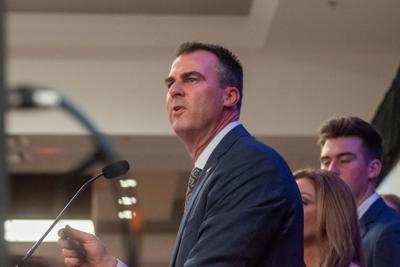

Gov. Kevin Stitt signed House Bill 4156 into law; the contentious bill authored by legislative leaders to curb immigration has been criticized as anti-immigration.
House Bill 4156 authored by Senator Pro Tempore Greg Treat (R-Oklahoma City) and Speaker of the House Charles McCall (R-Atoka), will subject immigrants in Oklahoma illegally to jail time and fines.
The first offense of violating HB 4156 will be classified as a misdemeanor and subject those guilty of impermissible occupation to up to a year in county jail, a $500 fine or both. The second offense would be considered a felony and those found guilty of impermissible occupation will be subject to up to two years in county jail, a $1,000 fine or both.
Those found guilty of impermissible occupation will have 72 hours to leave Oklahoma, no matter if it is their first or second offense. HB 4156 defines impermissible occupation as a person willfully remaining in Oklahoma without legal authorization to be in the United States.
Along with the bill signing, Stitt announced the formation of the Oklahoma State Work Permits and Visas Task Force. According to a press release, the task force will look to find ways to "create opportunities for those who are here contributing to our communities and economy."
According to an executive order, the task force will study ways to allow immigrants to contribute to the workforce and provide universities, aviation companies, farmers, ranchers, oil and gas and other industries the ability to hire and retain immigrants.
The Norman legislative delegation voted along party lines. Rep. Jared Deck (D-Norman), Rep. Jacob Rosecrants (D-Norman) and Rep. Annie Menz (D-Norman) voted against HB 4156. Sen. Mary Boren (D-Norman) joined them in their dissent while Sen. Rob Standridge (R-Norman) voted for HB 4156.
Menz wrote in a statement to OU Daily the issue of immigration is a largely federation issue, but there are things the state can do that requires leaders to have "honest" discussions.
"The rationale behind the bill is clear and understandable. The bill itself is extreme, otherwise it wouldn't have taken the governor so long to sign it," Menz wrote. "The Legislature has the resources, the will, and the intelligence to create good and lasting policy, which HB 4156 is not. As a result of this bill becoming law, there will be expensive legal challenges paid for by taxpayers, and a lot of good, hard-working people will leave Oklahoma."
HB 4156 has drawn criticism from voters, students and advocacy groups for being anti-immigration.
On April 23, protesters gathered outside the Oklahoma State Capitol to protest HB 4156.
Protesters called on Stitt to veto HB 4156 and reiterated the role immigrants play in the nation, as reported by OU Daily.
In a letter to Stitt, the American Civil Liberties Union of Oklahoma said the law will separate families, decrease trust in law enforcement and increase racial profiling. The ACLU of Oklahoma also said the bill is one of the most anti-immigrant laws to be passed in the United States.
On April 18, McCall told The Oklahoman those who want to work through the process of coming to the country legally are more than welcome in Oklahoma.
Treat told KFOR the bill would protect legal immigrants and give law enforcement the tools necessary to fight illegal activity.
In response to HB 4156 passing through the state House and Senate chambers, high school students at five Oklahoma City metro high schools held demonstrations protesting the bill.
On April 26, students at Southeast, Santa Fe South, Capitol Hill and U.S. Grant high schools held walkouts to protest HB 4156. On April 29, Harding Fine Arts students orchestrated a similar walkout.
Texas has a similar law, Senate Bill 4, passed in 2017 which allows law enforcement to detain people suspected of being non-U.S. citizens who entered the United States without authorization.
In March, Texas’ SB 4 made national headlines as it went through the federal judiciary system. The bill was rendered ineffective in February when the U.S. District Court for the Western District of Texas said the law was unconstitutional. However, the Fifth Circuit Court of Appeals halted the decision as the law made its way to the Supreme Court of the United States. On March 19, SCOTUS allowed the law to go into effect. But their ruling was blocked by the Fifth Circuit Court of Appeals when they reinstated the district court’s ruling.
SB 4 remains blocked by the courts.
This article was edited by Peggy Dodd and Ismael Lele.


