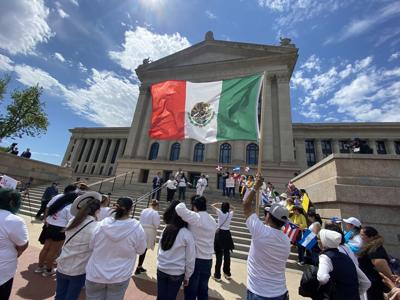

Over a hundred people gathered outside the Oklahoma State Capitol Tuesday to protest an anti-immigration bill as it moved to the Senate floor, just hours before it was approved and sent to the governor for signing.
The bill, HB 4156, was authored by Speaker of the House Charles McCall (R-Atoka) and Senator Pro Tempore Greg Treat (R-Oklahoma City) and introduced last week. If passed, it would allow local law enforcement to arrest noncitizens living in Oklahoma, mirroring similar bills in Texas and Florida.
A first-time conviction would result in a misdemeanor charge of up to one year in county jail and a $500 fine. Second-time convictions would face a felony charge of up to two years in jail and a $1,000 fine. In both cases, the person who committed "impermissible occupation" is required to leave the state within 72 hours. The measure has exceptions for people granted lawful presence or asylum by the federal government or approved for benefits under the Deferred Action For Childhood Arrivals program, or DACA.
The bill passed the Senate Tuesday afternoon by a vote of 39-8 and is now heading to Gov. Kevin Stitt's desk to be signed before officially passing into law.
During a press conference last week, Stitt said he is unsure if he will sign the controversial bill, adding that he will seek advice from a trusted foreign diplomat from Mexico.
“I'm not going to make a decision right now whether I'll sign it or not,” Stitt said. “There's too many variables on what's in the bill. Our team, we'll look at it, and we'll review that.”
At the rally, dozens of people stood on the steps of the north Capitol plaza holding flags representing different countries. The largest among them a U.S. and a Mexico flag — a visual representation of the message echoed by the demonstrators:
"El pueblo unido jamás será vencido," or "Our people united will never be defeated."
Surrounded by signs reading "Stop HB 4156" and "Immigration built this nation," Roberto Quijano, who has lived in Oklahoma since 1995, used a megaphone to encourage the crowd to embrace their cultures and unite in the fight against anti-immigration legislation.
"Your culture is the color of your soul. Your culture is who represents you. Your culture is you," Quijano said. "Just like we are all here, all nations united, whatever problem you are facing in your nation, together we can fix it."
Reps. Annie Menz (D-Norman) and Arturo Alonso Sandoval (D-Oklahoma City), two Latino members of the House of Representatives, were also in attendance.
Sandoval told OU Daily during the rally that while HB 4156 is similar to past anti-immigration bills, this one is particularly dangerous due to its broad and vague terms, which don't stipulate how the measure would be enforced or how a minor would be convicted compared to an adult.
Sandoval added the bill focuses on "political talking points" rather than solutions, noting the bill mentions nothing about additional training or resources for law enforcement to implement the measure.
The bill also disregards how undocumented people contribute to Oklahoma's economy, workforce and society, Sandoval said.
"Everyone has touched migrant labor, whether it's the food that you grab at the grocery store, the restaurants where the food is cooked (or) construction projects," said Sandoval, an OU alum who represents District 89 in south Oklahoma City.
"I represent a predominately Hispanic district, and I see the people paving the streets, the people building the buildings, a lot of that does depend on undocumented labor."
Sam Wargin Grimaldo, an associate attorney at Michael Brooks Jimenez, PC who is running for Oklahoma Senate District 46, said the broad language of the bill creates the potential for racial profiling, as anyone who “looks undocumented” could be targeted.
The bill also stokes fear within the immigrant community, Grimaldo said, which could dissuade people from calling the police during an emergency.
"You're going to decrease that trust in the police because they don't want to get them involved," Grimaldo said in an interview with OU Daily. "And that makes our community even more vulnerable because criminals will know that we are less motivated to call the police if there's a chance that someone in or around us may end up getting caught up in deportation."
Cindy Nguyen, a policy director for the Oklahoma American Civil Liberties Union, told OU Daily the bill doesn't include exceptions for places such as schools, hospitals, churches or domestic violence shelters, unlike a similar bill approved by Texas lawmakers in 2023.
SB 4, which was blocked by the federal appeals court in March, would allow police to question and arrest anyone they believe entered Texas through Mexico illegally and is currently without legal immigration status. However, the Texas bill prohibits police from arresting migrants in public or private schools; churches and other places of worship; health care facilities; and facilities that provide forensic medical examinations to sexual assault survivors.
"I think the authors make the bill intentionally vague on purpose," Nguyen said. "This bill also does not define legal authorization or lawful presence, and I think it is clear that they are doing that on purpose to create fear."
Nguyen added the basis of the bill itself is unconstitutional, as local law enforcement cannot enforce federal immigration law.
Still, Nguyen said the ACLU is closely monitoring the bill and will collaborate with its partners to take the necessary next steps should it be signed by the governor.
At the Capitol Tuesday, demonstrators took turns sharing their stories with the crowd. Many of them immigrated to Oklahoma decades ago and have been living and working here ever since. Some who were born in the U.S. have family and friends who were not.
After the speeches, the demonstrators walked around the Capitol building and echoed chants calling for unity.
A mother pushed a stroller side to side while her toddler giggled. The woman next to her held a yellow sign reading, "We were not born here, but Oklahoma is our home."
Many of the demonstrators used their work breaks to join the rally, some still wearing the gear for their jobs.
"This (bill) means that our parents get criminalized, that people within our community get criminalized, simply for being themselves," Grimaldo said.
Grimaldo said people need to get involved in local politics and to vote, particularly younger generations which have a low voter turnout.
On OU's campus, Latinos Unidos at OU, a civic media and leadership organization, is encouraging members to contact their state legislators to voice their stance on HB 4156.
"Even if this gets ruled unconstitutional, and I'm certain it will, it sends that message that in Oklahoma, as many of these Republican legislators had stated in this bill, they wanted to make this the most unwelcoming state for immigrants,” Grimaldo said.
"That, to me, is a travesty of humanity."
This story was edited by Anusha Fathepure and Ismael Lele. Sophie Hemker and Avery Avery copy edited this story.


