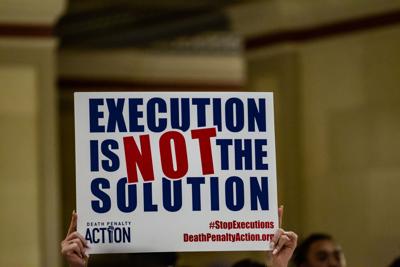

Oklahoma Gov. Kevin Stitt denied clemency for death row inmate James Coddington one day before his scheduled execution on Thursday, marking the start of 25 scheduled executions spanning a two-year period.
The Oklahoma Court of Criminal Appeals set execution dates for 25 of the 43 death row prisoners in two orders on July 1. Before Stitt’s decision, Coddington was recommended clemency on Aug. 3 by the Oklahoman Board of Pardons and Parole in a vote of 3-2.
This comes seven months after Stitt commuted Julius Jones’ sentence to life without the possibility of parole four hours before he was set to be executed on Nov. 18, 2021. Julius is a former OU student who was placed on death row in 2002 after being convicted of the 1999 murder of Paul Howell.
Justice for Julius Campaign Director Cece Jones-Davis said she believes 25 executions in 24 months is “abhorrent” and goes against criminal justice reforms the nonprofit supports. She said it also goes against Christian values in a state where almost 80 percent of its religious adults follow a Christian-based faith, and almost half are evangelical.
“I feel like (in) Oklahoma, where (most people) are committed to the gospel of Jesus Christ, (people) are standing around allowing the state to ensue a bloodbath. I think that is deplorable,” Jones-Davis said. “It’s extremely important and crucial for Oklahomans to stand up to the government and say, ‘No, not on our watch. Don’t kill in my name.’”
The Oklahoma Conservatives Concerned about the Death Penalty, a coalition that questions the alignment of capital punishment with conservative principles, will hold a press conference on Aug. 25 at 2 p.m. to call for a moratorium – a temporary prohibition – on Oklahoma’s death penalty.
The Justice for Julius movement and its supporters have called for Stitt to reinstate the moratorium that was in place for six years following concerns over its lethal injection methods.
OU Carceral Studies Consortium Director Constance Chapple said the beginning of Stitt’s term was more bipartisan, citing the change in sentencing of minor marijuana possession from a felony to a misdemeanor. Now, she said she believes he’s realized he doesn’t need to “reach across the aisle” as much.
“I don’t think there’s anything in the last two years that indicates that he plans to do anything on criminal justice reform and reduce the number of folks who are entering prison and staying in prison,” Chapple said. “I think that just goes along with the executions as well.”
Conservative lawmakers in Oklahoma, she said, are concerned with the fiscal responsibility and the fiscal impact of incarceration. Since death penalty cases are so long and almost always trial involved, Chapple said execution is extremely expensive, specifically for taxpayers.
“It doesn’t serve deterrent functions for society as a whole and it’s exorbitantly expensive,” Chapple said.
Putting someone on death row is also mentally taxing, Jones-Davis said, adding their family is put onto death row with them. She said she can only imagine how hard it was for the Jones family, and now the families of the 25 people set for execution will endure similar hardships.
“I know those people are suffering. Their anxieties are extremely high. They are holding out hope for reprieve,” Jones-Davis said. “But if the state doesn’t make a conscious decision to be moral, reprieves are not going to happen for everybody.”
Julius’ sister Antoinette Jones said being the loved one of a death row inmate is incredibly anxiety-inducing and nauseating, as she was constantly thinking about how he was doing.
What she thought was her final phone call with Julius was particularly traumatic. She said families of death row inmates don’t know what more they can say and can only focus on hearing their loved one breathing.
“I would never want anybody to have to go through what my family, my mother and my father (have gone through),” Antoinette said. “(They) have worked so hard to be pillars in the community. … (But) every day is like a nightmare with the fact of knowing that my brother cannot (leave).”
Antoinette said there are several serious innocence claims that should be examined among the 25 inmates set to be executed.
Richard Glossip, for example, is scheduled to be executed on Sept. 22. His attorney alleges he was convicted through the intimidation of a witness and that evidence was destroyed before his second trial.
Antoinette said there are also several inmates who have significant mental health issues. Coddington, for example, struggled with drug and alcohol addiction, has experienced severe mental illness and was admitted to a psychiatric hospital at 8 years old.
Antoinette said death row inmates aren’t numbers or a statistic — they are human beings.
“There’s so much that I can say, but, at the end of the day, we should not be killing people to prove that (murder) is wrong,” Antoinette said. “That is not of God. God did not want this to happen and does not want this to happen.”
Support for the death penalty has slowly declined over the past several decades on the national level, Chapple said, adding she believes the amount of executions Oklahoma has slated will garner nationwide attention.
She said there is a lot of social research done on the death penalty and its effects on society, particularly regarding crime deterrence and trauma. Chapple said there have been legal challenges with the death penalty which call into question its purpose and morality in terms of “cruel and inhumane punishment.”
“Even victims’ families don’t feel they get the closure they are hoping for,” Chapple said. “(The death penalty) is there, but it doesn’t seem to serve the purpose that it was intended to do.”


