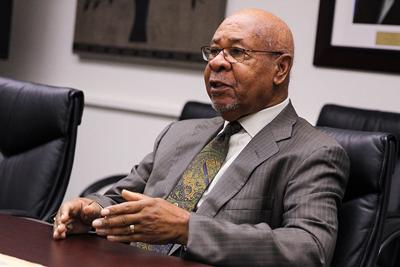

George Henderson has been a powerful figure for change at OU for almost half a century. When Henderson joined OU’s faculty in 1967, his family became the first African-American family to purchase a house in Norman.
Since then, Henderson has been a trailblazer for the advancement of diversity and racial relations at OU, establishing the university’s Department of Human Relations in 1970. In his 49 years at OU, Henderson has seen the university move through triumphs — like the civil rights movement and desegregation — and lows, such as the 2015 SAE scandal.
Here, Henderson reflects on the changes he’s seen at OU since 1983 — the last time Ohio State and OU met up.
Q: Can you tell me about what the environment at OU was in 1983 in regards to racial relations and diversity?
A: The '70s was the foundation — actually the '60s. I came in 1967, and somehow in 1967 the black students created the Afro-American student union. And that was the beginning of the so-called civil rights movement on this campus. They protested such things as a lack of minority faculty and staff and coaches and just an absence of people of color. They protested the fact that the dorms were racially segregated — people were segregated according to their race in rooms. They protested the fact that it was a hostile community on campus and off campus in the surrounding community.
That was the '70s. The '80s was a continuation. The university in the '80s — ’83 and the '80s — was really the best of times and the worst of times. It was the best of times in terms of students of color and other groups coalescing and really becoming allies. And when I say the students coalescing, I mean not just minorities, but also a substantial number of white students. We could not have had a successful movement without the white students who supported us and faculty. That was the best of times.
The worst of times was that the individuals as a whole that they were indeed protesting and challenging coalesced to try to maintain the status quo. So what was it like? Oh my goodness, take your pick: What side of this issue do you want to be on?
Obviously, I was on the side of change. And change in the '80s was very interesting for this reason: The people who were in the shadows academically — I’m talking about gays, lesbians, women, even Native Americans, Latinos and Hispanics — in the '80s, they said, ‘What about us?’ Finally we got it. It was a time in which the Human Relations department offered the first courses that focused specifically on women. I happened to be the chair of the department. We hired the first male full-time secretary at the University of Oklahoma. I chaired the gay alliance on campus so that they could have space, a meeting space. We were a hub of change, we were a hub of protest, we were a hub of coalitions and we were also a hub of separate, but unequal, relationships. The beauty of Oklahoma — people ask, ‘Well why do you stay so long?’ And I say, ‘Well, probably couldn’t get another job’ — that wasn’t it, really. ‘Why do you stay?’ To be very honest, I could not have found a better group of students and a more loyal group of colleagues and faculty committed to change in this place of all places — in Oklahoma. It was still a frontier, and in many ways we were the Sooners in terms of race relations: staked out our territory in places that others had claimed as their own, and we fought for it.
What was it like? With all of our differences, one of the few things that brought us together happened to be what happens on Saturdays when we have home games: the football team. We seemed to set aside whatever differences we had; we’d go in the stadium and cheer. We even sat next to individuals who indeed were not really friendly, and we cheered together. It was a promise of what could be. And some of us wanted more than just a Saturday football game, or a lecture/concert series to do this. We wanted it to be a way of life. So the '83s and '84s and '85s was a time in which all of the groups were pushing for more equality — exciting, challenging.
Q: What was the attitude of your opposition like?
Not very covert, very overt. It was not uncommon to see the Confederate flag flying out of some windows or just hanging in some windows. It was not unusual for students of color who were visibly students of color, in terms of their skin complexion, to be called — pick a word. What word do you find offensive? If you were a student of color, they heard it. It was not uncommon for the sidewalks to be chalked with all kinds of derogatory things. It was not uncommon for the walls in almost every toilet facility on this campus to have derogatory writings on them.
Q: When did you see that attitude start to fade into the background a little bit?
A: You know, I can’t pinpoint a specific time because we were gradually making changes. You win a battle, you lose a battle. You make a change, you keep a change. It’s such a gradual process. It’s kind of like someone asked, ‘When did you know you were an old man?’ I don’t know, it was a gradual process. I woke up, and I looked in the mirror, and I said, ‘Whoa, who is this guy?’
And I guess, when you ask the question, ‘When did it happen?’ — it’s still happening, so I can’t say that the change occurred because what we are about in Human Relations is a process of continually changing. What did I notice? I noticed more students, at least in the '70s and the '80s, were able to stand up and say, “Not only do I have a voice, but I will express my voice even if you disagree with me.” But most people don’t realize that in our classrooms, for the few individuals who were really, really committed to racial integration — not just desegregation, not just putting the bodies together, but having the bodies interact — it was an environment in which individuals on both sides of the racial divide felt free to express their opinions and did it in a way that was very civil most of the time. For someone like me who was involved in the civil rights movement in Detroit before I came here and committed to racial integration and committed to — when we sang ‘black and white together, we shall overcome,’ it had significance. When we started singing that on this campus, it also had significance. The change? Gradually. For people like me who wanted everything yesterday, it was never going to happen fast enough. But for individuals who really understood the culture — when it’s embedded in the culture, when it’s endemic, it takes an awful long time to see the change. But it was happening. It was happening in ways that — for example, our family was the first black family to own a home in Norman. I don’t know exactly when I started saying when I was out of town, ‘I can’t wait to get back home to Oklahoma.’ For a long time for me, home was still Detroit, because I felt like a stranger in a strange land. Somewhere in my interactions, mostly with students, I would say, I started saying, ‘I’ll be glad to go home to Oklahoma.’
And it was also a time that change occurred this way ... when we stop thinking about ourselves as unrelated, not interdependent individuals and started viewing ourselves as part of a community, that was the first step.
But the next step is we started thinking about one another as being brothers and sisters, and maybe fathers and grandfathers, and we start thinking about ourselves as being in a family called the University of Oklahoma. It’s interesting because, years later, we would get a president called David Boren who would start emphasizing the family concept. Well, in the '80s, with our allies, we referred to one another as brothers and sisters, and that prepared us for Boren — for David and Molly. It really prepared us for the family.
What was it like? I don’t know, maybe I and others like me were like the moth that flies around the flame, getting as close as you can, afraid that sometimes you’ll go too close, and you’ll burn, and you’ll fall. We did burn and fall many times as we flew around the flames of racism. But sometimes we extinguished that flame, and it felt good. I guess what I’m trying to say is that in the '80s on this campus, there was a growing feeling that the Pledge of Allegiance really meant something. “One nation, indivisible, with liberty and justice for" — it was that last word that we were struggling with and trying to find a way to make it operative. And the “all” became at first a small nucleus of individuals, and then it grew, and it grew, and suddenly it was a large minority here. It felt good.
Q: How have you seen resources, such as classes and student organizations, increase for students of color and minority groups?
A: If you look at the old OU Daily’s, if you look at the yearbooks and the others, you’ll see a not-too-subtle phasing in of people of color and different kinds of diverse organizations being represented. It was like a change that was just flowing. Not a tidal wave, nothing too drastic, but slowly there were ripples, and you could start seeing in school newspapers photos of people of color. And they were not all football or basketball players, and that felt good.
A few organizations, very few, started deciding that it was time to open up membership to people who were not just of one racial or ethnic group. That was slow, but it was happening.
Q: Other than the SAE incident last year, have you seen any other specific and major instances of racism in your time here?
A: No, I have not because most races are fairly sophisticated. It’s more civil now. People are more discreet and more careful, except, for example, SAE. In terms of singing those songs, those songs were not new. It wasn’t something that the young men woke up one morning and said, ‘Let’s create a song and sing it on the bus.’ Oh no, no, no. And it wasn’t just one house, it really wasn’t just one house. So if you ask if I’ve heard or seen: no, because individuals are careful now. And what’s been very helpful is that the organizations who indeed started integrating and bringing in more students of different racial and cultural groups, they then started changing somewhat.
That’s not what worries me now. What worries me today is that almost everyone coming to the University of Oklahoma can tell you what they should be doing. We talk a good diversity game; we talk a very good inclusion game. We bring in smart people. If you come to the university, you know how to give the answers to the question. But do you know how to behave in a way that will illuminate the question, and say that you live what you say you’ve committed to? That’s the next phase that we have to go through. More individuals talk about what we ought to and must do — it’s how we do it within the classrooms. The revolution that I see now — in all of my classes, every single one of the — the students may enter as strangers, but after the first night, they no longer are strangers, because they’ve had the opportunity to interact with one another. We don’t really get into the subjects until we’ve gotten into one another, and accept the relationship that, in this class, we are family. We can disagree, but let’s do it in terms of substance, not stereotypes and generalizations. Let’s talk about it.
But I still see individuals and clusters of individuals ... pick an eating place on campus. You still see clusters. But you know, you also see integrated clusters, some multiracial, multicultural clusters. Not wholesale, but enough to say, ‘Yay, OK, the family’s changing.’
Q: And that wasn’t something that you would have seen in 1983?
A: Oh heavens, oh no. No, you would not have. And in ‘83, it was a time in which in interracial activities, for example, to see an interracial couple walking down the streets or across campus, people would kind of look and some of them would stare and frown, and others would just say those obscene things. Not so much an event anymore. You pick a place, and you go and see interracial couples, especially if there are interracial babies — I mean, hey, you’re still looking. And if you’re going to comment, you comment, ‘That’s a cute baby.’ But the race is not a significant aspect of it now as it was before — that was, you didn’t see that.
Q: How have you seen the demographics of OU change since ’83?
A: Ah, the demographics is very interesting. I think that there is justice in demographics if you allow them to play out. The University of Oklahoma, which literally translated would be “the university of the red man,” we’re beginning to see more American Indians or Native Americans who are coming to the university. We’re also beginning to see more Latinos and Hispanics coming to the university. And so we’re beginning to see this shift, which means we’re beginning to recognize that race relations is not just black and white — it’s all of the different groups. And I see that shift. What I don’t see, however, is a shift in such a rapid way that we get past the point of thinking that the major players in race relations dramas are always black people and white people. I don’t see, on this campus or many other campuses, that all of the ethnic groups can be major players in the drama of change, and it doesn’t have to focus on just one group or two groups. There are issues within all groups; we’re gradually learning how to deal with those issues.
Q: How have you seen faculty attitudes toward diversity and inclusion change?
A: This might surprise you. When I came in ’67, through the '80s, we valued as a university teaching more than anything else — this was an excellent teaching place. So therefore, as teachers, we were not so much driven by our academic discipline in terms of research, we were driven by just the quest for knowledge. And so, we were not in silos — the physical, the social, the fine arts and so forth. People were not in silos, we were together.
I think as a whole, faculty members knew more individuals across campus than they do today, which meant also it was a time in which it was not uncommon to go to a student union and see faculty members, either from different departments together, or faculty members with students. There was an awful lot of that going on. I don’t see much of that anymore. Maybe that’s the price of progress — I hope not.
Q: What more would you want to see happen at OU in terms of progress?
A: I would want us to be as diverse as we possibly can with the resources that we have. I believe that we teach best what we live, and if we indeed have individuals who represent broad spectrums of race, gender, ethnicity, abilities and disabilities — if we have the broadest representation of our family, in all of the positions that are available, if indeed they want to be there, then we will have achieved that promised land that I’m not going to see. I’m not going there with you.
It’s up to the next generation to move us just a bit close to that. So, I would like to see us not just talk about diversity, but live it. And the best example that I can give you happens to be my family. We have a portrait in our home of four generations of us. The first two generations are African-Americans. The third and the fourth are multiracial, biracial. As our family has grown, that’s what I want to see happen more. I want us to be at a place where you really can’t worry what your race or ethnicity happens to be because you’re more concerned about moving together as a family and being better.
What would I like to see happen? I would like for us to reach a point where we no longer have a need for ethnic studies, women’s studies, special studies of any kind, because they will be an integral aspect of everything that we teach here when appropriate. That’s what I would like. Then we would be living what we say we’re committed to.
Q: Practically, how do you see some of these things playing out?
A: Time doesn’t heal anything; people make changes. But we tend to make changes slowly within institutions like universities. Maybe we’ll reach the point where we do it like we learn athletics; we learn our positions, and we play it well, and we’re not concerned about what the gender or the other kinds of identifiers are, as long as the person is playing their roles well.
How do you get there? You just do it. Almost every year in the '80s and '90s and '70s, I would have some of my white colleagues say, ‘How can I be effective teaching African-Americans or Latinos and students of color?’ And I have always answered, ‘The same way that I’m effective — you do it.’ This is not a head thing; you don’t have to think it. It’s a heart thing; you have to believe in it. Just do it.
Change occurs when us old folks step aside and let those of you who, indeed, have much more accepting ideas, let you live your lives and not fight our old battles.
The lines in South Pacific illustrated — ‘You’ve got to be taught to hate and fear. It’s got to be drummed in your dear little ear, to hate all the people your relatives hate before you’re six or seven or eight’ — we do it. I guess the change that you’ve asked me about ... the change will come when parents, your generation and generations after you, don’t teach their children to hate and fear people who are different. That’s our thing, and we pass it on to you, and I say maybe, just maybe, if we step aside and yield stage center to the next generation and let you have a shot at it without us being sideline coaches, you’ll get it done. Maybe if I do my job well in the classroom, then the students, thousands of students that I’ve taught now, their children will be more accepting, then I’ve done my job.
Q: Since the '80s, how have you seen diversity and demographics in faculty and administration change?
A: I say this not with pride: Students are still leading the civil rights movement. Students led us mostly in the '50s, '60s and '70s and the '80s, and you’re still leading us. Because there are too many of us who have not gotten into the game and who are not actively involved. And that’s my biggest disappointment: Too many of my colleagues would spend more time trying to write a book or do some research or do whatever they do than to take the time to interact with students across campus. Think about this: Let’s say that you want to meet and have a conversation with your professors. How many of them do you think you’ll find on campus Fridays? In the '60s and '70s and '80s, you would have found a lot of them. We managed to do our research and write our books and journal articles, but we also took time to be with students. So the change is not likely to come from us if you wait for a critical mass of us. You are our future. When people ask me where is my future, I don’t look a my colleagues, I look at you. It’s all about you. That’s what our civil rights movement was about. It was about the kids and the unborn, and now guess what? They were your parents, and now hopefully they pass it on to you, and it will be your children. Each of us, each generation, whether it’s in the classroom or outside the classroom, whether it’s in student organizations or it’s unofficial organizations, we do it generation by generation, one person at a time. It’s gonna happen. We’ll either work this out, or I don’t want to think about the alternative.
For OU vs. Ohio State weekend, we’re devoting our whole staff to coverage of the game and the events surrounding it. For all you need to know: oudaily.com/ohiostate.


