When Tatenda Dzvimbo moved from Zimbabwe to Norman, Oklahoma, she said the racism she experienced was surprisingly pervasive.
After surpassing Zimbabwe’s standardized testing requirements, Dzvimbo moved to Bosnia at 16 to attend United World College, where she finished her secondary education. In Bosnia — her first time out of the country — she was subjected to more vocal racism on a regular basis, but she said she is grateful for the experience as it prepared her for attending a university in America — where she has experienced more microaggressions and become more aware of racial disparities.
Dzvimbo, an OU economics junior, founded the African Women’s League in 2018 as an organization that focuses on bringing OU’s international African students together to create a community through networking and helping members navigate college and beyond.
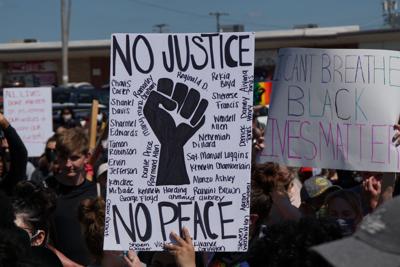
As movements demanding action for racialized injustice ignite across the country, leaders of Black student organizations at OU are uniting in different ways to address racism on campus, including supporting the Black Lives Matter movement and trying to create safe spaces for minority students.
Dzvimbo said she created AWL after going to an African women’s conference. She said she is a family- and community-oriented person, and she liked the atmosphere of the conference because it was a place for people of her culture to discuss views and share advice.
Dzvimbo said she created the organization at OU to give African international students a similar communal experience where no one is judged for differences in cultural backgrounds.
Dzvimbo said she has enjoyed her experience in the U.S. more than in Bosnia because, while racism is still an issue in America, she said she attends a university that allows her to be open about these kinds of issues.
“It’s a very scary thing,” Dzimbo said. “You come here hoping you’ll be safe far away from home, but because of the way racism is embedded so deeply into the system, we are also subjected to racism the same way our fellow African American brothers are subjected to it.”
Jasmine Burrell, a junior majoring in chemical engineering and vice president of OU’s National Society of Black Engineers, grew up in Houston, where she said she became more aware of Black issues after the death Trayvon Martin when she was 13.
Burrell is also a Black Student Association member and says other Black organizations have been brought together through mutual support in BSA’s endeavors. Burrell said many of the students who attended the protest organized by BSA weren’t involved in the organization but attended in support of the BLM movement.
Dzvimbo said AWL has remained a supportive community during the pandemic by looking out for one another in unprecedented times of masks and social distancing. The organization immediately reached out to its members, making sure they had clothes, food and other necessities. They also used Zoom to hold virtual hangout sessions for its members.
Dzvimbo said her organization worked with the African Student Association, and she hopes to reach out to more organizations. OU’s international committee has worked directly with AWL to ensure international students are dealing with the pandemic and nationwide protests. She said she wants to connect with the BSA because they have been at the forefront of racial issues on campus.
Chanel Glasper, an OU Law student and the president of the Black Law Student Association, said her organization also hopes to “bridge the gap” with BSA. Glasper helped mobilize students from the College of Law to attend the BSA protest, and she also said BLSA’s pre-law chair maintains a relationship with BSA leadership so they can support each other and attend events.
Glasper said she is hopeful that change will come.
“I’m seeing a lot more of this generation continuing the conversation and not letting things just die,” Glasper said. “I think we’re really fired up and the millennials and Gen Z’s are pushing for change.”
Jayelene Bryant, a senior majoring in social work and criminology and vice president of BSA, said her organization is aiming to make minority students feel more comfortable on campus. She said she plans programs and helps to build community relationships on campus by connecting students with Black faculty, staff and alumni.
“We just try to get the students here and retain them so they have a home and a welcoming space on a predominantly white campus,” Bryant said.
Bryant said BSA has responded to current events the same way they have responded to all racial incidents, such as professors using slurs and blackface incidents. BSA has participated in marches and protests, as well as talking to OU President Joseph Harroz and former Senior Vice President and Provost Kyle Harper.
“We are doing what we have always done,” Bryant said. “Try to make a change, have these meetings, make it a point for our voices to be heard in spaces they’re not normally heard in and to try and help people understand that this is something that needs to change — and it won’t change without the help of higher-ups.”
Cecily Tullis, president of Black sorority Alpha Kappa Alpha, said the organization’s initial reaction to BLM was to take time to digest what was happening around the world.
“We have been encouraging people to self-care and take the time they need to process and unplug from what was going on,” Tullis said. “It can be so traumatic to look at (videos of police brutalizing Black people) and consume that kind of media all the time.”
Tullis said Alpha Kappa Alpha also posted an educational pictorial about ways people can help, such as petitions to sign, where to donate and resources providing free therapy for Black people.
The AWL collaborated with the African Student Association in an Instagram Live conversation about race and prejudice in America.
In the video, Afro-Latinx OU alumnus Eduardo Campbell talked about the history of oppression in America and his experiences as a minority student at OU.
“I remember my first week of college when I went to a football game and people told me and my friend to go back to our countries, and we were really trying to process the fact that these things were still happening,” Campbell said in the video. “Like when I heard people say racial slurs on campus … I felt my Blackness in class just by the way people spoke. On one of the first days, one of my professors drew a chart on the board to show the benefits and consequences of colonialism.”
Campbell said for minorities, getting a degree is one of the biggest political fights and accomplishments.
“Getting a degree from an institution that isn’t welcoming to you is a big deal because this is what the system doesn’t want — to have people be educated that look like us in order to be critical of those systems of oppression,” Campbell said.
With activists calling for the defunding of police departments, Norman City Council discussed the matter and steeply reduced a scheduled increase in the Norman Police Department’s budget.
Glasper said the Norman City Council’s passing of a cut to this fiscal year’s proposed police operations budget is not enough to reconcile racial injustice.
Burrell said she was impressed by Norman’s forward stance on the issue, but she hopes they will “put their money where their mouth is.”
“A blanket cut in funding without reallocating those funds back into the community is not enough and misses the point of the call for defunding the police,” Glasper said “I’m hopeful that they reinvest that money into the community, but I’m not going to sit here and say I’m content slashing budgets and then sitting on their hands all day. I think it’s a step in the right direction and it’s a nice gesture but I’m looking forward to seeing how that actually plays out.”
The city council held a meeting July 9 to discuss allocating funds to a mental health crisis team, among other areas.
Despite evidence of police brutality disproportionately affecting Black people, some are still not on board with the movement, as they question its intentions and sometimes deny the existence of racism and white supremacy in American society.
Burrell said the attention BLM has received in the last seven years has weighed heavily on her. Burrell said hearing about the deaths of Black men at the hands of the police made her “feel the color of her skin” for the first time.
“I was in high school when Philando Castile was killed, and it hit kind of hard,” Burrel said. “It was like, okay, we're back here again. ... These are things that my parents dealt with, my grandparents dealt with and their grandparents dealt with.”
Over the years, she said the increasing number of police shootings in the news have stirred unrest in minority communities across the nation.
“After Trayvon Martin died, my parents sat my older brother and I down and had this conversation about what my brother’s life was going to look like as a Black man in America,” Burrell said. “It was sad. I was like, ‘What do you mean?’ He's a teenager. He hasn't done anything wrong. He just goes to school, work and home, like it's normal.”
Burrell said despite her achievements in life, others will always define her through a filter of bias.
“Even to this day, living in the 21st century, I’m seen first and foremost by my skin color, not by the accolades or the accomplishments that I've had,” Burrell said. “It's crazy because I'm seen first and foremost by what I look like, I will always and forever be a little black girl.”
Dzvimbo said a key point to supporting the BLM movement is understanding its historical context.
“Education is a powerful tool for eradicating ignorance,” Dzvimbo said. “Because once you eliminate certain pieces of knowledge or parts of history, and you claim that that’s the truth, people go out and believe racism doesn't exist. But it’s a reality that certain groups of people are living.
“Ending racism is a matter of understanding that race and racism has not been understood for what it is. I think it’s important that America begins to wake up whether it's our African peers or colleagues or its other non-Blacks that need to understand that racism is a part of history and that it is still very much present. It looks different but it’s still the same.”
Glasper echoed Dzvimbo's sentiment, saying it’s important to know the history of the BLM movement.
“The Black Lives Matter movement was started in 2013 by three Black women,” Glasper said. “It was never a political movement. Police brutality and Black bodies being lynched in the street is not political. And the fact that it has been politicized is disgusting and opened the door for a lot of criticism and unwarranted criticism. Politicians have been fighting for the Black vote since the beginning of our democracy. So I think it’s just a natural consequence.”
Dzvimbo said the BLM movement is far from a trend. She said the movement is a vision, especially for the non-Black community, to help them understand that Black people have been subjected to systemic racism, injustice and double standards.
Despite the politicization of the movement, Dzvimbo says it is a human rights issue, not a political issue.
“Now people are recognizing it and police are wanting to engage in conversation — but also in actions — that are able to eliminate such things and actually make America a more fair and just country and to live up to what it prides itself in — which is democracy for all its citizens,” Dzvimbo said.
As OU's Black communities work together to shed light on racism and prejudice in America, Burrell said these organizations are committed to a brighter future for Black students at OU.
“Racism is so ingrained into the history of this nation,” Burrell said. “But now, for the first time in a long time, people are finally opening the door for potential change and conversations about things that Black people have endured for centuries.”


