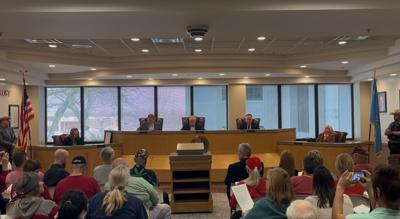

Protester interrupts Cleveland County Commissioners meeting on March 17.
Cleveland County Commissioners unanimously approved a resolution Monday requesting the Oklahoma Turnpike Authority resume its original plan to design and build frontage roads and access points through Cleveland County.
According to the agenda, this resolution was “sought in part due to the Oklahoma Supreme Court’s decision regarding the OTA’s authority which will unquestionably result in the East-West connector being installed across Cleveland County.”
The resolution reads that the frontage roads and access points are necessary to provide “safe and efficient transportation system for the use and benefit of Cleveland County residents.”
Around 60 Norman residents appeared at the meeting protesting the approval of the resolution.
The protest was organized by Pike Off OTA, a grassroots organization that has advocated against turnpike expansion throughout the state.
In an interview with OU Daily, Dave Moore, a member of Pike Off OTA, said protesters were frustrated that public comment was scheduled to begin after the county commissioners voted on the resolution.
“We kind of got thrown a curveball …,” Moore said. “What country does that happen in, where the citizen input starts after the decision’s already been made? What's the point?”
Rob Norman, attorney for Cheek and Falcone, addressed the audience before the meeting began. According to Norman, the commissioners meeting is the reason Oklahomans for Responsible Economic Development had to reschedule the time they planned to file their referendum petition appeal.
The meeting
Over 60 people gathered into the conference room, most of which were protesters. Several protesters wore the color red in solidarity against the turnpike.
In August, Norman City Council voted to reject the ACCESS Oklahoma Project. During the meeting dozens of residents attended to voice their disapproval of the OTA, similarly wearing the color red.
As Commissioners Rod Cleveland, Jacob McHughes and Rusty Grissom went through the items on the agenda, the meeting was quickly interrupted by members of the audience.
“I just want to know how you can subvert the Constitution?” One person asked.
“We voted for you!” Another audience member shouted.
As the meeting continued to be interrupted, Cleveland gestured toward Undersheriff Michael Finley, who told members of the audience to silence themselves so the board could continue with the meeting.
Finley told the protesters that they would have their chance to speak later in the meeting. Finley was interrupted by several audience members who were frustrated that public comment was scheduled to occur after the resolution was voted on.
Once the commissioners reached the OTA related resolution on the agenda, several members of the audience began to plead with the commissioners to not vote in its favor.
As the commissioners approved the resolution, several audience members shouted their disapproval.
“You guys will never get reelected,” Russell Rice, co-owner of Norman Care-A-Vans and a member of ORED said.
Public comment
When the commissioners announced the beginning of public comment, some members of the audience began to laugh.
The commissioners prefaced the rules of public comment, saying that it will be reserved for two minutes for each person for a maximum of ten minutes.
Only five members of the public were allowed to speak due to a 10 minute hard cap. The first was Deidre Ebrey, assistant city manager for the city of Moore.
Ebrey thanked the commissioners for their awareness of the situation and resolution and said there was no better way to foster economic development in the community.
Norman said it was no longer okay for the government to exercise eminent domain just because it has the authority to do so. He then criticized the commissioners by contrasting how they operated with Norman City Council.
“The city of Norman was prepared to do exactly what you did today in exactly the same manner you did today, but instead they spent a month listening to the public. They spent a month listening to Pike Off and the Oklahomans for Responsible Transportation people about why these resolutions are a bad idea,” Norman said.
Tim Morris, a Cleveland County resident, said nobody wants the turnpike but it's unfortunate because it's a necessity. Morris was interrupted by members of the audience as he tried to continue speaking.
“I know it was tremendously emotional especially for people that are losing your land. I mean, I can't even imagine that, but I do also understand that the exit roads are needed,” Morris said.
Morris said that commissioners were not approving the turnpike, but instead were approving the access roads, and that the turnpike was coming no matter what. Morris said what was being approved was best for the entire county.
“This is something that unfortunately is coming, whether all of us in this room like it or not,” Morris said.
Rick Sondag, a Norman North teacher, told the commissioners that they weren’t listening to the voice of the people.
“I'm disappointed,” Sondag said. “I really am disappointed, because the OTA is not the power of the people. It's some kind of an entity that just exists and it doesn't really care about the people.”
Sondag said he knows there are people who are going to benefit from the turnpike, but the overwhelming majority of residents are opposed to it being built.
“Do the right thing,” Sondag said. “I'm not quite sure why this is happening. Does anybody know what's happening?”
The last to speak was Randy Carter, communications director for Oklahomans for Responsible Transportation.
Carter pointed toward Morris and Edbrey, who both cited economic development as the reason the turnpike will follow through, and said the use of eminent domain for economic development was against the law.
Carter voiced his disappointment with the county commissioners for not continuing to fight against the OTA.
”I think that we are possibly able to stop these turnpikes, and I think you guys have given up, and I don't appreciate that,” Carter said.
After the meeting
In an interview with OU Daily after the meeting, Storme Jones, Cleveland County director of communications, said the county commissioners do not condone the ACCESS Oklahoma project.
According to Jones, the construction of the turnpike is likely to happen regardless of what the commissioners do, therefore the resolution they approved will allow for people to have access to the frontage roads and access points once it is built.
“This is not approving the turnpike,” Jones said. “The Supreme Court did that in 2023 this is saying if the turnpike comes, we should have access to it. There should be on and off ramps. There should be free frontage roads for folks who want to traverse around the Turnpike,”
Jones said the commissioners have heard from residents who, under the current OTA plan, would have their properties be landlocked without access points, leaving them no way to get to their properties, which would force the OTA to take those properties that aren't in the line of the turnpike.
According to Jones the opportunity to communicate this to the public did not present itself during the meeting.
“It is just obviously important to acknowledge that this is a really hard deal. Any time properties are taken, good people will have their properties taken as part of this bigger project,” Jones said. “I think the commissioners would say that two wrongs don't make a right. So the turnpike is coming is understood to be a fact at this point.”
Moore and Carter told OU Daily that they do not believe the idea that the commissioners are against the OTA and the turnpike.
“For them to pass that resolution is condoning the turnpikes, and what that says to the OTA is they can do anything they want in Cleveland County. ‘Come on down. We're open for business. We love you here,’” Moore said.
Background
ACCESS Oklahoma is a 15-year, $8.2 billion proposal to build new turnpikes and expand existing highways statewide, including two turnpikes that would run through Norman.
In 2023, the Oklahoma Supreme Court allowed the ACCESS Oklahoma plan to proceed after homeowners filed a lawsuit alleging part of the South Extension Turnpike is not among corridors approved in 1987.
Last week, hundreds of Norman community members expressed concern at a public town hall about the rerouting of the South Extension Turnpike, a part of the Oklahoma Turnpike Authority’s ACCESS Oklahoma plan.
On March 5, OTA Executive Director Joe Echelle announced it will reevaluate the South Extension’s alignment because the U.S. Bureau of Reclamation did not allow for it to cross federal property at Lake Thunderbird.
The proposed South Extension Turnpike is an approximately 19-mile highway expansion, which would stretch from the newly constructed East-West Connector in Franklin and Interstate 35 in Slaughterville. In the original plan, the expansion would have run just west of Lake Thunderbird.
This story was edited by Anusha Fathepure and Ana Barboza.


