
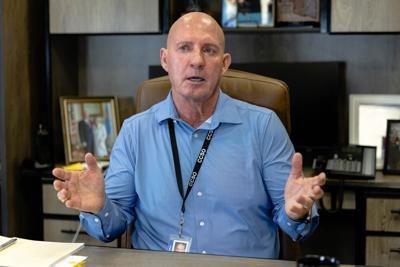
Despite inheriting a challenging circumstance in an already difficult job, Cleveland County Sheriff Darrell Weaver remains optimistic.
A former senator, Weaver brings an extended history of law enforcement experience to the sheriff position, and he intends to run for reelection in 2028.
Weaver’s new role has garnered a lot of attention.
He was sworn in July 6, taking over from Acting Sheriff Michael Finley, who filled the role following the resignation of former Sheriff Chris Amason. Amason resigned in April after pleading no contest to one felony count of embezzlement.
Weaver is determined to turn things around.
“I have put out this, and I'm not backing down at all. My expectation is to be a level of excellence, being the best sheriff's office in the United States,” Weaver said.
OU Daily sat down with Weaver Tuesday to talk about issues facing Cleveland County residents and his goals. Read the interview below.
This interview has been edited for length and clarity.
Homelessness encampments
One of the big things right now that (the Norman Police Department) is facing is addressing homeless encampments, especially around Food and Shelter. Do you see the county playing any role there?
A: “We're looking at some avenues to (address homelessness). I've got some very close friends in the Lawton area that I'm going to make contact with that are part of some nonprofits. … I know they've gone through some things and relocated some people just in the last two weeks. I don't know the details on all that, but I do know that they've been successful in helping people maybe be located and things of that nature.”
Lawton City Council voted two weeks ago to close the city’s major homeless encampment known as “Tent City,” per reporting by KSWO. Gov. Kevin Stitt praised council’s decision, stating he wanted to see similar leadership decisions across the state.
“I'm very adamant about this: We will never solve the homeless situations through enforcement actions. It's not designed that way. We can't go down there and start rounding people up. And you know, some people want drastic measures. I'm about a safe community. I feel like very strongly my number one function is to make Cleveland County safe, and I will try to make that safe and work with nonprofits. …
“I'm very sympathetic about non-governmental agencies and their role in helping government in partnerships. So I know that the homeless situation in Norman, that is a hot topic, and so whatever role (the sheriff’s office) can play within reason, we will try to do that to help.”
Amid continued city discussions of homelessness, Cleveland County Sheriff Darrell Weaver said the issue can’t be solved through encampment clearings.
Public safety, detention center
You’re taking on the mantle at a time where there's a lot of change not only in the county, but also a lot of skepticism surrounding local jails, detention centers (and) law enforcement. … How do you hope to approach your work in a time where there's so much skepticism surrounding public safety?
A: “It'll be 40 years ago next year I first strapped on a badge, and (there’s) always challenges, ebbs and flows. There's a time when law enforcement's under a great microscope and public trust, and there's other times they're not. …
“We have a wonderful sheriff's office here, we really do. The detention facility I believe was built in 2012. That's not very old for a detention facility. It's well kept. … It's in great shape. It can be better, but you just pursue a level of excellence, and you can't get bogged down in the clutter around you.
“You have a mission, you're focused on your mission. You've got, in my opinion, an ethical and a moral compass in your life of how you treat people and a history of how you treat people, and it's been successful, and it's going to be successful here. I'm determined for it to be successful.”
You talked about when you were sworn in, getting first your executive staff set, and then starting to look at the organization of everything. What were some of those first things you saw that you wanted to change or look into further?
A: “Anytime someone new comes in, they want to know they can be trusted, and I think that's very important to me. Building relationships with our other county officials, I think we've strived to do that already. We've made some headways there, and then just really looking at just the organizational chart and what we're doing, making sure the detention facility is well staffed.
“At the end of the day, the biggest liability the citizens of Cleveland County have is just right across this parking lot, and that's called this detention facility. Four hundred plus inmates there, and it's a high visibility, high risk to our citizens. We need to make sure that's run correctly and it's staffed correctly, and that's what we're looking at.”
Last week, someone filed a lawsuit against some former (sheriff’s office staff), but it was related to a death in the facility that now you have to take over and manage. After three weeks, what's your assessment of the detention center's healthcare provider?
A: “It's ironic that in the Senate I carried the Jail Standards Act last year for the Sheriffs Association. … Little did I know how important it was to me today. We're going to go by that act.”
The Jail Standards Act requires all facilities to adopt policies regarding key operation aspects, including 24-hour supervision of prisoners and ensuring proper diet and sanitary conditions.
“But you know, there's unfortunate deaths in there, and we're going to try to dissect. And that was before my time. I wasn't there, but I realize the responsibility now, it is my time, and I shoulder that. And we're going to do everything we can to keep everyone in that facility safe. And my family's from a healthcare background, and I know how important that is — health to anybody — I don't care if you're an inmate or employee. We want to make sure that it's done right and properly, you know. It's an unfortunate fact that jails have issues at times. … There's people in there that have obviously done some things, and it's a tough place to be, but we're going to try to make it the best we can for our citizens.”
What are you afraid people will get wrong about your work?
A: “There's sometimes a misnomer that the sheriff's office is like almost a Barney Fife type deal. … You know, they're Mayberry, they've got a deputy out here, one bullet in his gun, and they're undertrained, and that's just simply not true.
“There's people that are very high-speed in this place, and I've been around some of the most high-speed law enforcement the state’s ever offered at the Bureau of Narcotics. … And there's people that match that right now in this place. So that's what I want. I want a cadre of people that are highly trained, and I want to be looked at when the sheriff's office pulls up on something, it'll be like, ‘They're going to do it right, they're going to treat people right and they're going to be knowledgeable.’”
Finances, accreditation
So you've got that background in law enforcement. You also have a background in finance, and at your swearing in, you said you wanted to start looking at the money and dissecting it in your first few weeks. What are some of your preliminary thoughts on the office's finances?
A: “Well, overall, the Cleveland County Sheriff's Office is better funded than many sheriff's offices in Oklahoma of the 77. … It's a little early, but we are recognizing some places we're going to need some help financially. We've got some places that are pretty slim, if you would, personnel-wise. So we're dissecting that as we speak, and we're working through that. …
“Like our fleet manager, we're down to one person that does all our fleet here, and you can't have a sheriff's office without cars moving up and down the highway. … But we’ve just got to look at it and dissect it, make sure that we're staffed at the levels we need to be staffed at.”
How do you go about addressing that? Can you reallocate money?
A: “You look for reallocation, and then quite frankly, you ask for more. It's just what the (county) budget board and things want to fund, and so that's something that we will look at. …
“So I'm always mindful that we're not going to go out here and ask for a bunch of things we don't need. I don't think that's fair to the budget board. It's not fair to citizens. But we're going to look at things and we're going to make a legitimate ask, if you would, as we make our way through this process.”
While speaking on his intention to run for sheriff when his term is up, Weaver touched on seeking a higher level of accreditation for the sheriff’s office.
A: “I'm one of 21 national commissioners on an organization called CALEA, (Commission on Accreditation for Law Enforcement Agencies), and what that is, that's the gold standard of accreditation. …
“It is the highest level of standard of accreditation for any agency …, and we will pursue that, and we will get that accreditation for this county, and we'll be the only sheriff's office in Oklahoma to get it. … Once you get to that, you've got policies in place, you've got things in place that make you successful and give you a shield that you're going to do things right.
“Can you always control behavior of people and employees? No, people sometimes do things they shouldn't, and we'll take care of that. But you put these accreditations, and people know very clear goals on what you're doing, and that's what we're going to do with that accreditation.
“So we're going to start that pretty quickly. I'm trying to locate and identify an accreditation manager. … But we're going to make that happen.”
County growth, OU
So having been in the Moore-Norman area for a long time, it's changing a lot. … How do you see yourself and your office adapting to that constant change in the area?
A: “Cleveland County's growing, and we're not going to stop growth. We're not going to come in here and say, ‘Oh my gosh, you know what we're going to do? We got to go back to the days where there's farmlands all around us.’ Well, that's not going to happen, and so I embrace growth, and we'll try to adjust everything we can based upon our mission here at the sheriff's office.”
It's a college town. You see a lot of underage drinking (and) DUIs. … Do you have preliminary thoughts on addressing some of those student-focused issues?
A: “I'm out there in the stadium cheering our Sooners on every game, so I'm very much aware of the impact OU has on Cleveland County, and I just want the students safe. … I was a Senate author of Senate Bill 54, which is the biggest, probably the most significant DUI bill we've ever had in Oklahoma. It doesn't really have to do with underage drinking and stuff like that, but it really has to do with really aggravated instances where the sentencing can be impacted.”
Senate Bill 54, which took effect in November, expanded the definition of aggravated DUI under Oklahoma law by including additional offenses including causing vehicle incidents and eluding police.
“Anytime you have campuses, you're going to have drinking. You're going to have those type of things. I understand that. … I've already met with the OU police chief …, and we just want the students safe. And any role (the county) can play in making that safe, we will.”


