As a high school sophomore, Cutter Seay stood before a painting at his local museum, unaware it would soon change his life.
The painting hanging in the front hall had a story no one seemed to know. The only information available was a name and a date. Seay connected with the Williams’ family to reveal more about her paintings and history. The amount of research helped Seay realize how valuable history beyond a classroom can be and wanted other students to have a similar opportunity.
Now a senior history major at OU, he is the founder of Developing Historians of the World, a nonprofit that aims to teach high school students to “preserve, protect, and present history” through hands-on experiences. The program offers students the chance to explore history and learn from experts in the field.
The program’s roots can be traced to fall 2021, when Seay founded a history club with his high school history teacher and local museum manager, who built the original hierarchy. Seay eventually took over the club once his local museums manager left and founded Developing Historians of the World in spring 2022.
“It’s based around the idea of (Future Farmers of America), or (Business Professional of America), or (Family, Career and Community Leaders of America). You know, all those different divisions have a thing. Well, the humanities — and history in particular — is left out,” Seay said.

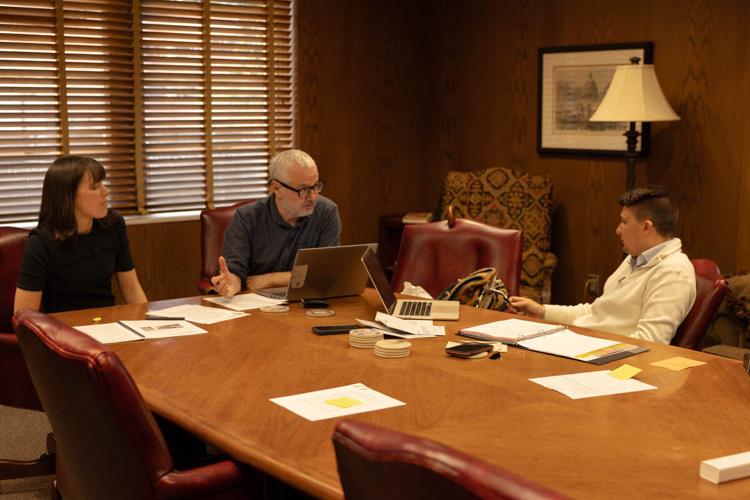
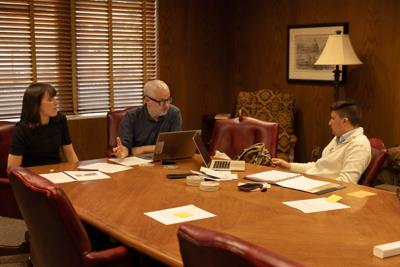
Developing Historians of the World Board Meeting in Carl Alberts Center Board Room on Oct. 14, 2026.
He believes students are starting to lack skills in research, critical thinking, reading and writing due to the increased access to information online.
“Research is a skill that’s fading quite quickly,” Seay said. “One of the main parts of the program is research. Most of everything is research-based.”
Developing Historians of the World receives help from experts in the field to give students more information about local history. Professors and museum officials volunteer their time to chime in on the program’s curriculum.
Another source of help comes from volunteers who have interest in history or want to help out students.
Anyone can volunteer to help the program. People with experience in history or museums are encouraged to reach out to Seay through the contact information on the Developing Historians of the World website.
“We’d figure out what your strengths, what are your weaknesses, and I would correspond a project from there,” Seay said.
For students who want to volunteer, it’s simple. “Attend any local museum that signed up for the program, and they would set you on the correct path,” said Seay.
While the program develops and grows, Seay also works on expanding partnerships with museums across Oklahoma.
The nonprofit currently has one fully-fledged program in Cheyenne and has four museums ready to pair with high school students: The Edmond History Museum, the Chisholm Trail Museum and Seay Mansion in Kingfisher, the OSU Museum of Art and the Boone Pickens Legacy Experience.
Seay organizes materials that are then distributed to the partnered museums once the program begins.
These materials guide students and provide structure through the program’s curriculum for their projects.

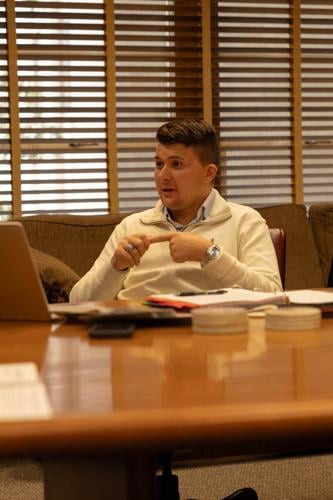
Developing Historians of the World Board Meeting in Carl Alberts Center Board Room on Oct. 14, 2026.
Students participating in the program progress through levels and specializations called “expedition tickets” that detail the project and its goals. The projects were developed through museums and student collaboration.
Before partnering with museums for the program, Seay had to figure out how to turn his program into a nonprofit to help it grow.
When he arrived at OU, Seay enrolled in Introduction to Nonprofits with the organization in mind.
“(Developing Historians of the World) was always there in the forefront of my mind,” Seay said.
Vicki Lavastida, who taught the course, encouraged him to pursue the organization and offered her assistance with bylaws and paperwork to establish a nonprofit. Now an assistant professor at West Texas A&M, Lavastida is on the organization’s board.
Lavastida said previously teaching Seay allowed her to view his work ethic and gave her confidence that he is committed to the organization.
“I knew this wasn’t just going to be something that he started and fizzled out,” Lavastida said. “I knew that he was going to go all the way with this.”
The commitment Lavastida saw in Seay extended beyond time and effort. Eventually, he invested his personal money to help the program grow.
Seay said he initially spent around $350 from his personal income on filing fees, the organization website and additional expenses to establish the nonprofit.
After years of development and navigating the establishment of his nonprofit, Seay is beginning to watch his ideas come to life. This fall is the organization’s first year in full production.

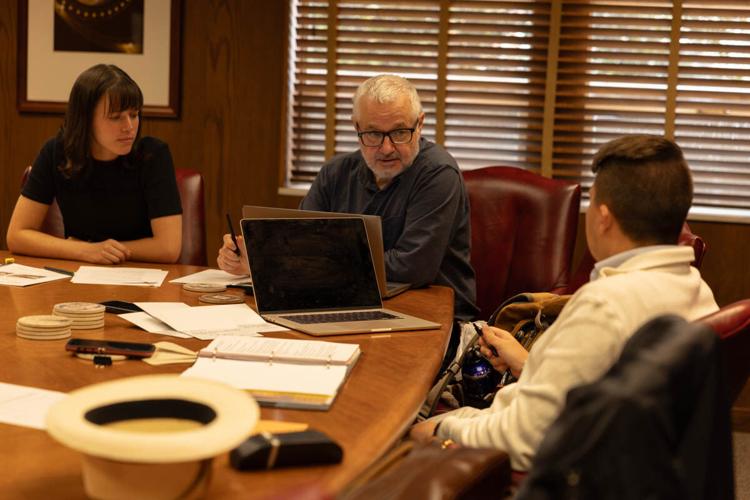
Developing Historians of the World Board Meeting in Carl Alberts Center Board Room on Oct. 14, 2026.
Katherine McRae, a Developing Historians of the World board member and Carl Albert Congressional Research and Studies Center staff member, said students will be taught how to present historical materials, draw their own conclusions and understand how history relates to the present while visiting museums.
While Seay works to give students an appreciation for history, the creation of those opportunities have led him to take on responsibilities beyond the typical college student.
The mix of being an OU student and founder of Developing Historians of the World has taught Seay skills beyond his history major. He has learned about taxes, IRS regulations, and nonprofit law, and he attributes his biggest sources of enlightenment to books, professors and nonprofit professionals.
“I have zero time, …” Seay said. “You spend all day in class, you go to work after class, and then you go and you have to figure out, ‘Where am I going to find time for this?’”
Seay said watching his nonprofit come to fruition makes the busy schedule worth it. A downside, Seay said, is that the position of founder and executive director requires a lot of work but doesn’t pay.
“I would like to get paid at some point, just because I would rather do this than (work at) the casino every night,” Seay said.
Seay runs Developing Historians of the World by handling a range of tasks. He maintains the nonprofit’s bylaws, ethic statements, conflict of interest policies and tracks its monthly expenses and revenue. He also works on board meeting agendas, financial reports and coordination between schools, museums, and donors while balancing OU courses and a job.
Seay said his age has sometimes made it difficult to build professional relationships with those who have more experience in the field.
“If anything, it puts me at a disadvantage because I am dealing with an older crowd,” Seay said. “If you ever look at a museum board, there is no 20-year-old on the museum board. There’s nobody to relate to.”
Fundraising has become another challenge for the organization.
At the first OU home football game, roughly two hours ahead of the gates opening, Seay arrived on campus to hand out around 200 raffle flyers.
He said only one person bought a ticket.
McRae said she believes establishing Developing Historians of the World throughout Oklahoma should come before expansion beyond the state. She hopes the organization can develop relationships with museums and statewide professional organizations over the next two to three years.
“There’s no necessarily limit on how far the organization or how large the organization’s reach could be,” McRae said.
The long-term goal for the nonprofit is to operate nationally with regional, state and national conferences designed to discuss and grow the program.
In the next five to 10 years, he hopes to establish chapters throughout the region, including Texas, Colorado, Kansas, Arkansas and Louisiana.
This story was edited by Macey Thaxton and Audrey McClour. Avery Shaw, Parker Newman and Tori Pham copy edited this story.


