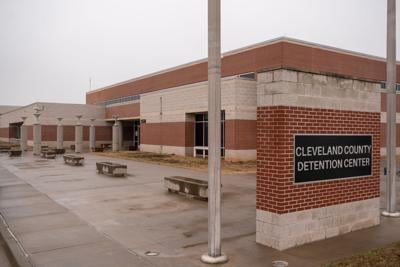

Amid rising public concern about jail conditions and accountability, Cleveland County officials and state lawmakers weigh in on a new law that will establish comprehensive standards for the operation of detention and lockup facilities across Oklahoma.
Gov. Kevin Stitt approved and signed Senate Bill 595 Monday. Known as the Oklahoma Jail Standards Act, the bill authored by Sen. Darrell Weaver (R-Moore) requires all facilities to adopt policies covering key operational aspects, including 24-hour supervision of prisoners by direct observation or electronic video surveillance and ensuring adequate diet and proper sanitary conditions.
“The Oklahoma Jail Standards Act will establish clear guidelines for operations at Oklahoma’s detention facilities,” Weaver said in a press release. “Given the inherent challenges jails face, our goal is to put standards in place and proactively solve issues in order to prevent dangerous situations, injuries, or deaths. This effort aims to unify and consolidate expectations for jails, ensuring that all our detention facilities operate under consistent and effective standards that will minimize risks for both inmates and staff.”
In a statement to OU Daily sent by Meyer Siegfried, the governor’s spokesperson, on behalf of Stitt, Stitt explained why he signed the bill and how he believes it will help keep the detention centers up to standards.
"Jails have a tough but important job— protecting the public while treating people in custody with dignity,” Stitt said. “I signed SB 595 because I believe in setting clear, consistent standards that will improve conditions and strengthen oversight. It's a smart, proactive step that will make Oklahoma safer and more accountable."
The Oklahoma Senate unanimously approved SB 595 on March 24. It was then engrossed in the state House, where Rep. David Hardin (R-Stilwell) carried the bill forward.
Hardin said, due to his background working as a sheriff, he believes the bill is a benefit rather than a limitation to the health and wellness of both staff and detainees.
“This bill will allow video, somebody watching videos, …” Hardin said. “In certain instances where unforeseen things happen — weather, tornadoes, gas leaks, fire, whatever may happen — … the number one priority is the health and welfare of the prisoner, but it also gives a little bit more time for the sheriff, for the jail trust administrator to start taking care of some of these issues.”
Hardin clarified that there will be restrictions on where these cameras can be placed to ensure each prisoner still has privacy.
“There are certain areas that are off limits,” Hardin said. “We're not going to watch them take a shower. We're not going to watch them go to the bathroom. So anything in that bathroom area, you're not going to be able to video.”
Cleveland County Detention Center
SB 595 comes at a critical time for Oklahoma's detention system. Recent inspections revealed that 51 of the state’s 65 county jails, including the Cleveland County Detention Center, were not in compliance with health standards.
In the past three years, nine inmates have died at the Cleveland County Detention Center, including Shannon Hanchett, a 38-year-old mother and bakery owner. Hanchett was arrested in November 2022 while experiencing a mental health crisis.
She disclosed her bipolar disorder and lupus to detention center staff but was not evaluated by medical staff for over 72 hours being held at Cleveland County Detention Center. During this time, she was left unsupervised although she showed severe dehydration and psychosis. An autopsy later revealed she died from heart failure, with psychosis and dehydration being contributing factors.
Although medical staff noted Hanchett showed signs of suicidal ideation and was severely dehydrated, jailers routinely missed the mandatory 15-minute sight checks required by state law.
“I was the Sheriff of Adair County, and I also spent 32 and a half years in Oklahoma City PD. I didn't get sued, and nobody died in the jail or on the sheriff's side, either one,” Hardin said. “It's hard for me to speak for the Cleveland County Jail because I don't know the circumstances down there.”
Since 2022, the Cleveland County Detention Center has repeatedly failed unannounced annual inspections. Major complaints cited in inspection reports include unsanitary living conditions, delayed provision of hygiene products and inadequate inmate safety checks.
In an email to OU Daily, Storme Jones, director of communications for Cleveland County, wrote that many officials support SB 595 and believe it will promote better oversight and accountability.
“Cleveland County Commissioners Rod Cleveland, Jacob McHughes, and Rusty Grissom applaud Sen. Darrell Weaver (R-Moore) and Rep. David Hardin (R-Stilwell) on their efforts to establish uniform standards for detention facilities in Oklahoma through passage of the Oklahoma Jail Standards Act,” Jones wrote.
Inspectors reported accumulations of dirt, trash and mold in inmate living areas, including showers. Inmates reported having infrequent access to cleaning supplies. Female inmates also reported long delays, sometimes hours or until the next shift, for access to hygiene products.
“I understood the fact that, you know, the jail inspector is not going to call and say, ‘Hey, I'll be there on Wednesday at 10 o'clock,’ because Wednesday at 10 o'clock, that jail is gonna be perfect,” Hardin said. “There can be a lot of issues with these jails, and it's tough to run one. I thank God that God graced me and watched over (me).”
In response to these ongoing issues, Cleveland County Sheriff Chris Amason acknowledged the challenges and outlined measures to address them, such as facilitating attorney visits via email and waiving medical fees for indigent inmates.
A state audit released in April revealed the Cleveland County Sheriff’s Office overspent nearly $4 million under Amason’s tenure, despite receiving an increase in funding. The office embarked on 24 out-of-state conferences, purchased or leased 40 vehicles and issued retroactive raises to 28 employees, all while the jail staff was reduced by 45%, according to the audit.
John Bishop, the former detention chief at the Cleveland County Detention Center, resigned earlier this month. On the same day, an officer was hospitalized after an inmate assaulted her. Bishop’s resignation took effect immediately, and no reason was provided.
Detention officer Lydia Saunders sustained a broken nose and other injuries after being attacked during a routine check. Inmate Donna Lair, who already had felony counts of assault and battery, now faces additional charges.
McHughes, District 2 Cleveland County commissioner, commented on the ongoing struggles at the facility and highlighted the importance of SB 595 as a solution.
“Senate Bill 595 highlights a very important, but simple fact - Oklahomans deserve higher standards when it comes to the operation of our detention facilities,” McHughes wrote in an email to OU Daily. “As Commissioners, our primary focus at the Cleveland County Detention Center is always the safety and security of our officers and inmates.”
Despite previous efforts to address the issues, McHughes emphasized that significant problems at the facility continue to persist, affecting operations and overall efficiency.
“It is very unfortunate that even in the midst of record-high funding, we still see reports of detention officers being brutally beaten and inmates dying at our facility,” McHughes wrote. “We hope that the standards contained in Senate Bill 595 will provide the sheriff with much-needed direction to ensure the Cleveland County Detention Center becomes as safe and secure as possible.”
Hardin said he is understanding that this law might cause fears of undermining external oversight when many facilities are struggling to meet basic standards.
“I can see that everybody is going to be concerned about that, when it comes down to the brass tacks of it, jails are going to have to conform to the jail standards, and the jail standards are run through the health department,” Hardin said. “ I understand their concerns. This is a new bill. We're changing the way things are done, but I don't think that's going to be a concern.”
This story was edited by Anusha Fathepure, Ana Barboza and Ismael Lele. Kylie Caldwell, Sophie Hemker and Grace Rhodes copy edited this story.


