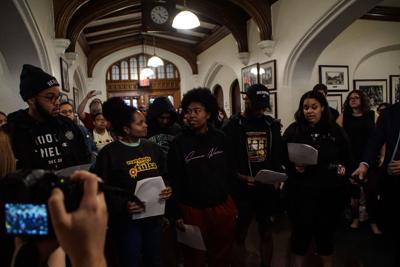

OU’s Black Emergency Response Team posted its previously non-public final set of demands in addition to the ones released on Feb. 26, 2020 — following the sit-in at Evans Hall and hunger strike — in a Monday release.
BERT included additional demands to “make up for (the) gap in the changes” it expected to achieve with the sit-in and strike after university administrators could not commit to the firing of former Senior Vice President and Provost Kyle Harper. BERT wrote the administration failed to meet its “top demand due to bureaucratic barriers.”
“Today, we have decided to release the final demands which were shared with the administration, but not with the public or our community,” BERT wrote in the release. “We find the time now most important to be transparent as possible with our community as we continue to work towards equitable change at the University of Oklahoma.”
Among the new demands is the creation of a Provost and President Advisory Board “to provide students with more multicultural representation and access to enhance relations between students and the provost.” The board must meet with the provost once a month and can call for special meetings if deemed “necessary or vital,” BERT wrote in the release.
BERT asked for an inquiry or funding of a Center for Research on Race and Ethnicity, and additional funding and assistance for all multicultural communities. Increased funding would serve as an incentive for diverse faculty to come to campus, allowing them to “receive the research rewards they deserve in this area,” BERT wrote in the release.
BERT also requested an “expeditious 360 (degree) review” of the provost office and president’s offices. The reviews would be conducted by faculty, staff and students.
The final demand called for the creation of an assistant provost position — a Vice Provost of Institutional Equity and Excellence — over faculty, curriculum and inclusion. According to the release, the position will work toward supporting the “entire college population with diverse, multiple and intersecting identities.”
In response to the BERT's previous demands, OU announced a new mandatory diversity training program — accounting for educational materials — to address topics of identities, power, privilege and creating a culture of respect. The course is self-paced and is required at least once every three years.
BERT wrote it will continue to work with the administration so every demand can be met in “an equitable manner” in hopes of leaving “long-lasting institutional change” and making OU “more accepting and welcoming for all people regardless of background and identity.”


