
In 1954, the U.S. Supreme Court declared segregation in public schools was unconstitutional following Brown v. Board of Education.
In 1948 — six years before the ruling — George McLaurin became the first Black student to attend OU.
McLaurin had been denied admission at the university but finally enrolled after a federal court found his rejection unconstitutional.
According to David Levy, a retired OU history professor, McLaurin was selected by the NAACP, the nation’s oldest civil rights organization, to challenge Oklahoma state law regarding segregation on campus.
While McLaurin was the first Black student to attend OU, Ada Lois Sipuel Fisher was the first Black student to apply to OU in 1946. Fisher fought for over three years with the U.S. Supreme Court for the right to admission to the OU College of Law, with the court finally ruling in her favor in 1948.
“There was a series of court cases, and in the end, the district court required the university to admit McLaurin,” Levy said. “But they did not require that they be integrated.”
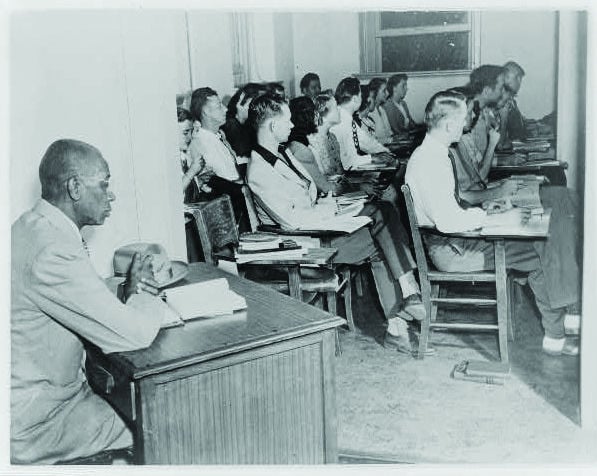
George McLaurin sits segregated from white students in 1948 classroom at OU.
McLaurin was given his own table in the Oklahoma Memorial Union for lunch. He had his own bathroom toilet and his own desk in the library. While he could go into the stacks and check for books, McLaurin had to take them to his own table.
If any Black student wanted to go to a football game, the university would set aside a plywood barrier between the white and Black students at the top of the stadium, according to Levy.
In lecture rooms, a row would be set aside for Black students, and in laboratories, they had their own space. In housing, Black men would live in the units built during World War II while Black women were housed at Cate Center.
“That was very difficult for the administration,” Levy said. “They were trapped between the federal insistence on admitting Black (students) and the state law.”
When Brown v. Board of Education was decided, around 50 to 60 Black students were enrolled at OU, according to Levy.
In 1959, Melvin B. Tolson Jr., a poet and essayist, became the first full-time Black professor at OU’s Norman campus where he taught French literature.
“He was a very good teacher, and the students liked him,” Levy said.
In 1967, George Henderson became the third full-time Black professor at OU. He and his wife Barbara were the first Black couple to purchase a home in Norman.
A civil rights activist, Henderson has written many books on social issues including “Race and the University: A Memoir,” a recollection of his time in Norman and the struggles of Black students during OU’s civil rights movement.
“When I came to the university, there was a separate and unequal desegregation and separate and unequal integration,” Henderson said.
Integration in residence and dining halls was lacking, Henderson said. Every minority group would be in their own clusters with no requirements to interact with one another.
“(OU) was two universities in one,” Henderson said. “Black students came to the campus, and it was many, many years before they became an integral part in terms of classroom activities and study sessions.”
In every class Henderson taught, he required students to get to know somebody in the class they hadn’t met before in order to break the small groups. For group assignments, he would encourage students to interact and work together.
During his first class at OU, Henderson felt exhilarated yet frightened. He did not want the class to fail and tried to present issues in a way that did not alienate students or groups.
“I’ll never forget a young man sitting in the front row. I asked the students, ‘What do you expect here?’ and (he) said, ‘I did not expect to have a Black professor,’” Henderson said.
After the class ended, the young man waited outside to talk to Henderson.
“He said, ‘I hope you didn’t misinterpret what I was saying. I was raised in a community and in (a) family (that) did not tolerate or expect African Americans to be our teachers,’” Henderson said. “We talked, and guess what? By the end of the semester, we were friends.”

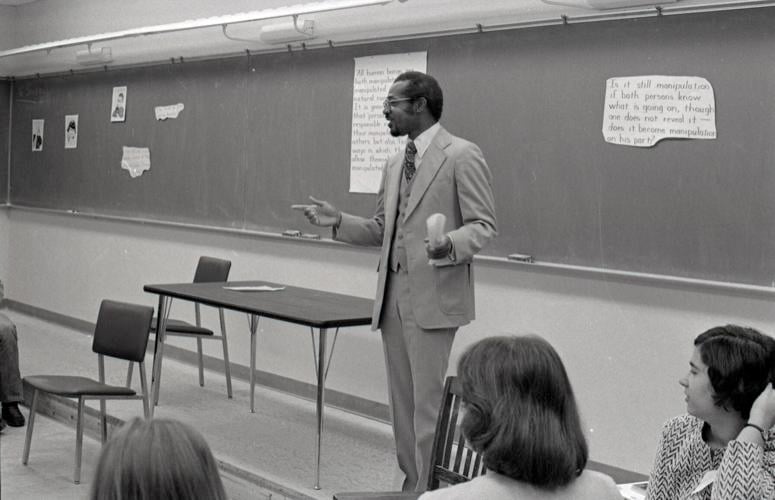
George Henderson speaks at a human relations student and faculty meeting Nov. 18, 1974.
On Nov. 12, 1967, around 90 Black students and three faculty members, including Henderson, Tolson and Lennie-Marie Tolliver — the first Black woman to become a professor — met in a small auditorium in the Oklahoma Memorial Union basement. There, they discussed the campus climate and how it was affecting their college experience.
As they kept meeting and connecting with one another, the group decided they needed to be an official organization.
“That meeting was interesting because, even within the Black students, there were clusters,” Henderson said. “Athletes sat together. The different fraternity groups sat apart from others, and it was strange for me to see these blocks of Black students, but they were looking for something, and they wanted something more than just simply going to school at OU.”
Students didn’t know what to do for the organization, but Henderson had one condition: Whatever they did would be nonviolent.
Henderson said there was a small group of students who didn’t like that and wanted to fight against the aggression and comments they would receive.
“I guess that meeting was a meeting where they said, ‘Hey, we’re all Black people, and we should not have our differences based upon hatred. We should have our differences based upon lack of opportunities that some of us want and others do not,’” Henderson said.
Henderson, Tolliver and Tolson served as mentors for the students but made it clear students were free to build the organization as they wanted.
Seven days later, the Black Student Association, then Afro-American Student Union, was officially recognized.
Henderson said graduate students were the main leaders in combating racial segregation, especially those who came from other southern states.
“They came to OU saying, ‘We would have preferred to go to graduate schools in our own places, … but we can’t go to schools because of white kids there. But what we want to do here is we want to be a part of something,’” Henderson said.
Henderson said he and his wife became advisers and mentors for several students, and their house was the first social setting where the students could express themselves.
However, the organization wasn’t received well.
People would write racist comments on the sidewalk and in the stalls of public restrooms. Henderson said he received anonymous messages degrading him to the point he forbade his children to answer the phone for the first two months they moved to Norman.
The organization received several negative reactions to the extent that some fraternities had “slavery days,” Henderson said, where members would do blackface and dress up like slaves.
“It was also the greatest challenge that I think I would have ever had, in terms of deciding was I really committed to nonviolence and desegregation and love and all of those things, or was it just theory? …” Henderson said. “It became a lifestyle.”
Once, a former dean told Henderson he didn't have tenure and could lose his job, and he should keep his mouth shut and stop helping students be agitators.
“I remember saying, ‘I didn’t come here to have a job of silence, and if I never get a tenure, I’m going to speak my truth and encourage students to speak their truth,’” Henderson said.
He said though he lost more than he gained, he would do it all over again.
“That’s what I believe I was born to do,” Henderson said. “And it had nothing to do with awards and honors (and) everything to do with students speaking up and finding their voices and supporting them. It had everything to do with us looking up at each other and deciding that we will find common ground, and together, black and white and brown, we did.”
As the Black community on campus grew, Henderson said OU was like a “tale of two universities.”
“It started out as a university that was separate and seemed to have no common ground. The new university decided to turn their back on the old ways and live new ways,” Henderson said. “I like the new university. I like the one that we have (now).”
Even with all the progress, there have been several instances in the past decade involving racist remarks.
Nearly 10 years ago, an OU fraternity received national attention for a video of members chanting a song with racial slurs and references to lynching.
Former OU President David Boren issued an intent to expel the students in the video, but the students withdrew from OU before their expulsion took effect. The OU chapter of Sigma Alpha Epsilon, the fraternity in question, was immediately disbanded by its national organization.
In 2019, OU President James Gallogly's tenure was marked by administrative turmoil and multiple instances of students wearing blackface on or near campus.
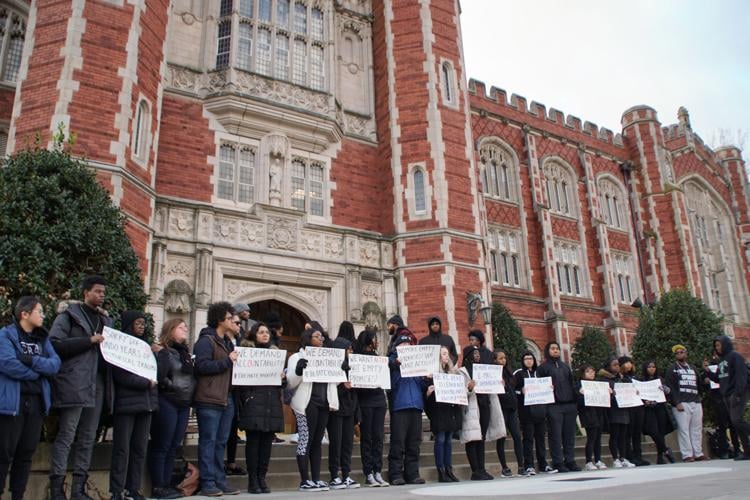
In February 2020, two OU professors used racial slurs in class, prompting a sit-in orchestrated by the Black Emergency Response Team in Evans Hall.

Members and supporters of the Black Emergency Response Team protesting with signs outside of Evans Hall on Feb. 26, 2020.
Henderson said many students have asked if the fight is over and if equality has been achieved.
“And I say no, never. Never until all students, or most students, or a critical mass of students, continue to press for equality,” Henderson said.
On Nov. 19, the Student Government Association declared it will recognize Oct. 14 as George McLaurin Day beginning in 2025.
Shrey Kathuria, community health senior and author of the bill, said McLaurin worked hard to desegregate OU, and his case helped lay the foundation for Brown v. Board of Education.
“The work he did was very historic, and it's something that I think all of us here should be grateful for,” Kathuria said during the presentation of the bill. “I know there are some state politicians who are trying to hide some of the ugly aspects of our history.
“As student government, (we) have the obligation to make sure we are telling the story about the movement towards racial justice and being able to work on correcting our past wrongdoings and honoring those who helped enhance the civil rights movement.”
Kathuria recalls learning about McLaurin during a Camp Crimson event his freshman year and researching his story later.
“I learned so much about his legacy, being a pioneer for the civil rights movement … and just being a monumental statewide figure that is forgotten by many,” Kathuria said. “Many OU students unfortunately don't even know who George McLaurin is.”
Kathuria said integration was the best thing to happen in the country, especially in the OU community. He believes it’s important for people to embrace inclusivity and respect.
“We have our unique stories, as all of us come from unique backgrounds,” Kathuria said. “At the end of the day, we are so much more than what label we have. It’s more about celebrating our own humanity.”
With many politicians attacking civil rights issues like diversity, equity and inclusion policies, Henderson believes people could experience a very oppressive state and country for the next several years but hopes there won’t be any changes.
“I do not move. I remain unchanged. I look around and say, ‘This is right, and this is wrong,’” Henderson said. “We, as a collective, must understand that whatever comes, negative or positive, we can't just settle for what it is. We have to continue to make it better, or at least make it good.
“As far as I'm concerned, game on. (I’ve) played it before. The game is still on, and I'm not leaving. I'm not giving up, ever.”
Read more:
This story was edited by Anusha Fathepure, Peggy Dodd and Ismael Lele. Avery Avery, Grace Rhodes and Mary Ann Livingood copy edited this story.


