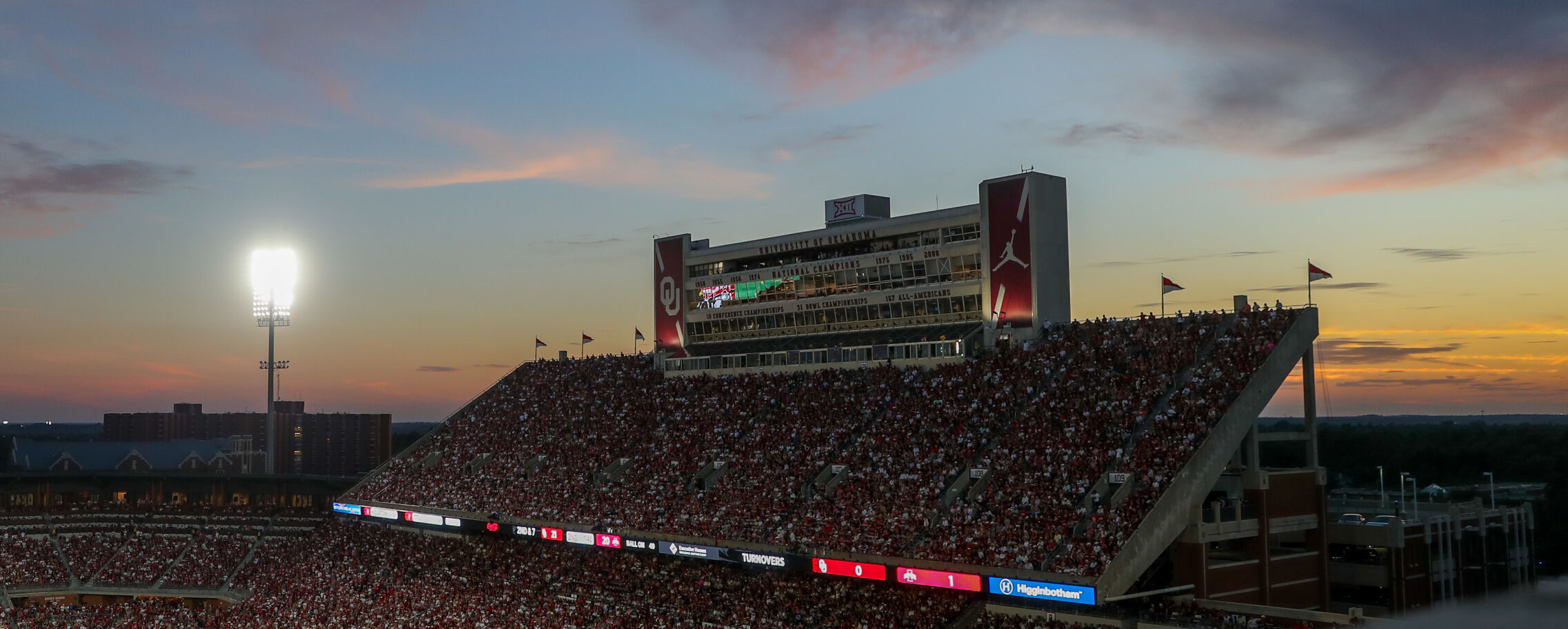
Gaylord Memorial Stadium at sunset during the game against Iowa State on Sept. 30.
When the NCAA’s NIL policy was instituted, Oklahoma got to work.
In July 2021, the Sooners prepared comprehensive presentations for Oklahoma’s student athletes and potential recruits, which included data about the program’s social media presence and how it could boost their own following. Oklahoma began to provide resources centered around photo and video content for athletes to use. It was not only meant to use the university to promote their brand, but also with companies to set up personal NIL deals.
The message to athletes was clear: If you want to build a long-term and potentially lucrative brand for yourself, not just make an initial few bucks, become a Sooner.
“We said, ‘Here’s OU’s national brand, and here’s how we're going to support the growth of yours,’” said Zach Hefley, OU’s director of content for football from 2017-21. “We focused on the strength of the university's brand and the power that it has on a national level.”
Throughout NIL’s two years, these deals have been designed to help athletes make money off their name and likeness. A recent example came after OU’s 34-30 win over then-No. 3 Texas on Oct. 7 when junior linebacker Danny Stutsman unveiled a T-shirt last Thursday with the words of his viral pregame speech, "Oklahoma only fears God. Texas fears Oklahoma," on the back.
Some for-profit deals are done between businesses and athletes, while others are done through collectives, entities that pool money from boosters, donors and fans to facilitate NIL deals for athletes of the school they support. Additionally, OU navigated state legislation and NCAA memos by helping lawmakers craft laws, such as Senate Bill 840 in May, catering to NCAA rulings, such as prohibiting school fundraising groups from being involved in NIL deals and preventing boosters from discussing deals with recruits.
With OU’s move to the SEC looming, the Sooners are attempting to do more to compete against their future conference foes. The Crimson and Cream Collective, and others associated with OU, are designed to help Sooner athletes create and receive NIL opportunities like non-program affiliated endorsement deals or fan engagement events. The university also partners with Altius Sports Partners, an advising company that helps partners like OU implement NIL strategies and solutions.
Those who work with OU believe the Sooners are positioned favorably compared to others across the country, giving them an edge as they enter their new conference.
“I think they’ve taken a very thoughtful and innovative approach,” said Andrew Donovan, Executive Vice President at Altius. “They're not leaning simply on donor dollars. They are looking at commercial opportunities for their athletes, and they've certainly made a nice investment in resources. As we go forward, they're going to set the standard.”
But in the NIL arms race, schools must toe ambiguous NCAA regulations. The ambiguity has led to questions on how much boosters can be involved in NIL deals, whether deals through collectives involving many athletes constitute pay for play schemes and how much a school can be involved in deals for its athletes. Only 32 states have NIL laws, which NCAA President Charlie Baker argues could create an uneven playing field.
Nevertheless, OU is pushing forward to put itself in the best position possible before entering the SEC.
“I guess it's an opinion, but I think it'll be pretty close to a fact that … With everything we're about to execute, Oklahoma will be better positioned than anyone in the country. Forget about the SEC,” said Jason Belzer, the CEO of Student-Athlete NIL, which runs Crimson and Cream. “There’s zero question. Oklahoma will be in a very strong position.”
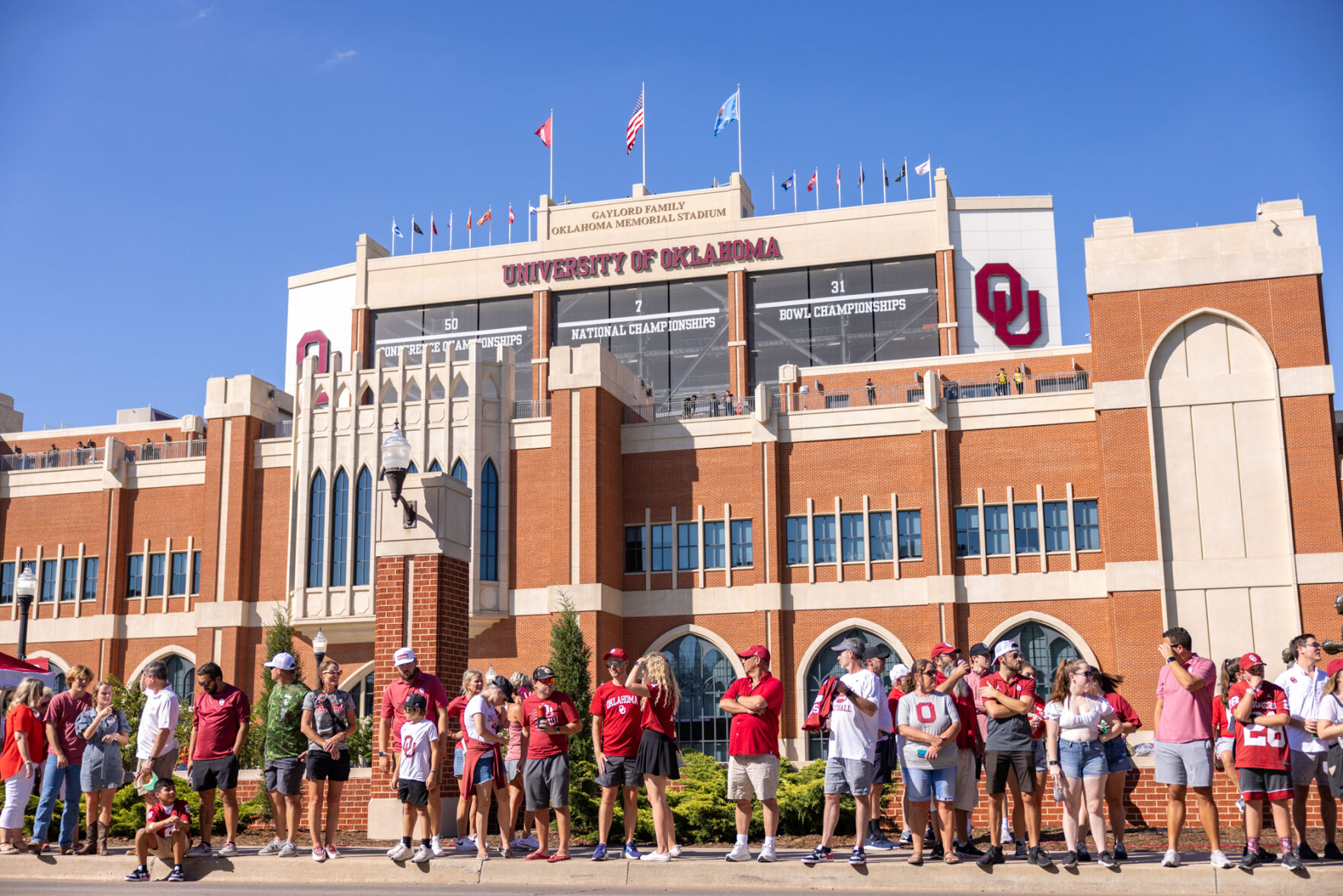
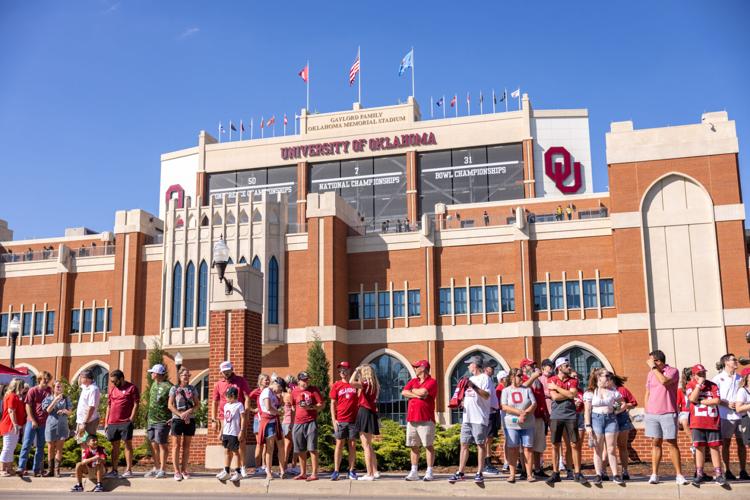
OU Fans in front of Gaylord Family Oklahoma Memorial Stadium during Walk of Champions on Sept. 30.
‘We do something, and then everybody else does it’
OU recently took more steps to increase its NIL footprint.
After revamping its website on Sept. 1, Crimson and Cream launched an “engagement app” on Oct. 1, designed to further connect fans with OU athletes. The app will include benefits for members with exclusive video content and winnable OU memorabilia.
Crimson and Cream has been ambitious since its launch. It held a large fundraising campaign when it started, raising $1.6 million in 30 days, and has since raised over $5 million in fan donations according to Belzer, of which 85% has gone to OU athletes.
With their new app, Belzer hopes to raise the collective’s membership to over 20,000.
“It will be the Netflix of OU sports,” Belzer said. “The goal is to build a membership community … Just like you pay for your membership with Amazon or Costco. It’s going to be our core program.”
Crimson and Cream also launched a new NIL deal on Sept. 8 with Hal Smith Restaurants, a Norman-based corporation that owns 85 restaurants in the Midwest. All 130 of its athletes on retainer deals, contracts where athletes have multiple NIL deals facilitated by the collective, were signed up for at least $500 each, totaling at least $65,000 in value.
They also host events like golf outings and meet and greets, including the latest “Meet the Sooners” event at Gaylord Family - Oklahoma Memorial Stadium on Aug. 5. While Crimson and Cream is an “official corporate partner” of OU, they’re independent of the university.
So far, Belzer claims Crimson and Cream has created NIL opportunities for over 300 OU athletes with at least 20 companies.
“We run the whole business,” Bezler said. “We represent all of the student-athletes at (OU) and we represent them to three different customers. The first being fans… the second being businesses, and the third being donors or individuals who want to raise money for us.”
Additionally, OU launched a first-of-its-kind “Athlete Services Division” with Altius back in August. According to Donovan, the division will include three people, two from ASP and one from OU, and will focus on helping athletes “navigate the complexities of NIL.”
The division will focus on making Oklahoma more adaptive in NIL by tapping into Altius’ existing partnerships, strategies and research to influence OU’s decisions. Donovan believes having people specialized in assisting athletes with NIL will make OU and its athletes more aware of NIL trends, rule changes and opportunities.
OU’s member will be its head of NIL, Toby Baldwin, while ASP’s two representatives have yet to be hired.
“With this, Oklahoma is going to invest in additional personnel to support athletes directly,” Donovan said. “Those individuals are going to have access to all of our national intelligence. They are trained in a way where they are not only bringing value to what’s specific and unique to Oklahoma, but to the national landscape.”
Some OU athletes have also worked with INFLCR and Opendorse, software platforms designed to connect student-athletes with businesses.
Former OU punter Michael Turk and Opendorse worked with Cheez-It to create the “cheesiest” hotel room to promote last season’s Cheez-It Bowl. The promotion consisted of Turk posting a video in the hotel room, surrounded by cheese-themed pillows and sheets, and said he woke up “feeling the cheesiest.”
NCAA rules state players can’t get paid “directly or indirectly for promoting an athletics competition in which they participate." So, the concept was created for Turk to promote Cheez-It without technically promoting the game.
“We had to come up with a creative, problem-solving way for this promotion to happen,” said Braly Keller, an NIL specialist at Opendorse. “So, we just decorated (Turk’s) hotel room as the cheesiest hotel room. He created some great Instagram and YouTube content off of it.”
So far, Donovan believes OU has successfully provided vast NIL resources and opportunities to its athletes. For Hefley, he believes OU created an “innovative and disruptive” model.
On the surface, it gives OU a good foundation going forward.
“I think our work at OU has always been looked at (by other universities),” Hefley said. We do something, and then everybody else does it. There are certainly schools behind the eight ball. I would never worry about OU being one of them.”
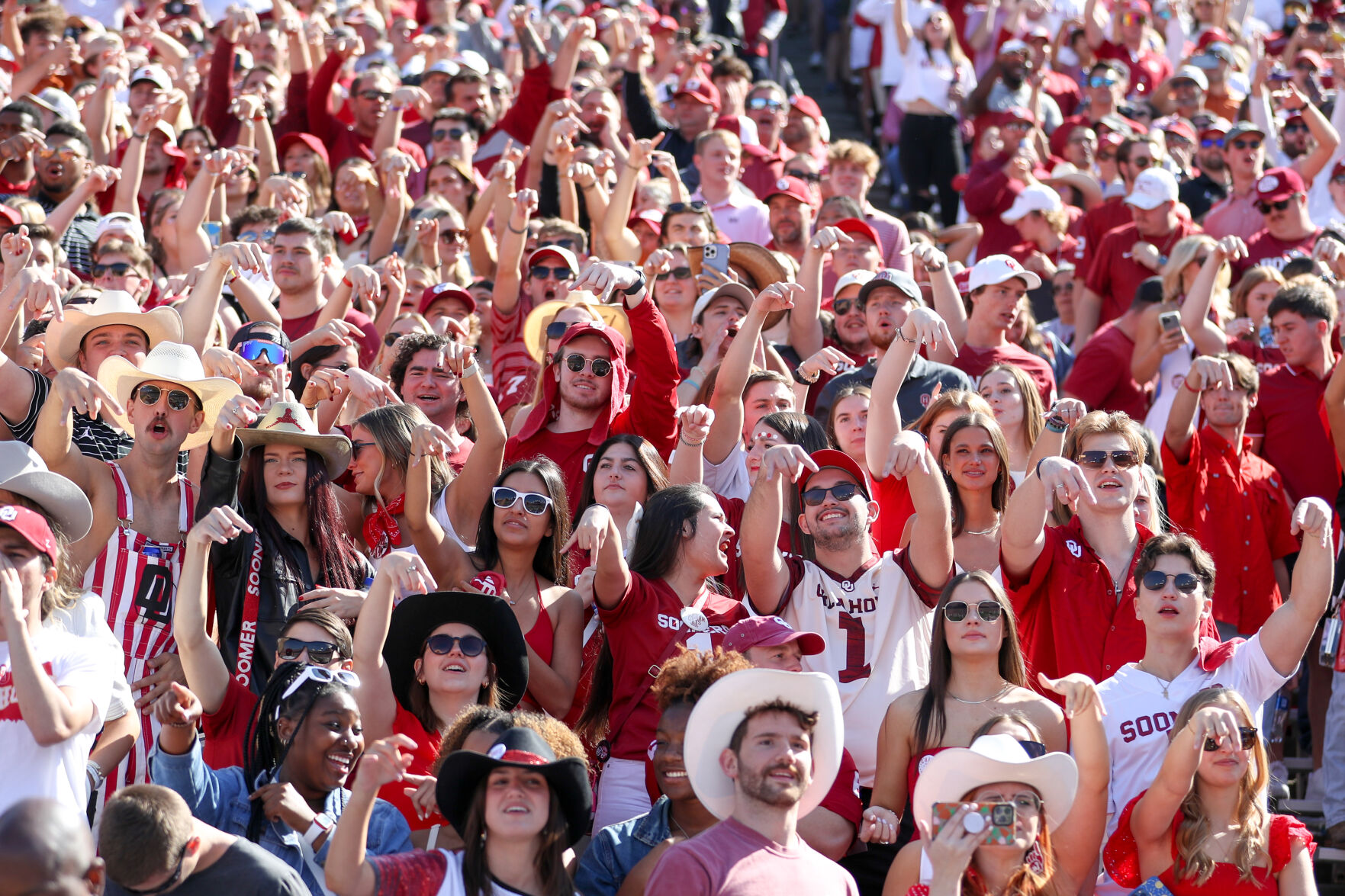
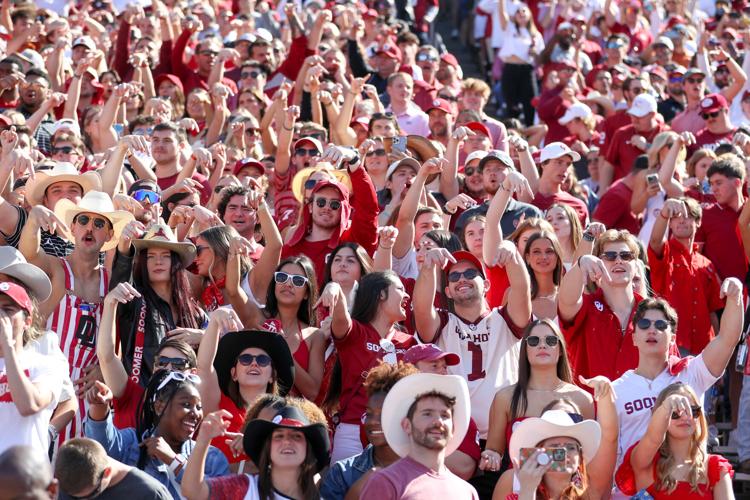
OU fans during the game against Texas on Oct. 7.
‘We’re able to compete’
While collectives and schools have impacted the NIL landscape, state legislation has made its mark too.
In May, the Oklahoma State Legislature enacted Senate Bill 840, which prevents the NCAA from taking actions such as investigations, sanctions or entertaining complaints against institutions involved in protected NIL activities. In addition, the bill also removes a prohibition of “an entity whose purpose includes supporting or benefitting the postsecondary institution or its athletic programs” from professionally representing its athletes or providing compensation to them.
A veto of the bill from Gov. Kevin Stitt was overruled by both the Oklahoma Senate and House of Representatives.
The bill followed a fellow NIL-related bill passed in January, which stated that student-athletes could no longer be classified as employees. Similar laws to Senate Bill 840 have been enacted in Arkansas, Colorado, Missouri, New York and Texas.
According to Sen. Mary Boren (D-Norman), the language of Senate Bill 840 was crafted with OU’s help to avoid NCAA conflict.
“They were 100% involved,” Boren said. “We specifically tried to craft that piece of legislation so we wouldn’t have that conflict. We knew the vulnerabilities and the ambiguity that we were facing… so that’s where we were being proactive so we could be as clear as possible with student-athletes.
“If somehow, the NCAA doesn’t like our policy, then they need to go back and make it clear on their end.”
Boren believes the bill makes the state’s NIL structure more coherent and gives schools like OU less worry in pursuing its ambitions. She even says OU athletic director Joe Castiglione personally spoke with her about why the bill should be passed.
“He said this was needed, because (OU) needed some kind of structure and protection,” Boren said. “(OU) needed more of an understanding of what everyone wanted. That way, everyone worries less.”
But, other lawmakers believe the legislation doesn’t erase potential NCAA problems. That’s why Sen. George Young (D-Oklahoma City) wants Oklahoma to establish stricter NIL guidelines like limits on how much compensation student-athletes can receive and regulations on contact between athletes and agents.
Young believes it won’t happen due to how strong collegiate athletics are in the state, but also thinks clashes with the NCAA may be coming.
“I never had a problem with the bill. I voted for it. But, I think that’s coming,” Young said. “I think (the NCAA) is gearing up for a battle with Oklahoma. There’s not much they can do until they get federal legislation that allows them to do something. But, I think we’re going to run into some problems.”
Additionally, both Boren and Young have issues with certain legislation. The Missouri General Assembly passed House Bill 417 in July, which included an amendment to its existing NIL law that allows high school athletes to receive NIL benefits by signing with an in-state school. The law could give schools like Missouri a recruiting advantage, preventing in-state kids from going elsewhere.
Boren and Young said they wouldn’t support a similar bill in Oklahoma.
“It’s almost like a trap,” Boren said. “That’s what I think bills like that are. It seems like you’re arbitrarily pushing kids toward a certain school to keep them in the state. It’s taking advantage of kids almost.”
Despite their concerns, lawmakers like Boren and Young want to help Oklahoma schools and its athletes. Boren, who graduated from OU's law school and is related by marriage to former OU President David Boren, supports its efforts to help the Sooners navigate NIL’s complexities.
Young sees it from a human perspective, believing legislation protects athletes’ interests.
“Money controls athletics, and I don’t think that’s good for society. But, I think folks ought to be paid what they’re worth,” Young said. “I supported this because I thought it was important that the students receive some of the benefits they’re providing the schools.”
And of course, lawmakers believe the current legislation helps OU as it enters the SEC.
“It was a very proactive step to allow us to be as competitive as possible,” Boren said. “Because Oklahoma got our act together, we’re able to compete and the terms are clearer. I think the reward (in Oklahoma) compared to other states is greater.”

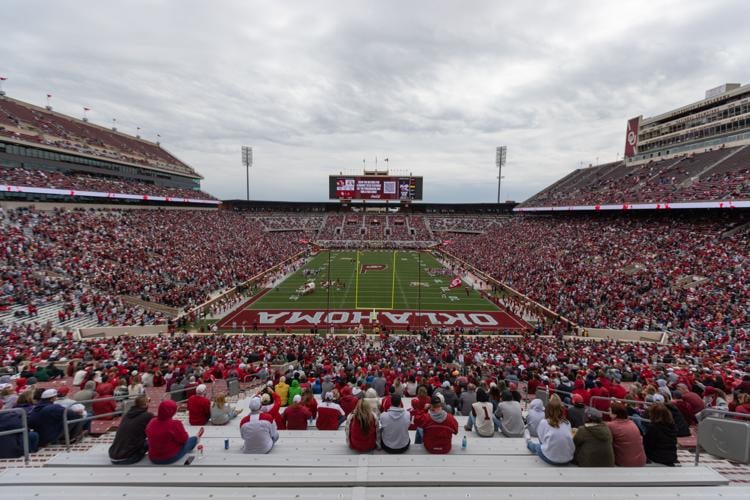
Gaylord Family-Oklahoma Memorial Stadium during the OU football spring game on April 22.
‘Other schools are going to look towards OU for the blueprint’
As OU prepares its next steps, other SEC schools are monitoring closely.
Back in February, Texas A&M launched its own collective, the 12th Man+ Fund, seen as the first time a major collegiate athletics program brought a collective under its umbrella. However, it was met with NCAA resistance after it published a memo stating “entities acting on behalf of the institution” could not pay athletes, and the collective was shuttered on Aug. 9 after recommendations from A&M advisers.
Tennessee’s collective, The Volunteer Club, has secured more than 1,400 NIL deals for Tennessee athletes totaling over $13.5 million according to its parent company, Spyre Sports Group. South Carolina’s collective, Garnet Trust, was one of the first NIL collectives to launch back in November 2021, and has since garnered $450,000 in membership dues according to its director of operations, Jeremy Smith.
Garnet Trust also works with NOCAP Sports, which operates similarly to INFLCR and has helped it bring in 30% of its annual revenue.
“We do a good chunk of our deals with the football team,” Smith said. “When the opportunities arise, we take advantage of what's out there for the student-athlete. We have a lot of athletes on contract.”
Smith says Garnet Trust has worked with around 120 South Carolina athletes, including former OU quarterback Spencer Rattler after he transferred to the Gamecocks in 2021. Smith says they attempt to work with other collectives but still try to compete with schools like OU.
“We try to measure ourselves to them in some criteria,” Smith said. “Ultimately, there's a few schools that we look at in certain areas and go, 'OK, we want to be like them.’ It’s not everything about that school, but it can be certain parts of that school.
“Oklahoma is set up similar to the way we are. But to be candid, they’re a huge national brand … Our monetary opportunities are going to be less than what they have. We have to adjust to that.”
And OU might be using those resources to push the needle further. Several transfers in the Sooners’ 2023 class mentioned those resources as part of why they transferred. Some of those transfers, like sophomore linebacker and Indiana transfer Dasan McCullough and junior wide receiver and Michigan transfer Andrel Anthony, bolstered OU’s starting lineup as the Sooners started 6-0 and have risen to No. 6 in the AP Top 25 a year after finishing 6-7.
Speaking at a local media day on Feb. 16, McCullogh discussed how the Sooners’ resources drew him in.
“No question, the brand here is unbelievable,” McCullough said. “I think Oklahoma has those types of resources to help me grow as a man beyond football. It’s what’s best for me and my future.”
Another transfer, redshirt senior defensive lineman Davon Spears, said something similar.
“Without a doubt, Oklahoma takes care of their players with what they have,” said Spears, who transferred from Texas State. “That’s why Oklahoma always stood out to me.”
Leveraging resources to attract recruits and transfers is a slippery slope. By NCAA rule, a school can’t offer a sum of NIL money to an athlete. But, they can use the NIL money an athlete could hypothetically receive as a recruiting pitch through a collective.
Those who work with OU already seem to do this, and the Sooners may have to leverage it even more to increase their ambitions in the SEC.
“A coach can’t go to a student-athlete and say ‘If you come to our university, you’re gonna get paid a certain amount,’” Belzer said. “But he or she can say ‘Every single one of our athletes is making this right now.’ Or they can say, ‘This guy is getting paid this amount.’”
Belzer is prepared to help OU do more like set up more fan engagement events, work with larger businesses for NIL deals and sign more OU athletes to retainer deals. He hopes to eventually work with 150 Sooners, believing more group deals are beneficial for OU.
“Soon, we’ll be seen as the gold standard,” Belzer said. “In six months, that's how we’ll look at it. And not just that, we’ll be the diamond and platinum standard too.”
Whether OU still has ways to go or whether they’re right where they want to be, those working with it feel a collective desire to improve. While the Sooners may already be in a strong place, the consensus is there must be more ambition to reach their ceiling.
If you hear it from them, the sky's the limit.
“Once the dust settles, we’ll be at the top,” Hefley said. “If there’s one thing I have pride in … We exceed the expectations, and then set new ones for others to follow. We’re going to have such a solid foundation that other schools are going to look towards OU for the blueprint.”
This story was edited by Colton Sulley, Jason Batacao and Louis Raser.


