

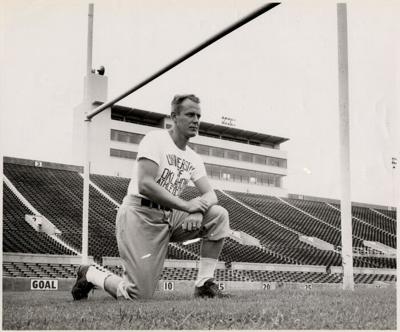
Chuck Bowman looked up at the ceiling, confused.
He knew it was 1954 and recalled celebrating the New Year just three days earlier. But, Bowman could not remember how he got here. He and his girlfriend had been driving through their hometown in Ponca City, Oklahoma, before everything went blank.
Now, as the faint hum of “Auld Lang Syne” still murmured from the radio, the 18-year-old struggled to move, as he tried to put the pieces together. There, lying in a hospital bed, his world had changed instantaneously.
“I had heard it was a guy who had still been drinking from the New Year,” Bowman told OU Daily. “This drunk put me in the hospital for 10 weeks.”
The man had smashed into the driver’s side of the car, fracturing Bowman’s right arm and leaving him without his spleen and left lung. In the nine days following the wreck, the senior in high school lost 50 pounds, physically becoming a shell of who he once was.
As the weight slipped away, so did the plans he had made for the next chapter of his life, and while Bowman lay in the hospital, he thought about the dreams that had been squandered. There, he mourned the loss of his scholarship to the University of Oklahoma, and his opportunity to be coached by the man who would influence OU football for the next eight decades.
He had missed his chance to play for Bud Wilkinson.
However, as Bowman looked up, he noticed the outline of a familiar frame. It was the same one he had seen walking into his home four years earlier.
“When my brother was in high school, Coach Wilkinson came over to recruit him,” Bowman said. “I knew right then, at 14, that if I could be a football player, I was going to play for that man.”
Now, Wilkinson was standing in the doorway of his hospital room.
“I can still hear his voice, and hear what he told me,” Bowman recalled 70 years later. “He drove to Ponca City, came to my bedside, and said, ‘Don’t worry if you can’t play after this car wreck. Your scholarship is good at Oklahoma whether you play or not.’”
Wilkinson, who served as OU’s head football coach from 1947 to 1963, had been a naval officer in World War II and fought in the battles of Okinawa and Iwo Jima. Returning from a war where 400,000 Americans died, he was not the type of soldier, or man, who would leave somebody behind.
In the same ways that he helped carry his country through a war, and sustained Bowman on that cold day in January, Wilkinson would also support OU football, building a foundation that could be transferred to future coaches like Barry Switzer, Bob Stoops and, now, Brent Venables.
“He had the old Marines mindset,” Bowman said. “You had to be so tough, that you even had to go without water. During that time, Oklahoma players did not have water on the field or during the games, and it was just that military type of discipline that Coach Wilkinson felt we needed to have. But I never even thought about it, I just felt blessed to be there.”
As Bowman arrived in Norman later that fall, he was still recovering from his injuries and would not take his first snap at center until a road game against the University of North Carolina in 1955. During his collegiate career, which spanned from 1954-58, he played behind All-American Jerry Tubbs and Ken Northcutt, seeing the field intermittently. But for Bowman, it was never about that.
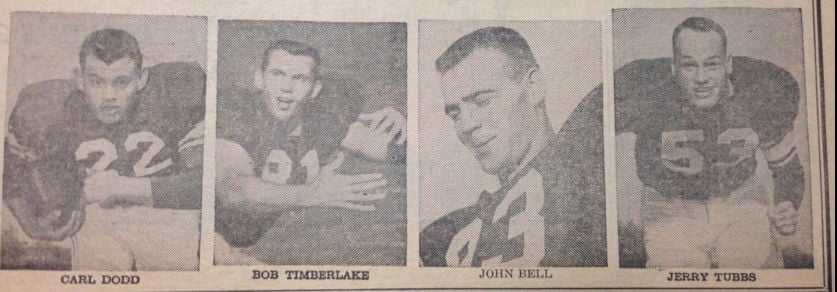
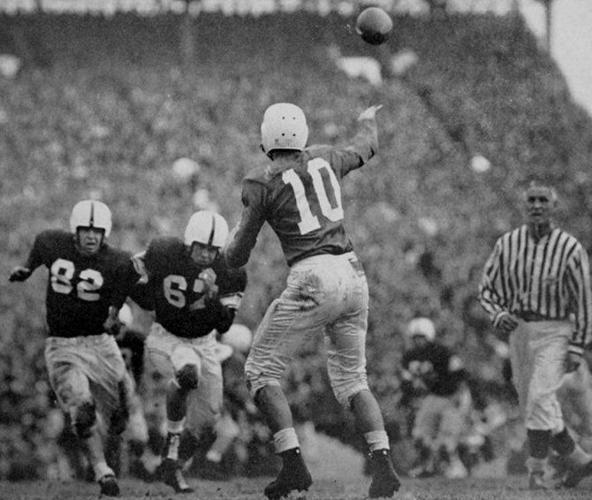
Carl Dodd, Bob Timberlake, John Bell and Jerry Tubbs show off their classic crimson home uniforms in an ad that ran in The Daily on Oct. 6, 1956. The team, coached by Bud Wilkinson, was in the midst of their record setting 47 game winning streak when this ad ran. The only thing missing from these pictures are their iconic white helmets.
From early morning practices, to sitting next to the fireplace in Jefferson House, while he and his teammates watched Elvis Presley and westerns featuring Roy Rogers and Gene Autry on T.V., the football player relished the opportunity he was given.
He was thankful for the chance to attend the University of Oklahoma and most of all, to learn from a man like Wilkinson.
“To this day, as far as football is concerned, I have never met a person that I respected more,” Bowman said of the former head coach. “He was just an amazing man. Not only was Bud Wilkinson articulate and kind, but he was brilliant, and he conducted his life in ways that reflected that.”
Now, 70 years later, the conversation Wilkinson had with Bowman in the hospital room, remains a true reflection of who the head coach was and always will be.
“He was a man who kept his word,” Bowman said. “He was a man who never faltered on his promises.”
‘He made people believe in the power of OU football’
Fans stood in the stands, refusing to leave, well after the final whistle blew. They waited in disbelief. There was no way the game was over.
There was no way that the Wilkinson streak had ended.
In the locker room, the players fell silent waiting for the head coach, not knowing what to expect. To them, Wilkinson quoted Shakespeare, rarely raised his voice and had never used profanity. He was somebody who fought in combat, an intellect and the inventor of the no-huddle offense and the “Go-Go” scheme.
But he was not a loser, he never had been.
“Not a single player in that room had lost a game until that day against Notre Dame,” Bowman said.
From 1953-57, OU, which still holds the longest college football winning streak, had won 47 consecutive games. During Wilkinson’s tenure with the Sooners, from 1947 to 1963, OU had a .826 winning percentage, won 14 league titles, six of eight bowl games, and three national championships in 1950, 1955 and 1956.
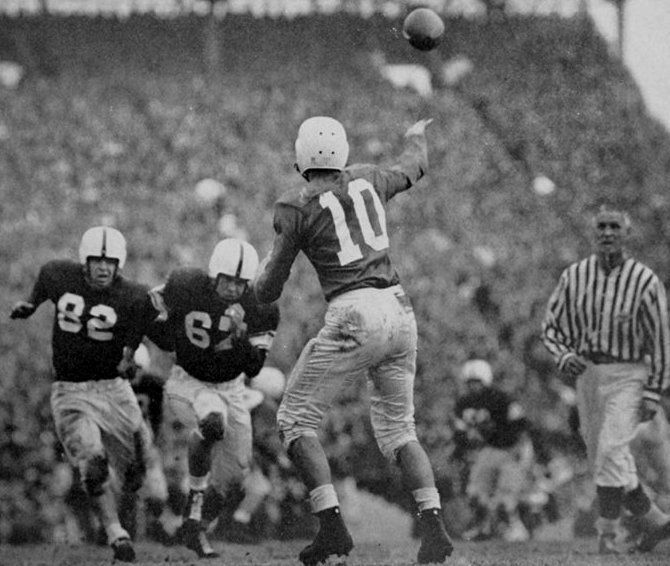
FINAL SCORE: 13-7, Oklahoma loss
Oklahoma was awarded its first national championship after a 10-1 campaign in 1950, despite a 13-7 loss to Kentucky in the Sugar Bowl on New Year’s Day 1951. The game was a match-up of two coaching legends Bud Wilkinson and Bear Bryant. The final Associated Press poll was released before the bowl games, allowing Oklahoma to claim the national championship. However, Kentucky also claims an NCAA-recognized championship in 1950.
Now, after falling to Notre Dame 7-0, the pang of loss felt unfamiliar and even unnatural. For the players, the minutes felt like hours, and as the team waited in their shoulder pads, heads hanging low, Wilkinson made his way to the opposing team’s locker room to say congratulations before going to his own.
“Here was Bud Wilkinson, the coach of the year, the man who just lost a national championship, congratulating the other team,” Bowman said. “But as he steps into our locker room, this is what he says, ‘I hate this loss for the state of Oklahoma. I hate this loss for the University of Oklahoma. But I hate this loss most for the seniors in this room because it will keep you from winning three national championships in a row. No one has ever done it, and no one ever will do it.”
For Wilkinson’s son Jay, this moment was fitting. His father was never one to shy away from difficulties, and in the same way the head coach faced those players in that locker room, he encountered life.

Prentice Gautt, the first black football player on scholarship at OU.
Despite receiving criticism, through post-game telegrams and in-person judgment, Wilkinson was someone who had composed his teams of men returning from wars who were in search of an education. However, in 1956, Wilkinson would break barriers, by recruiting Prentice Gautt — the first African American football player on scholarship at OU.
“Aside from his so-called record, he was professorial, an excellent communicator and a good motivator,” Jay told OU Daily. “But something else that was very important to him, was Prentice Gautt. For many people in those days, that was a really hard transition for them to make, but my dad knew, and we all knew, that Prentice was a person with such great class and character.
“My dad always said that breaking the color code at the University of Oklahoma was the most significant thing he felt he had done.”
Wilkinson who died from congestive heart failure in 1994 at the age of 77, was a believer in preparation and hard work, but he always valued relationships, especially the one with his family.
Jay, who would eventually become an All-American halfback at Duke, recognized this. Whether it was while he caddied for his father at the golf course during the offseason or while they played a hand of cards over the weekend, he understood the rarity.
He knew there would never be another coach like Bud Wilkinson, and he was certain there would not be another man like his father.
“In addition to being a great leader on the football field, he was a wonderful dad,” Jay said. “Yes, he made people believe in the power of Oklahoma football, but he also made them understand the value of being a good human.”
‘This jersey is still beautiful’
As Joe Castiglione walked out onto the field at Gaylord Family - Oklahoma Memorial Stadium, he looked up as the clouds that once drizzled with rain disappeared.
There, gazing toward the sky, he donned what would become his trademark fedora. However, before the hat ever belonged to Castiglione, it was Wilkinsons.
“This was the first time that Joe had ever worn a fedora to the game,” Greg Tipton, who is OU’s executive associate athletic director and has worked in athletics since 1991, said. “Because Bud Wilkinson wore a fedora.”

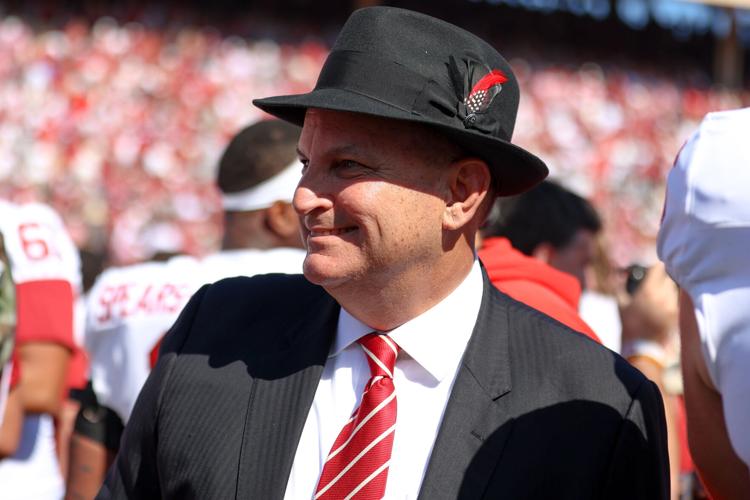
OU athletic director Joe Castiglione after the game against Texas on Oct. 7.
That Saturday not only marked the moment where Castiglione would inherit a new accessory, but it was also the day OU football scheduled to unveil the new east side of the stadium and debut college football’s first-ever throwback uniforms.
The “Sooner Legacy” uniforms, replicated those worn from 1946-56. Head coach Bob Stoops had worked together with Castiglione and the athletic department to bring back the jerseys during OU’s 37-3 win over North Texas in its 2003 season-opener.
However, inspired by the 100th anniversary of Oklahoma Memorial Stadium, OU’s athletic director was called to revive them two decades later.
“In 2021, Joe had mentioned bringing back the uniform to commemorate the Bud Wilkinson era,” Tipton told OU Daily. “So, we obviously, right off the bat, just engaged our brand Jordan to start that design and development process.
“Really, it wasn’t that difficult. We had already liked the look, so I mean the design process was pretty seamless with Jordan because we had a good template to work off of and knew what we wanted to do. This jersey is still beautiful.”
The throwbacks, which are three years in the making, were approved by Venables upon his arrival at OU, and have replaced OU’s “Rough Rider” alternate uniform.
“I know our players will like running around in those,” Venables said. “We know uniforms don’t win for you, but certainly it’s a great opportunity to honor those teams.”
Although the OU athletics department and Jordan decided to keep the same game pant, small alterations were made to the uniform’s jersey, helmet and shoes.
As OU takes the field against Houston on Saturday, this time the jersey, as opposed to one worn in 2003, will have the correct varsity block lettering identical to what was worn in the 1950s, the crimson stripe down the middle of the helmet will be painted, instead of using a decal, and players will have the option to wear crimson or white cleats instead of black.
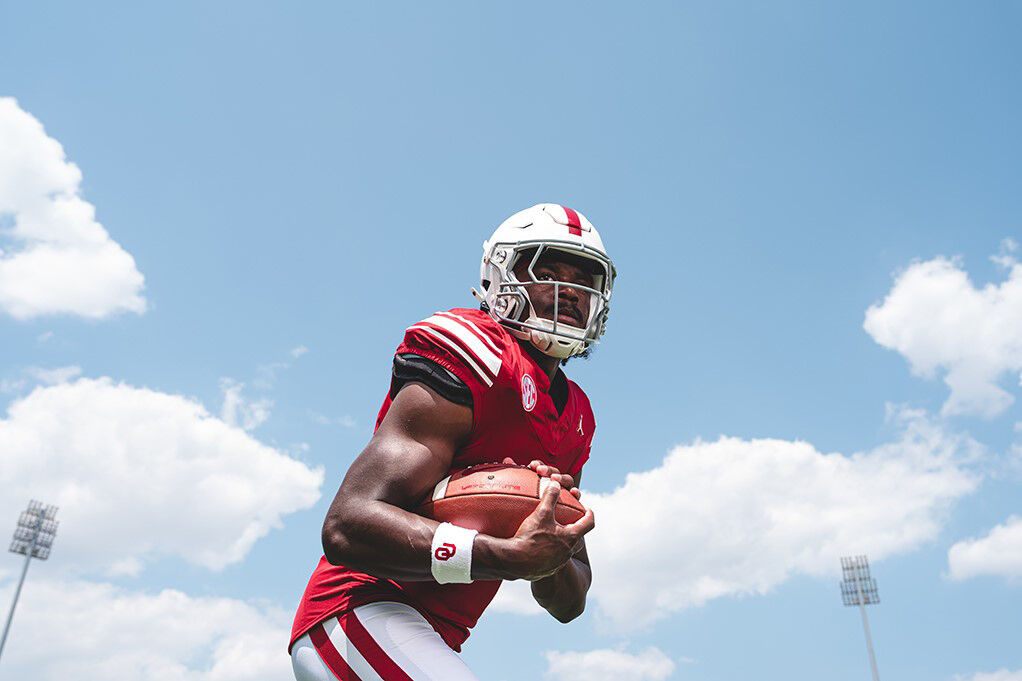
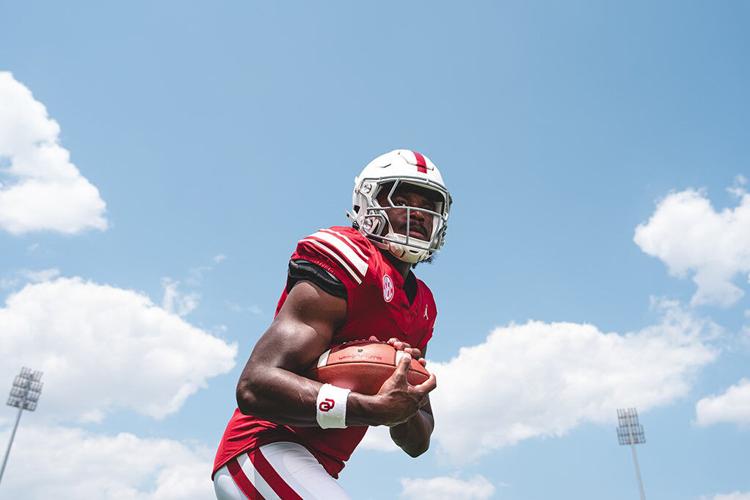
Gentry Williams in throwback uniform.
“I love the way this one looks, even more than the one compared to 2003,” Tipton said. “It is about the materials and the colorways because the varsity crimson in 2003 had a specific type of machine jersey. Now, with the Cordera performance jersey, just with the way they look and fit, it looks a lot cleaner.
“But uniforms evolve year to year. I’ve been here 33 years, and they have evolved from the original Russell uniform my freshman year in college to where we are now with Jordan. It is sleek, and it is elite because this is an elite program.”
The uniforms represent a way to honor the past amid an ever-changing present for OU, but for Jay, and players like Chuck Bowman, the look of the jerseys does not matter as much as the memories they hold.

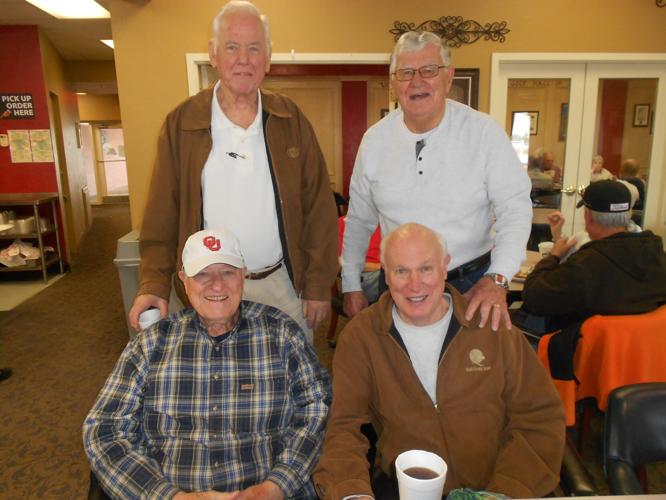
Former OU football players Clendon Thomas, Chuck Bowman, Bill Krisher and Bud Wilkinson's son Jay at a reunion.
For Bowman, whose jersey from the 1950s hangs in a frame in his office, it is a representation of a second chance given to him, that first snap taken in North Carolina and the coach who changed his life. But for Jay, these uniforms are a reminder of the soldier, father, coach, and philosopher that Bud Wilkinson was.
“I was always so proud of my dad,” Jay said. “This is emotional for me because I always had such pride in the accomplishments that his players and he and the other coaches made. As that continued with Coach Switzer, Coach Stoops and Coach Venables, it has been a wonderful thing for my family, for the university and for the state.”


