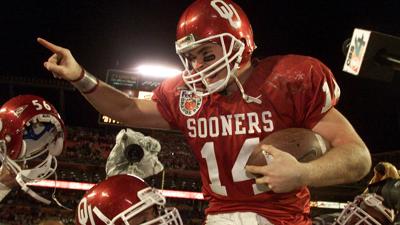
Looking toward the sky, a young Josh Heupel watched as snowflakes fell on the recently cleared ground.
While the weather continued to decorate the South Dakota soil, Heupel kept shoveling anyway, unaware that this would one day be a metaphor for his life.
“If he would ever mess up as a kid, his dad would make him shovel snow up and down his neighborhood,” Heupel’s former teammate Patrick Fletcher told OU Daily. “He thinks things like that are what gave him his work ethic.
“I think he was just born with it.”
There, it was evident that for Heupel, the difficult things in life, the moments that make it feel most frigid, and seemingly erasing the work that was done, would also allow him to clear a new path — one that would eventually lead him back to Norman for No. 15 Oklahoma’s first SEC game against No. 6 Tennessee on Saturday.
Now, the calluses on his hands are just a faint reminder of the storms he has weathered. However, what he experienced on the streets of South Dakota would follow him from his childhood home to his highest and lowest points in Norman, and eventually to Knoxville.
“I wouldn't be here today in Tennessee if I didn't have all of those experiences,” Heupel said.
For Heupel, who is now in his fourth year as Tennessee’s head coach, life has not always been linear, forcing him to learn constantly and leap when necessary. This is something that Fletcher, who played quarterback at OU from 1996-2000, noticed from the moment Heupel arrived in Norman in 1999.
“In walks this blond-headed, Justin Timberlake-looking kid, that was my new competition,” Fletcher said, recalling his first time meeting Heupel. “Even that day, he rarely spoke, but when he did, that funny South Dakota accent would come out. From that moment forward, we knew he meant business.”
Although Heupel carried a sober demeanor, signs of the quarterback's commitment to OU were witnessed in unspoken ways.
From a thin strip of paper taped in his locker and written in his left-handed scrawl reading, “generals donʻt get hurt,” to the light that was always left on for him in the film or weight room, traces of the quarterback were felt and seen, even when he wasn’t heard.
This quiet approach also reflected his work on the field.
Prior to Heupel’s arrival, OU had spent the last three seasons under head coach John Blake cycling through quarterbacks Justin Fuente, Eric Moore, Jake Sills, Jarrod Resse and Fletcher. However, alongside new head coach Bob Stoops and his offensive coordinator Mike Leach, Heupel helped silently rebuild the room, abandoning the option offense, and instead implementing the spread.
“There were three things that clicked in 1999,” Fletcher said. “First, it was coach Stoops’ ability to bring in this amazing staff, and his determination to get Oklahoma back to a championship-level team. Then it was Jerry Schmidt, who changed our strength and conditioning program, and third, there was Josh Heupel. They were all young and hungry guys. It was the perfect storm.
“I mean Josh quickly came in and was already playing chess, while we were stuck playing checkers, and as for the coaches, they just brought it. That newness, that new regime, is what made that era of OU football special.”
This would be the start of a 16-year journey for Heupel at Oklahoma. It was one highlighted by a place and people who helped launch his career — and later set it off on an unexpected and initially painful new trajectory with stops at Utah State, Missouri, UCF and Tennessee.
As he steps onto Gaylord Family — Oklahoma Memorial Stadium for the first time in a decade on Saturday, on the visiting sideline during OU’s first Southeastern Conference game against Tennessee, Heupel’s future is in his own hands.
“It'll be unique going back,” Heupel said. “I'm not sure I've ever spent a day on the opposing sideline inside of that stadium, not even for a scrimmage. So it'll be different.”
‘Are you ready?’
As Oklahoma players gathered on the first day of the 2000 season, Heupel listened as coaches and players took turns speaking.
Fittingly, the quarterback, who was often the last one to talk, waited for everyone to finish. Then he stood up and made his way to the front of the room. There, as he looked each player in the eye, he asked them each one question.
“Are you ready?” Heupel prompted.
For Fletcher, who had already spent a year behind OU’s starting quarterback, watching his mannerisms both on and off the field, this was the vocal leader Heupel could be but often was not.
“I can remember him pacing back and forth and looking you in the eye,” Fletcher said of that day 24 years ago. “He would ask that question in a way that was so powerful because everyone knows the guy doesn’t hardly talk except to call a play.”
Oklahoma had finished the 1999 season 7-5, with three of the five losses being by four points or fewer. Heupel had completed 63% of his passes for 3,850 yards and 33 touchdowns that year, but 2000 represented a fresh slate for OU.
After prodding his teammates with the first question, Heupel’s roommate Josh Norman remembers watching him pull out the Sooners' schedule and, with the emotion evident in his voice, start to list the opponent’s names off one by one.
“He is going, ‘Do y’all think we can win this game,’ and after every single one, we are all looking at each other like yeah of course,” said Norman, who is now a director for SOUL Mission — OU football’s player development program. “Collectively, we witnessed that we can win all of these games. That really set the mindset going into the year, believing we can win every freaking game, and that just laid the foundation for the entire season.”
What Heupel and his teammates predicted that day ultimately came to fruition, as they went undefeated during the regular season, and finished the year 13-0, defeating Florida State 13-2 and winning OU football’s seventh national championship. Heupel led the way, completing 305 passes for 3,606 yards and 20 touchdowns.
Heupel still ranks among the top three quarterbacks all-time in school history in passing yards (7,456), completions (654) and touchdown passes (53) after playing just two seasons with the Sooners. He was named OU’s first All-American quarterback since x player in 1971.
The 6-foot-2, 215-pound quarterback, who transferred to OU after two seasons with Weber State and a one-year stint with Snow Community College, never had the arm to be a national championship winner and Heisman Trophy runner-up. However, his ability to understand, manipulate and, at times, outsmart the game, was evident during Oklahoma’s undefeated run.
“Josh, physically had the size, height and weight, but he could not outthrow anybody,” Fletcher said. “He threw on time really well because he knew where everybody was going to be. I mean this guy was playing chess, because of how well he knew blocking schemes.”
After finding immediate success at OU, and etching his name into the university’s history, Heupel would get selected as the 177th pick in the sixth round of the 2001 NFL Draft by the Miami Dolphins. Still, after struggling with shoulder tendonitis in his left arm, he failed to make the team.
This marked the end of a dream, but it also represented the chance for Hepuel to do what he has always done — start over.
“This is a guy who came from Snow Community College to the University of Oklahoma,” Norman told OU Daily. “Nobody knew who he was, just a lefty, who made everyone ask, ‘Who is this guy?’ I mean he was recruited as a quarterback with potential, but he wasn’t recruited to be the starter. He earned it because that has just always been who he is.”
‘It really can’t be quantified’
As recruits went and spent time with players on OU’s roster, Heupel decided to stay behind.
The young quarterback had always been interested in the small details. From fixing the slight wobble on the ball after he threw it to understanding the Xs and Os, Heupel was invested in not only playing the game but learning about it. So, after finishing his tour, instead of going to hang out with his future teammates, Heupel and Leach turned on the TV to watch film.
“Here was this crazy, weird, science-focused quarterbacks coach,” Fletcher said. “And there was Heupel and him up there watching tape and skipping out on the recruiting visit.”
It was moments like these that showed who Heupel was, and the coach that he could one day be.
After being cut by Miami, Heupel would return to the place he had won a national championship just three years earlier, as a graduate assistant for OU in 2003.
“When we came back as assistants, there were already signs he would be a great coach,” Fletcher said. “He would go to every meeting, and he would learn everybody’s schemes. I mean, he knew the offensive line scheme, he knew how to block all different running and pass protection schemes. He took what he knew from when he was playing to a whole other level.”
After spending two years as a graduate assistant, Heupel spent a season at Arizona as the tight ends coach before returning to Oklahoma in 2006. Over the next five seasons, Heupel served as OU’s quarterbacks coach before becoming the Sooners co-offensive coordinator in 2011.
His ability to read coverage, understand blocking schemes and construct unique passing routes led to a decade of quarterback success at the University of Oklahoma under Heupel.
During his time at Oklahoma, he coached 2008 Heisman Trophy winner and No. 1 pick in the NFL Draft Sam Bradford, alongside Landry Jones, who won the Sammy Baugh Award as the nation’s top passer in 2010, throwing 4,720 yards and 50 touchdowns with just eight interceptions, and Trevor Knight who was the 2014 Sugar Bowl Most Valuable Player.
Heupel also set an NCAA record after recording five straight 60-point games during the 2008 season. He coached eight consecutive teams that averaged over 400 yards of offense per game and coached 12 bowl games, three national championship games and six Big 12 conference championships during his nine seasons with OU.
But after struggling in the 2014 season, Stoops fired his former quarterback and offensive coordinator in January 2015.
The ending to Heupel’s decade-long relationship with the university was abrupt, but it also gave him the opportunity to look back, reflect and move on.
“What he did for this university and what he meant for this university, it really can’t be quantified,” Norman said. “If you look at Josh Heupel and think about the way he affected his team, and the state of Oklahoma, it puts all of good things, and difficult things in perspective.”
‘No love lost in the competition’
When Heupel walks onto Owen Field on Saturday, the memories of who he was and the sting of what happened are bound to return.
However, Heupel has had the space, time and perspective to learn to stand on his own.
“I wouldn't change anything,” Heupel said. “I wouldn't be here without everything that happened at Oklahoma."
After getting fired from OU, Heupel would become the offensive coordinator at Utah State, then Missouri, and a head coach at UCF, before taking the same position at Tennessee in 2021. But it was lessons learned at Oklahoma, under Stoops and beside current OU head coach Brent Venables that gave him the knowledge to navigate through it.
On Saturday, Heupel’s return, not only serves as his first time back at Gaylord Family — Oklahoma Memorial Stadium, but it also serves as a reunion with Venables.
"There's so many things that I learned from Brent,” Heupel said. “As a player, you saw his energy and his passion. His focus everyday. Super consistent inside of the building and in the meeting room. His preparation, the detail that he had in his preparation and how he poured into his players. I saw those same things as a coach working with him there as well. Brent has had a huge impact on my career."
Although Stoops, made a public post earlier in the week declining all interview requests regarding Heupel and his return, for the former head coach, Venables and people like Fletcher and Norman acknowledge Heupel’s impact and the perseverance it took for him to end up at Tennessee.
“There have been a lot of ups and downs for Josh, but he always comes out on top,” Norman said. “It is awesome to see him performing and leading at such a high level. On Saturday, in between kickoff and the last horn, there will be no love lost in the competition, but all love outside of that.”
Now, for Heupel, three decades removed from those weathered South Dakota streets, he hardly ever sees snow.
But when he does, like during OU’s game against Tennessee on Saturday, it is just a reminder of how far he has come.
“Through the good and the bad, there is one thing that has stood true,” Fletcher said. “God made Josh Heupel to coach college football.”
This story was edited by Louis Raser, Daniel Homrok and Peggy Dodd.


