

College football as it stands today would be unrecognizable to Chris Del Conte and Joe Castiglione when they entered their professions decades ago.
In the ever-evolving collegiate athletics world consisting of seemingly daily changes to NIL, the transfer portal and conference realignment, holding back change is rare. However, the Texas and Oklahoma athletic directors are determined to do their parts to preserve one of the sports’ longest standing and most unique traditions: playing the Red River Rivalry at the Cotton Bowl in Dallas.
Other annual neutral-site rivalry games have mostly fallen by the wayside, including the Iron Bowl, which until 1999 was most commonly played in Birmingham, Alabama. Mississippi and Mississippi State’s Egg Bowl was played in Jackson, Mississippi, for 17 years. Army and Navy rotate annually between locations such as Baltimore, Philadelphia and others.
OU and Texas’ current deal with the stadium runs out in 2025. In the past week, Castiglione, Del Conte and their Florida counterpart Scott Stricklin told the OU Daily how tradition has outweighed talks of a home-and-home series even with potential recruiting, economics and television boosts. SEC Commissioner Greg Sankey also shared with the Daily his anticipation for his first trip to the game and its future in his conference.
Castiglione confirmed in July the two schools had begun discussions with the City of Dallas and the State Fair of Texas’ board leadership to keep the game at its 97-year-old home.
Later that month at SEC Media Days in Nashville, Florida head coach Billy Napier and Georgia head coach Kirby Smart called for their teams’ rivalry — known as the World’s Largest Outdoor Cocktail Party — to move to a home-and-home format to bolster their recruiting efforts. The game is the only other annual Power 5 neutral-site rivalry, excluding the Southwest Classic between Arkansas and Texas A&M, which only moved to AT&T Stadium in Arlington in 2009 and whose contract ends in 2024.
For Del Conte and Castiglione, close friends who forged a bond even before the latter tried to hire the former at Oklahoma years ago, the tradition that spans generations outweighs the potential recruiting and local economic booms.
“There is an enormous tradition around this game being played at the Cotton Bowl,” Castiglione told the OU Daily this week ahead of No. 12 Oklahoma’s (5-0, 2-0 Big 12) matchup with No. 3 Texas (5-0, 2-0) at 11 a.m. Saturday on ABC in the series’ 119th meeting. ESPN’s College Gameday will air pregame ahead of the first undefeated matchup between the schools since 2011. “It's been such a special event that happens to surround one of the great games of a college football season. There's no other setting like it; it just simply stands on its own.
“And we know that there will be 96,000-plus in the stadium and another 100 to 150,000 outside of the stadium wishing they could get a ticket to come in. It draws that much interest, and it's every year, so it's one of the special experiences for anyone who loves college football. I feel very blessed to have been part of it now for 25 years.”
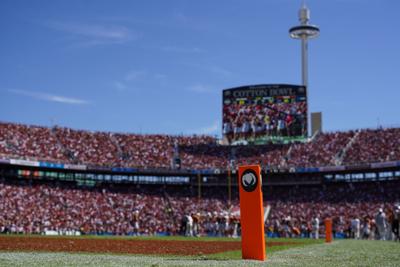
Castiglione is aware of the infrastructure concerns of the current venue. The Cotton Bowl was most recently renovated in 2008, which included an encircling of the second deck to expand capacity from 68,252 to 92,100 and adding a new scoreboard.
Castiglione says further renovations is a constant topic of discussion for those involved. Besides OU-Texas, the stadium also continues a long history of hosting Grambling State vs. Prairie View A&M, concerts and high school football games.
“(We’ve worked) to improve, renovate and expand parts of (the stadium),” Castiglione said. “We're always having conversations about improvements that need to be made in the stadium. We know it's one of the oldest stadiums in America; we get all that, (the fair does) too, and we're working to look forward at ways that the fan experience can be improved.
“That speaks to the interest of continuing to have the game there.”
Sankey, who was raised in upstate New York, has an affinity for the game dating to his childhood. He recalls making a trip to visit his grandfather in Oklahoma in the late 1960s and vividly remembers family members rooting for Barry Switzer’s 1970s and ’80s OU teams.
News of Sankey’s planned attendance Saturday made rounds on social media this week, especially after Big 12 Commissioner Brett Yormark said he will not attend his conference’s premier matchup.
Sankey lived in Dallas for 11 years but never caught the game in person, which will change when he attends the first half before jetting to College Station for Texas A&M vs. Alabama, which kicks off at 2:30 p.m.
“Having seen it any number of times from afar on television, I’m excited to experience the atmosphere,” Sankey told the OU Daily this week. “And obviously with both teams' successes this year, I know it's exciting for the fan bases, but it's also a look to our future. … To be thinking about both this year and what's ahead is an exciting part of the trip.”

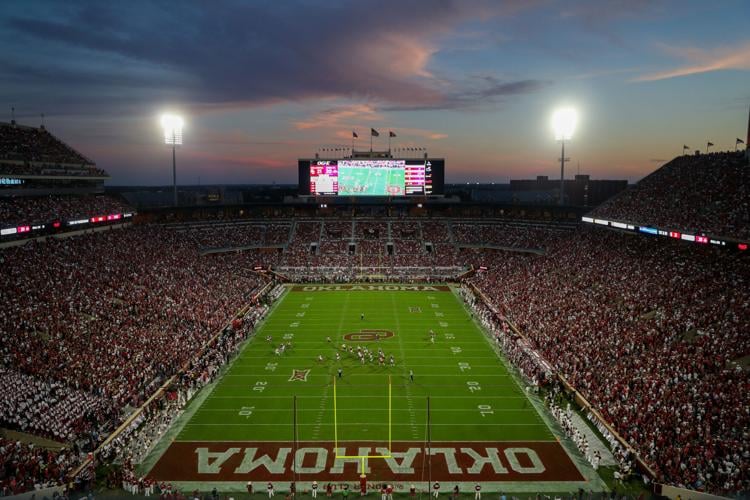
Gaylord Memorial Stadium at sunset during the game against Iowa State on Sept. 30.
‘Don’t have the opportunity to host recruits’
While tradition is holding the day at the Cotton Bowl, it’s been a different story for EverBank Stadium, the host of Georgia and Florida’s annual cocktail party and its anchor tenant the Jacksonville Jaguars.
The NFL team is tied to the venue until 2030 and is planning a $2 billion renovation that would transform the venue, which opened in 1995, into a “stadium of the future.” Two weeks ago, Jaguars president Mark Lamping made comments widely seen as threatening to move the Jaguars from the city if no stadium funding agreement is reached.
Florida and Georgia announced in May they exercised options to keep the contest at the venue through 2025 even as Napier and Smart have called for relocating their rivalry game.
Stricklin, however, told the OU Daily last week through his conversations with Georgia’s leadership that the schools agree the combination of tradition and revenue both programs generate in the neutral site matchup outweighs the recruiting benefits.
“(There are) two main primary benefits,” Stricklin said. “One is the tradition of it. The Florida-Georgia game has been in Jacksonville for generations, so there's the traditional aspect of it that is still pretty important. Second is financially it's better for most schools to play that game in a neutral site every year as opposed to home and home.
“We probably make as much each year in Jacksonville per team. So Florida will make as much playing this year, playing that game in Jacksonville as we would playing Georgia on campus. But the benefit of it being neutral is next year, we're going to make the same amount or more, whereas if it's a home and home you're only making it every other year.”
Sankey also told the Daily he sees the games being played in Dallas and Jacksonville as pluses for fans due to the ticket allotments. If the games were to move to a home-and-home model, traveling fan bases wouldn’t receive as many tickets.
“It's kind of an annual rallying point for both fan bases where it's not just limited to the few 1,000 visiting tickets that may be available directly or online,” Sankey said. “(By) splitting the crowds, in my experiences at the game we have, it always provides a great atmosphere, and I'm certain that the same is true in the Cotton Bowl stadium.”
Smart is the loudest proponent of switching to a rivalry home-and-home series. His two consecutive national titles back up his belief in the vital role recruiting plays in running a program and maximizing every advantage in a coach’s grasp.
“When it comes down to it, there’s a very basic element of everything that comes back to: No. 1, money and No. 2, recruiting and getting good players,” Smart told reporters in October 2022. “I firmly believe that we’ll be able to sign better players by having it as a home-and-home because we’ll have more opportunities to get them to campus.”
Stricklin acknowledges the loss of a home recruiting opportunity due to playing a neutral site game as a crucial negative. It’s no secret that a win for Florida, Georgia, Oklahoma or Texas on their respective campuses against a rival would impress recruits while showcasing distinctive home environments.
“That is the one downside to the neutral side as you obviously don't have the opportunity to host recruits in the same way that you can on your campus,” Stricklin said.
There’s also a popular belief among college football fans that home rivalry games present a better television product for the networks. For example, in recent years ESPN has leaned heavily into marketing Penn State’s White Out game, which is considered one of the best environments in the country.
Like Castiglione and Del Conte, Stricklin is content with continuing the tradition of playing his school’s rivalry game at a neutral site for at least the next three seasons. He seems unwilling to punt on the history surrounding the game and says there haven’t been any substantial discussions about a neutral site outside of Jacksonville.
“Every now and then, you'll hear people throw out ideas,” Stricklin said. “ … Obviously, anytime the contract is coming up, we sit down with Georgia and we work together collaboratively on this game anyway.
“So throughout the year we have regular conversations regarding hosting that game because we put it together. Anytime a contract is coming up, you want to consider all of your options and certainly taking it back to campuses is one of the options and up to this point, we've always felt like keeping it in Jacksonville is what’s made the most sense.”
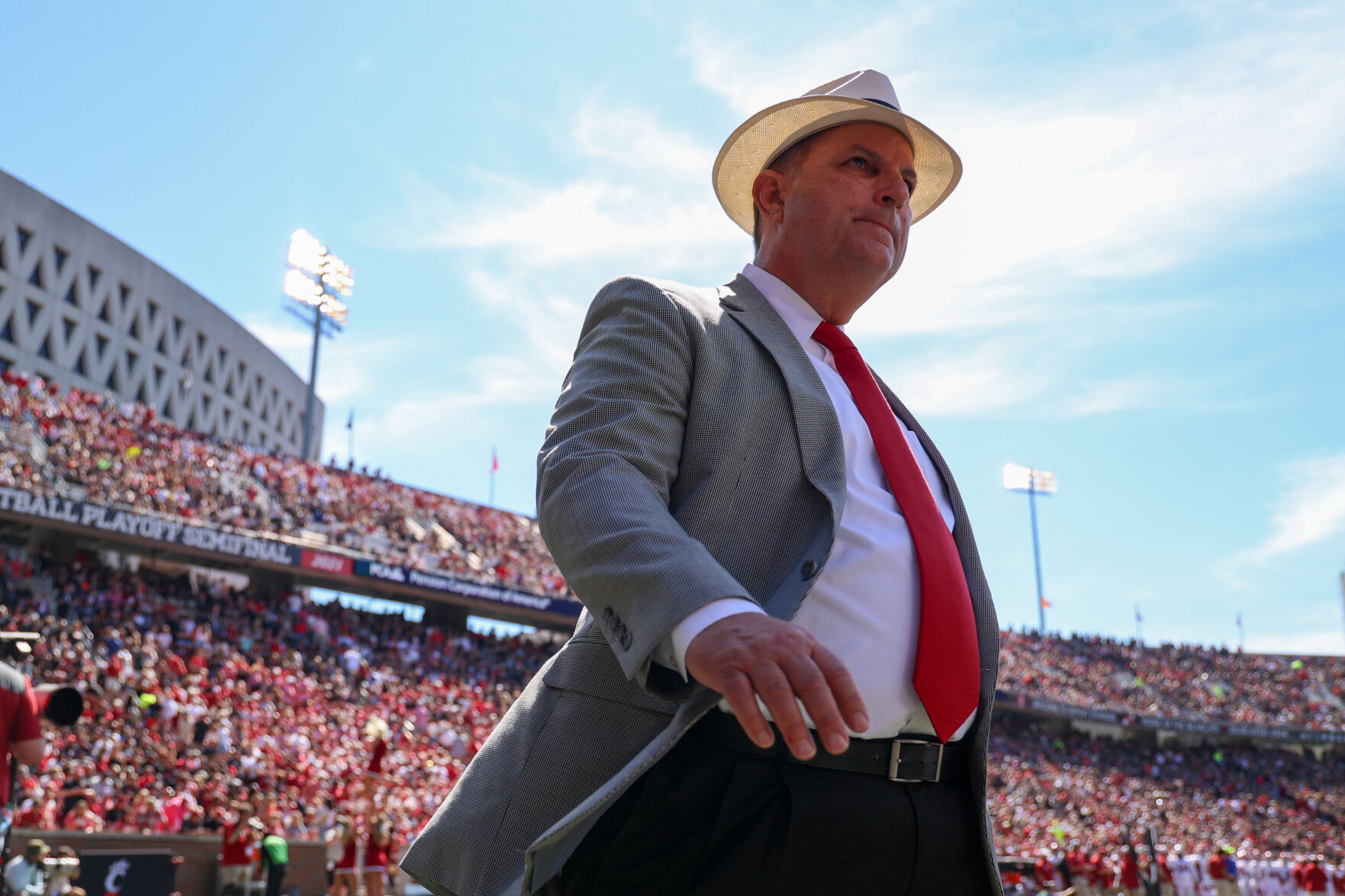
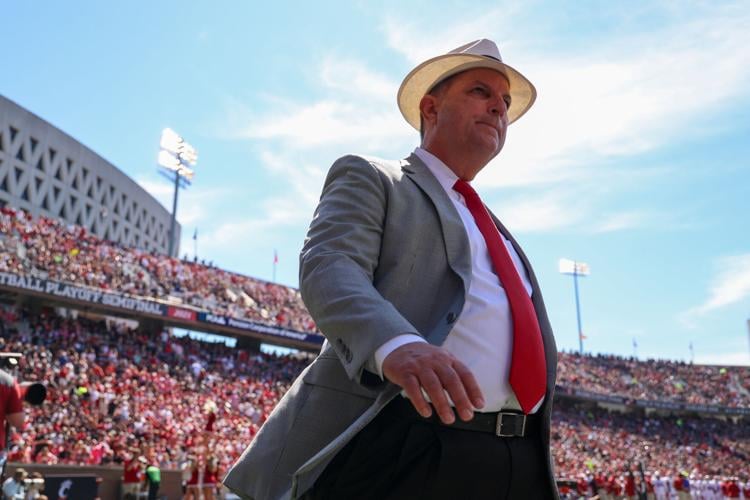
OU athletic director Joe Castiglione during the game against Cincinnati on Sept. 23.
‘One of those treasures in college football’
Although Oklahoma and Texas leaders would like to see their rivalry game mostly stay the same, with ESPN and the SEC’s new 10-year media rights deal going into effect next season, there’s bound to be some changes made.
For starters, will OU and Texas escape the 11 a.m. CT time slot they’ve mostly played in? The last time the game kicked at 2:30 p.m. CT was 2017.
Sankey has already begun thinking about the potential of switching the game to the 2:30 p.m. window, where CBS has regularly broadcasted the top SEC game of the week.
“We know that the noon ET kickoff window has actually become a really important television viewership window,” Sankey said. “We've had great success at 3:30 p.m. ET as well. What is our CBS contract will then go to ABC, so we know there's some level of tradition being early but we will work with our TV partners to see what may be possible next year.”
People will always watch the game, however. Even Sankey, a year before OU and Texas arrive in his conference, is fitting it into his busy itinerary. After meeting with SEC athletic directors in Birmingham on Thursday, Sankey will jet to Austin for a friend’s daughter’s rehearsal dinner on Friday night. He’ll then travel to Dallas Saturday morning and to College Station that afternoon.
While he’s at the Cotton Bowl, he’ll meet with Del Conte, Castiglione and the future SEC school presidents.
And while OU’s Joseph Harroz Jr., was one of the key orchestrators of the Sooners’ tradition-upending move to the SEC, he also loves the neutral-site atmosphere and traditions of OU-Texas.
“It's a huge part of those programs and a huge part of college football,” Harroz told the OU Daily in August. “It's one of the great games that takes place and I'm fully committed to (extending).”
Tradition seems to be the underlying reason the game has stayed and will stay at the Cotton Bowl. Several generations can tell stories of their favorite moments of the contest.
While Castiglione and Del Conte see themselves as stewards of tradition, they acknowledge they periodically discuss the idea of a home-and-home series. The former says every time it’s been brought up, the parties end up where they started, keeping it at the Cotton Bowl.
“If it were to go home-and-home,” Castiglione said. “Not to say it never will, I just go back to don't mess with happy. People love this game and where it is.”
Del Conte concurs.
“I think that the State Fair, the history, the surroundings and circumstances, that game, we've been playing it for dang near 100 years,” Del Conte said. “I mean, it is one of those treasures in college football that you look back on a life memory of a family. I've had stories where a family says I've been going there for 50 years, this game has been part of my life.
“So one of the things we're looking at to make sure that we continue to improve the fan experience is to continue to improve the Cotton Bowl and its physical structure and the city of Dallas and the Fair Park is committed to doing that and that's all we can ask them.”

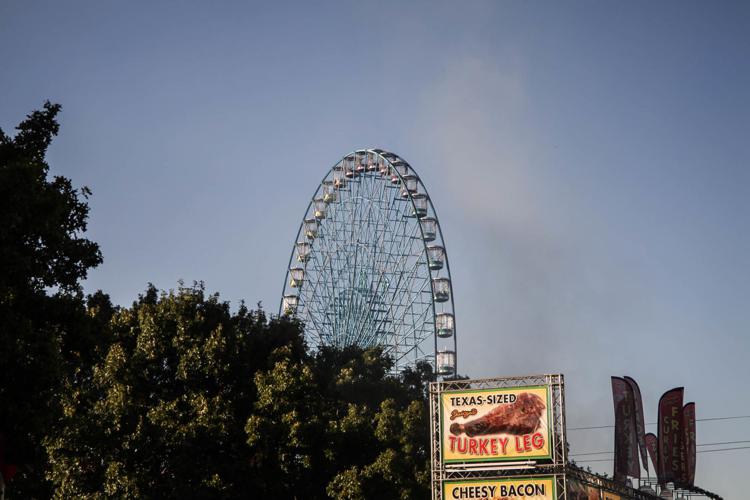
The ferris wheel at the State Fair of Texas Oct. 12, 2019.
‘Football at its best’
There is no college football game quite like the Red River Rivalry.
During no other contest, collegiate or professional, does half the crowd who cheered for the loser have to walk out of the stadium next to the half who cheered for the winning team. The taunting is inescapable as fans have to walk through the crowds at the fair and the banter from rivals is only masked by the noise of the Midway (and perhaps softened by comfort of Fletcher’s Original Corny Dogs and funnel cakes).
Such sustenance is part of the charm.
Every year, Castiglione attends meetings and the team’s walk-through on the Friday before the game. After he’s finished at the stadium, he follows it up with what he calls “my own taste of the state fair.”
He finds the site of all the award-winning foods each year and enjoys as much as he can stomach before undergoing “a cleanse” for several hours afterward.
“It’s my personal man vs. food,” Castiglione said.
By Saturday morning, after recuperating, Castiglione will savor a heaping of tradition like all others packing the venue, soaking up the crimson and burnt orange crowd, the emerald green grass and the baby blue sky.
“It touches every sensory element of our body when you think about it and then add the noise factor,” Castiglione said. “It looks, feels, sounds and smells like football at its best. That's why you really respect the opportunity you have to be part of it.”
And after the game, while sweaty drunks are shuffling out into the afternoon fair rush, Castiglione and Del Conte will make their annual call where the victor gets to gloat to the defeated. While they keep open the possibility of reevaulating the game in the future, for now tradition outweighs recruiting and economics.
“When we hang up the phone,” Del Conte said about the two’s calls, “we say we love each other.”
Just like the sentiment fans feel about the game itself right where it is.


