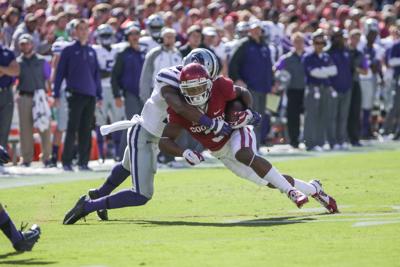
How do you think college football fans outside of Norman, Oklahoma follow Sooners football? How do you think the playoff selection committee reviews games when ranking teams? Where do we get all those awesome hype videos and giant posters of football players? The answer to all of the above is sideline photographers. Photographers who willingly put themselves in the path of barreling football players to take the action shots we all love that athletic departments use in marketing campaigns to rake in the dough.
Absurdly, OU football has decided to impede those photographers’ ability to document games at Owen Field. We believe OU football’s updated sideline photography policy is absurd and a childish reaction to a rare accident. OU wide receiver Sterling Shepherd flew out of the end-zone and landed on a camera lens belonging to a Tulsa World photographer during the Oct. 18 football game vs. Kansas State University. Shepherd was mildly injured and the $10,000 lens was shattered.
Obviously no one wants players, who are already risking injury with nearly every move on the football field, to be hurt by extraneous objects, like a cameraman’s lens. However, the Oct. 18 was extremely rare. Rather than brush off the incident as an accident and focus only on football, OU head coach Bob Stoops went on a rant about sideline photographers after the game, claiming, “They’re not playing. Those people need to be gone.”
Hmm. We understand Stoops was upset that Sterling, arguably OU’s most valuable player this season, was hurt by something outside of the game while he was trying to get a touchdown. But to say photographers don’t need to be on the field is insane. Those photographers take the shots that are shown on TV, shared on the Internet and ultimately maintain the value of the OU brand.
Even more absurd, on Oct. 22, OU released an updated sideline policy for the remainder of this season’s home games prohibiting photographers from using tripods, only permitting monopods attached to cameras and requiring all equipment to be on the photographer’s person while on the sidelines.
Really? Clearly whoever decided to update the sideline photography policy has never tried to photograph a football game. The lenses used to capture sporting events are huge and extremely heavy. By only permitting monopods attached to cameras, you’re effectively requiring photographers to hold up any camera not attached to their one stabling device with arm strength alone for indeterminate periods of time. Unless newspapers start recruiting extra-buff photographers, we’re pretty sure the photo quality from that shaky style of photography won’t be the best.
Limiting equipment to only what a photographer can keep on their body at all times will also unduly interfere with photographers’ ability to do their jobs. Sideline photographers bring multiple cameras and lenses for a reason — different equipment works better for different types of shots.
We see OU’s updated sideline policy as a petulant response to an infrequent incident. We believe football personnel should handle football and leave the media policy up to media professionals.


